
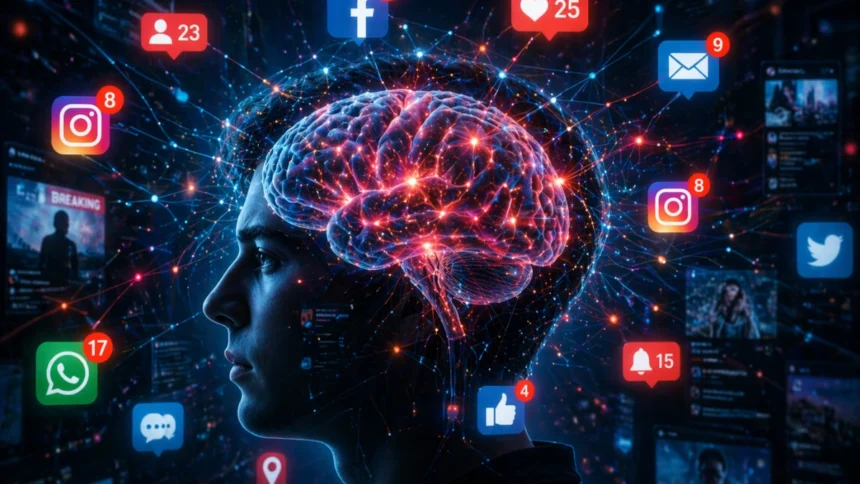
A teenager in Delhi scrolls through short videos past midnight, the blue glow of the phone reflecting off tired eyes. A delivery worker in Mumbai checks notifications between orders, drawn into a loop of messages, reels, and trending clips. In Bengaluru, a startup founder studies user engagement graphs that measure not just clicks—but how long someone stays, pauses, reacts, and returns.
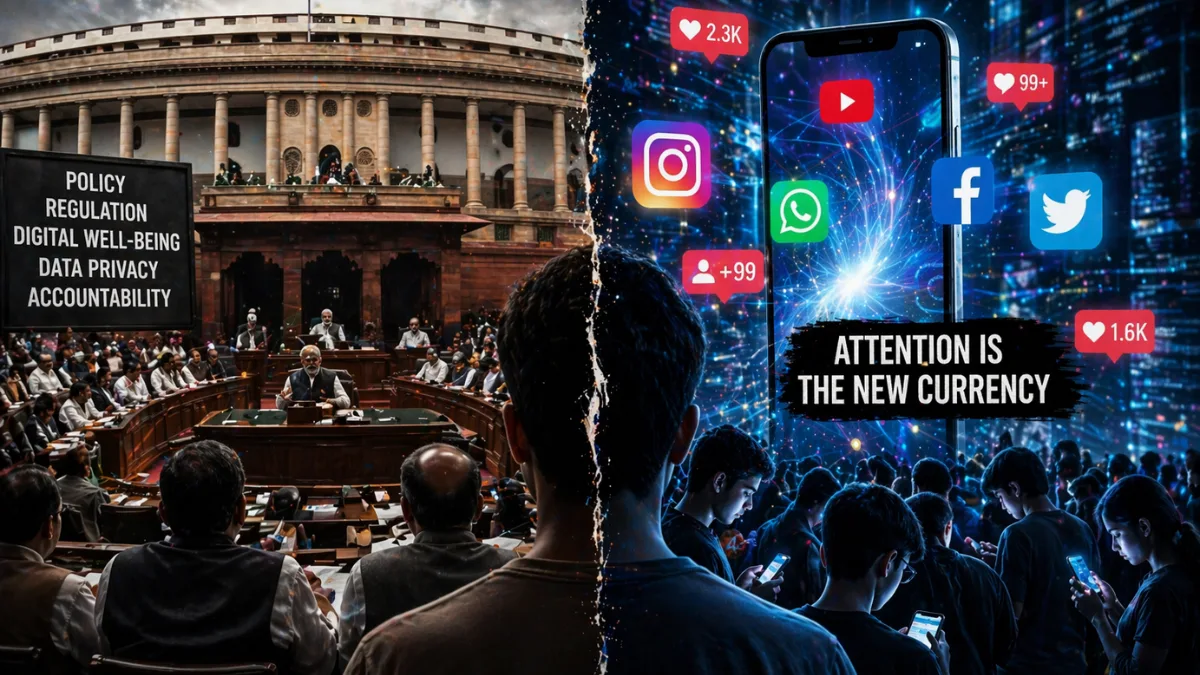
None of this feels unusual anymore. Yet, somewhere between harmless scrolling and engineered habit, something larger has taken shape. The currency is no longer just money or data—it’s attention. And increasingly, the Attention Economy in India: Why Policymakers Are Getting Concerned is becoming a serious question in government corridors.
Understanding the Attention Economy in India: Why Policymakers Are Getting Concerned
At its simplest, the attention economy refers to a system where human attention is treated as a scarce resource. Platforms compete not just to attract users—but to hold them for as long as possible.
India, with its massive smartphone penetration and one of the world’s largest internet user bases, has become a fertile ground for this model. Social media platforms, streaming apps, gaming ecosystems, and even news outlets are designed with a singular objective: maximize user engagement.
But the concern isn’t about engagement alone. It’s about how that engagement is engineered.
Algorithms are trained to understand behavioral patterns—what keeps someone watching, what triggers emotional reactions, what creates dependency. Over time, this shifts from passive consumption to active capture. Attention stops being voluntary; it becomes subtly manipulated.
This is where policymakers are beginning to take notice.
From Harmless Scrolling to Structural Concern
For years, digital growth in India was celebrated as a sign of economic progress. Affordable data plans, widespread smartphone access, and a booming app ecosystem created opportunities across sectors—from education to entertainment.
However, the scale of digital immersion has brought unintended consequences.
One emerging concern is digital addiction, particularly among younger demographics. Studies and reports have pointed toward increased screen time, reduced attention spans, and rising anxiety linked to online behavior. Schools, parents, and psychologists have been raising alarms—but policy attention remained limited until recently.
Now, the conversation is shifting.
The issue is no longer framed as a personal habit problem. It is increasingly viewed as a systemic design issue—where platforms are incentivized to keep users hooked, regardless of long-term impact.
Why the Attention Economy in India Is Raising Policy Red Flags
1. Mental Health and Social Impact
India’s youth population is one of the largest globally. When a significant portion of that demographic spends hours daily on algorithm-driven platforms, the societal impact becomes hard to ignore.
There is growing evidence linking excessive digital consumption with:
- Reduced focus and productivity
- Sleep disturbances
- Increased anxiety and comparison-driven stress
Policymakers are beginning to see attention not just as a personal resource—but as a public health concern.
2. Data Exploitation and Behavioral Manipulation
Attention is not an isolated commodity—it is deeply tied to data. Every second a user spends online generates behavioral insights.
These insights are then used to refine algorithms, personalize content, and, importantly, drive targeted advertising.
The concern here is subtle but significant:
Are users truly in control of what they consume, or are they being guided—sometimes unknowingly—toward specific content patterns?
This raises questions about:
- Informed consent
- Transparency in algorithmic design
- Ethical use of behavioral data
India’s data protection discussions are increasingly intersecting with these concerns.
3. Impact on Democracy and Public Discourse
Perhaps the most sensitive area of concern is the influence of attention-driven platforms on public opinion.
Short-form content, viral trends, and algorithmic amplification can shape narratives rapidly. What gets attention often becomes what gets believed.
Policymakers worry about:
- Spread of misinformation
- Echo chambers reinforcing biases
- Manipulation during elections or sensitive events
In a country as diverse and complex as India, even small distortions in public discourse can have large-scale consequences.
The Business Model Behind Attention
To understand why regulation is difficult, it’s important to look at the economics.
Most digital platforms operate on an ad-driven model. More time spent equals more ads served, which equals more revenue.
This creates a powerful incentive structure:
- Design addictive interfaces
- Promote emotionally engaging content
- Prioritize virality over depth
The system rewards what captures attention—not necessarily what informs or benefits.
For Indian startups and global tech giants alike, this model has been incredibly profitable. Any policy intervention that disrupts engagement metrics is likely to face resistance.
That’s why regulation in this space isn’t just a technological issue—it’s an economic balancing act.
Global Trends and India’s Policy Direction
India is not alone in grappling with the attention economy.
Countries in Europe have introduced stricter regulations around data privacy and algorithm transparency. Discussions around limiting addictive design features—like infinite scrolling or autoplay—are gaining traction globally.
India, too, is moving in this direction, albeit cautiously.
Recent policy conversations have included:
- Strengthening data protection laws
- Holding platforms accountable for harmful content
- Encouraging digital well-being frameworks
There’s also a growing push for self-regulation by platforms, though critics argue that voluntary measures often fall short.
The Psychological Layer: Why Attention Is So Easy to Capture
Human attention is not designed for the digital age.
The brain is naturally drawn to novelty, reward, and social validation. Digital platforms amplify these triggers through:
- Endless content feeds
- Instant feedback (likes, shares, comments)
- Personalized recommendations
Over time, this creates a feedback loop. Users return not just for information—but for stimulation.
This psychological dimension makes the attention economy uniquely powerful—and uniquely difficult to regulate.
Unlike traditional industries, the product here isn’t tangible. It’s behavioral.

What Could the Future Look Like?
The trajectory of the attention economy in India will likely depend on how policymakers balance innovation with responsibility.
Possible future directions include:
- Algorithm transparency requirements
- Limits on addictive design features
- Stronger digital literacy programs
- Clearer data usage disclosures
At the same time, there is an opportunity for India to shape a model that aligns with its socio-cultural context—one that values not just growth, but well-being.
For businesses, this could mean rethinking engagement metrics. For users, it may involve becoming more conscious of digital habits. And for policymakers, it will require navigating a complex intersection of technology, economics, and human behavior.
More Read

Conclusion
The rise of the attention economy has quietly transformed how India consumes information, interacts socially, and even thinks. What once seemed like harmless digital engagement is now being examined through a sharper lens.
The real question isn’t whether attention is valuable—it clearly is. The question is whether it should be extracted without limits.
As policymakers begin to engage with this challenge, the outcome will shape not just the future of India’s digital ecosystem—but the quality of its public life.
Final Insight
The battle for attention isn’t going away—it’s only becoming more sophisticated. The real shift will come when attention is treated not just as a commodity, but as a responsibility. For India, the choices made today could define whether its digital growth empowers its citizens—or quietly consumes them.-The Vue Times
Frequently Asked Questions
What is the attention economy in simple terms?
The attention economy refers to a system where businesses compete for users’ time and focus, treating attention as a valuable resource that can be monetized through ads and engagement.
Why are Indian policymakers concerned about the attention economy?
Concerns include digital addiction, mental health impacts, data misuse, and the influence of algorithm-driven content on public opinion and democracy.
How do social media platforms capture attention?
They use algorithms, personalized content, notifications, and design features like infinite scroll to keep users engaged for longer periods.
Is the attention economy harmful?
Not inherently, but excessive or manipulative engagement can lead to negative effects like reduced productivity, anxiety, and misinformation exposure.
What steps can India take to regulate the attention economy?
Possible steps include data protection laws, algorithm transparency, limits on addictive design features, and promoting digital literacy among users.