

It often starts without you even planning on it.
Maybe it’s just a quick look online, a random video catches your eye, or a headline piques your interest just enough to click through. You reassure yourself it’s only going to take a couple of minutes. But somehow, before you know it, forty minutes have passed, and you’re deep into an analysis of something you never knew existed—your original goal completely out of mind.
That subtle slide from focusing on what you need to do to getting caught up in something else has a name now: the Internet Rabbit Hole.
What Is an Internet Rabbit Hole, Really?
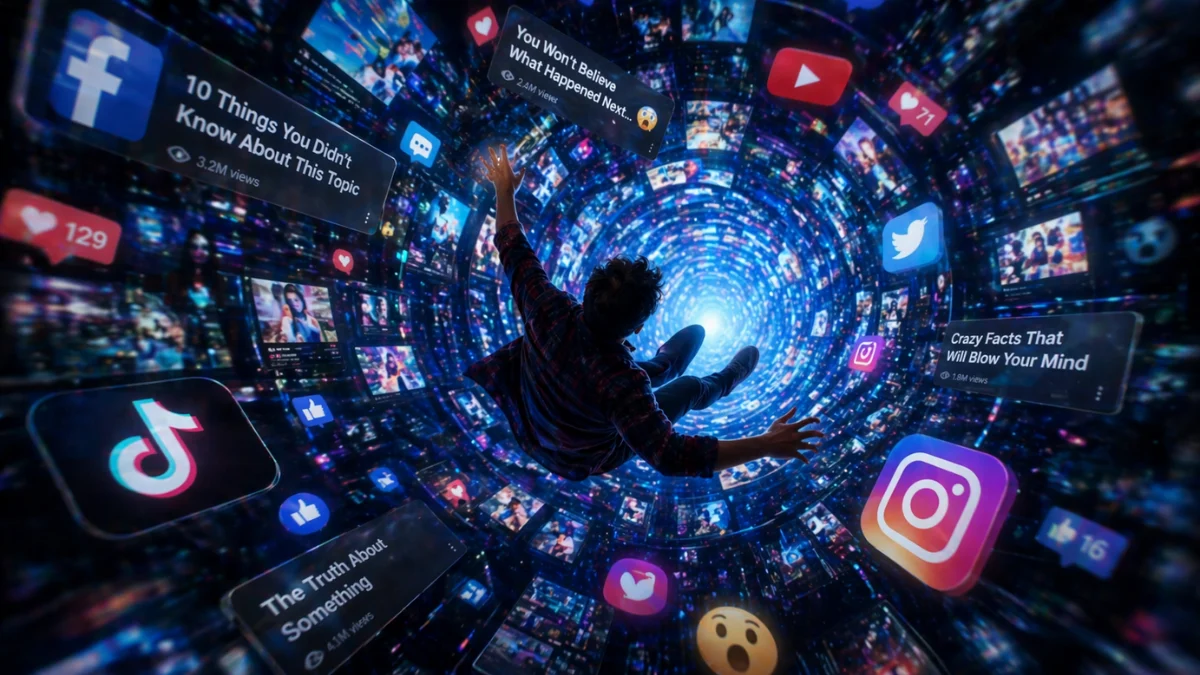
An “Internet Rabbit Hole” isn’t just about getting sidetracked online. It’s a particular kind of digital adventure where one piece of content effortlessly pulls you into the next, forming a chain that seems both unexpected and strangely well-planned.
It’s not random at all. It’s more like organized chaos.
You begin with one subject, and the online world subtly guides you deeper—via suggested videos, linked articles, and algorithmic tips. Before you realize it, you’ve arrived in a completely different area, yet it feels like there’s some unseen thread connecting it all.
The phrase itself comes from “Alice in Wonderland,” where tumbling down the rabbit hole leads to a strange yet captivating world. The modern version might lack the fantasy, but it’s much more deliberate and widespread.
From Curiosity to Capture: How It Hooks You
The real strength of getting pulled down an online rabbit hole is its knack for playing on your curiosity without you ever feeling like you’re being manipulated.
Every move you make along the way feels entirely like your own decision.
These platforms are specifically built to capitalize on this. Their recommendation systems do more than just guess what you’ll enjoy—they figure out what will keep you hooked. The distinction might be slight, but it’s significant.
You aren’t just passively watching or reading. You’re being led through a carefully constructed experience.
This is where the mental game truly begins. We humans are naturally inclined to look for patterns and seek resolution. When a piece of content sparks a question or leaves a story unfinished, you’re naturally drawn to find the answer. The next video or article seems to offer that closure, only to then introduce a new question or thread.
It creates a snowball effect.
Because each step feels like it logically follows the last, the whole process doesn’t feel like wasting time. It feels more like an exciting journey of discovery.
Why the Internet Rabbit Hole Is Trending Now
There was a time when the internet felt like a library. You searched, you found, you left.
Today, it feels more like a maze that rearranges itself around you.
The rise of short-form content, infinite scroll, and hyper-personalized feeds has amplified the Internet Rabbit Hole effect. Platforms like YouTube, TikTok, and Instagram have perfected the art of keeping users inside the loop.
They’ve removed friction.
No loading delays. No decision points. Just continuous flow.
Add to that the cultural shift toward “micro-learning” and “bite-sized content,” and you get an environment where depth is replaced by endless progression. You don’t explore a topic—you orbit it.
And the longer you stay, the more the system learns.
The Hidden Cost: Attention, Time, and Mental Space
At first glance, falling into an Internet Rabbit Hole feels harmless. Sometimes even productive—you’ve learned something new, after all.
But the cost is rarely visible in the moment.
Time slips first. What was meant to be five minutes stretches into an hour. Then attention follows. The brain, constantly shifting between loosely connected topics, struggles to retain depth.
You end up with fragments instead of understanding.
There’s also a cognitive fatigue that builds quietly. The constant intake of new stimuli—new ideas, visuals, narratives—creates a sense of mental clutter. Not overwhelming, but persistent.
Like too many tabs open in your mind.
Over time, this changes how we engage with information. Patience for long-form content drops. Focus becomes conditional. Depth feels like effort.
And yet, we keep going back.
Why the Internet Rabbit Hole Is Trending Now
Short videos, endless scrolling feeds, and super-customized content have really turned up the “Internet Rabbit Hole” effect. Sites like YouTube, TikTok, and Instagram have mastered the trick of keeping us stuck scrolling.
They’ve basically removed any roadblocks.
No waiting for pages to load. No tough choices to make. It’s just one thing after another, non-stop.
Then you have our culture leaning into “micro-learning” and “bite-sized content,” creating a world where going deep on something is swapped for just moving forward forever. You’re not really exploring a subject—you’re just skimming around the edges of it.
And the more time you spend there, the more the platform figures you out.

The Hidden Cost: Attention, Time, and Mental Space
On the surface, getting sucked into an internet rabbit hole might seem pretty harmless. In fact, sometimes it can even feel productive—you did learn something new, right?
But the real cost often isn’t obvious right away.
First, the time just disappears. Suddenly, those five minutes you planned turn into a full hour. Then, your focus starts to drift. Your brain jumps around from one loosely related topic to another, making it really hard to dig deep or hold onto complex thoughts.
What you’re left with are bits and pieces, not a true understanding.
There’s also this quiet, building mental exhaustion. The non-stop stream of new stuff—ideas, images, stories—starts to create a kind of mental mess. It’s not necessarily overwhelming, but it’s definitely there, hanging around.
It’s like having way too many browser tabs open in your head.
Over time, this actually changes how we interact with information. We get less patient with long articles or books. Our ability to focus seems to come and go. Thinking deeply starts to feel like a chore.
And still, we keep right on doing it.
The Business Behind the Rabbit Hole
The Internet Rabbit Hole wasn’t an accidental outcome of design—it was actually built in on purpose.
In today’s world where attention is currency, time is directly tied to value. The more time users spend on a platform, the more ads they’ll see, the more data can be gathered, and the easier it becomes to predict their behavior.
It’s not just that engagement is encouraged; it’s meticulously fine-tuned. Algorithms are specifically trained to figure out what keeps you hooked—what makes you keep watching, scrolling, and clicking. It’s not about finding the most informative content, but about discovering what will hold your attention the longest. That’s why you often find controversial, emotionally charged, or highly niche content lurking deeper in the digital labyrinth—it’s effective at keeping you engaged.
The Psychology: Why We Don’t Pull Ourselves Out
There’s a certain point in the middle of endlessly scrolling when you suddenly realize you’ve spent way too much time. You think about stopping, but then you don’t. Why is that?
Part of it is just pure momentum. Stopping would mean deliberately breaking the rhythm you’re in, and that rhythm feels good. But there’s more to it than that—it’s also the feeling that the next thing you see might finally be worth all the time you’ve already invested.
It’s that “just one more” urge.
It’s a lot like how we get drawn into puzzles or stories with cliffhangers. Our minds don’t like loose ends. The scroll keeps promising resolution, even though it never really gives it to you. So you just keep going.
Can You Escape the Internet Rabbit Hole?
Running away isn’t really the goal here.
Getting lost down an Internet Rabbit Hole isn’t necessarily a bad thing. It can actually lead to real discoveries, learning things you never expected, or even sparking some creative ideas. Some of the most fascinating things you find online happen when you just browse around, rather than having a specific search in mind.
The real challenge is being aware.
When you notice that shift—from having a plan to just aimlessly wandering—you start to take back control. Little tweaks can make a big difference: setting time limits, turning off autoplay features, and being choosy about where you begin.
It’s less about trying to avoid the rabbit hole altogether and more about deciding when it’s okay to jump in.
Because once you’re in there, figuring out how to get out isn’t always straightforward.
Where This Is Heading: The Future of Digital Exploration
The Internet Rabbit Hole is evolving.
With advancements in AI and personalization, the experience is becoming more immersive, more intuitive. Soon, content won’t just respond to your clicks—it will anticipate your thoughts, your moods, your micro-preferences.
The rabbit hole will feel less like a fall and more like a guided journey.
This raises important questions.
If discovery is curated, is it still discovery?
If curiosity is shaped by algorithms, is it still curiosity?
The line between exploration and manipulation will continue to blur.
And as users, the challenge won’t be avoiding the system—it will be understanding it.

Conclusion
It offers endless pathways, but not always meaningful destinations.
The real question isn’t whether we’ll fall into it—we will. The question is whether we recognize when curiosity turns into capture.
Final Insight
At its best, the Internet Rabbit Hole is a doorway to unexpected knowledge. At its worst, it’s a loop that quietly consumes attention without returning value.
The difference lies in awareness.
In a world designed to keep you scrolling, the ability to pause might be the most valuable skill you can develop. The Vue Times