
There’s a strange feeling many people have started noticing online. You open a blog, scroll through a news article, or watch a video, and something feels… off. The words are technically correct, even polished—but they don’t quite say anything. The tone is flat, the ideas predictable, the insight missing. You keep reading, but nothing sticks.
That subtle unease now has a name. And it’s spreading faster than most people realize.
What Is AI Slop? Understanding the Term Behind the Trend
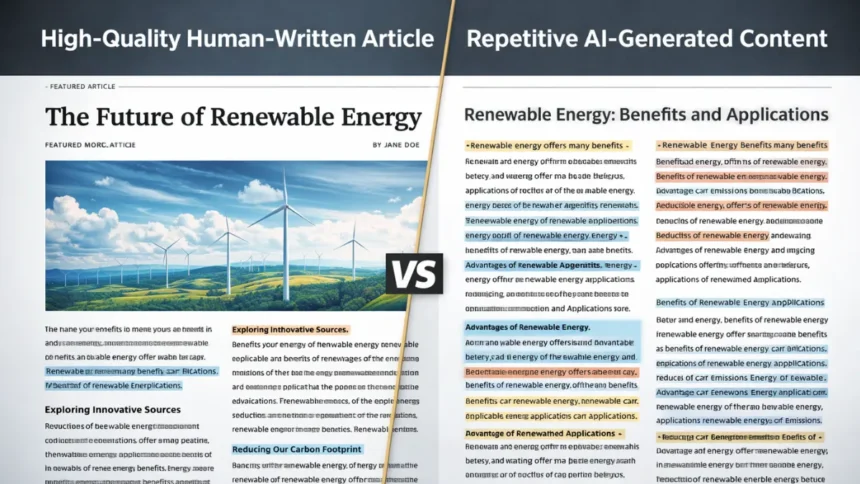
At its simplest, What Is AI Slop? refers to the growing mass of low-quality, mass-produced content generated using artificial intelligence tools. It’s not necessarily wrong or misleading—but it’s often shallow, repetitive, and created at scale with minimal human thought behind it.
AI slop isn’t defined by the technology itself. It’s defined by intent and execution.
A well-researched article written with AI assistance can be valuable. But when AI is used to churn out hundreds of posts, videos, or images purely for clicks, rankings, or monetization, the result becomes something else entirely—content that fills space without adding meaning.
And increasingly, that content is everywhere.

How the Internet Got Here
The rise of AI slop didn’t happen overnight. It’s the natural outcome of several forces colliding at once.
First, the tools became accessible. Platforms like ChatGPT, Midjourney, and Runway ML made it possible for almost anyone to create content at scale, regardless of writing or design skills.
Second, the incentive structure never changed. The internet still rewards volume. More pages mean more chances to rank. More videos mean more chances to go viral. AI simply accelerated a system that already favored quantity over depth.
And third, the cost dropped to near zero. What once required teams of writers, editors, and designers can now be done by one person—or even fully automated pipelines.
The result is predictable: when content becomes cheaper to produce, more of it gets produced. Not necessarily better—just more.
Why AI Slop Is Trending Now
People didn’t start talking about AI slop because it suddenly appeared. They started talking about it because it became impossible to ignore.
Search results are increasingly filled with similar-sounding articles. Social media feeds are crowded with templated posts, auto-generated videos, and recycled ideas. Even product reviews and “expert guides” often read like variations of the same script.
It’s not just the volume—it’s the sameness.
The internet has always had noise, but AI slop introduces a new kind of noise: content that looks polished but lacks originality. It doesn’t just clutter the space; it dilutes trust.
Readers begin to question what they’re reading. Viewers start to scroll faster. The attention economy shifts from curiosity to skepticism.
What Is AI Slop Doing to Content Quality?
The most immediate impact is a quiet erosion of standards.
When large volumes of average content flood the system, genuinely thoughtful work becomes harder to find. Not because it doesn’t exist—but because it gets buried under layers of algorithmically optimized material.
For publishers, this creates a dilemma. Compete with speed and volume, or invest in depth and risk being overshadowed.
For readers, it creates fatigue. The more content feels interchangeable, the less engaging it becomes.
There’s also a subtle psychological shift. When people consume large amounts of AI-generated content, their expectations adjust. They become accustomed to surface-level information. Depth starts to feel unnecessary—or even inconvenient.
That may be the most concerning part.
The Business Angle: Efficiency vs. Value
From a business perspective, AI slop is both an opportunity and a risk.
On one hand, companies can scale content production dramatically. Blogs, landing pages, product descriptions—everything can be generated faster and cheaper than ever before. For startups or small teams, that’s powerful.
But there’s a catch.
If everyone is producing similar content using the same tools, differentiation disappears. The competitive advantage shifts from who can produce more to who can produce better.
Search engines are already adapting. Algorithms increasingly prioritize originality, expertise, and user engagement signals. Content that feels generic may still rank temporarily—but it struggles to sustain performance over time.
In other words, AI slop might win short-term visibility, but it rarely builds long-term authority.

The Human Element: Why Authenticity Still Wins
Despite the rise of automation, one thing hasn’t changed: people recognize authenticity.
It shows up in small ways—unexpected phrasing, nuanced arguments, real-world examples, even imperfections. These are things AI can mimic, but not fully replicate with consistency.
When a piece of content reflects lived experience or original thinking, it stands out immediately. Not because it’s louder, but because it feels real.
That’s why some of the most successful digital brands today are doubling down on human voice rather than replacing it.
AI can assist, accelerate, and refine. But it cannot replace perspective.
And perspective is what gives content meaning.
What Comes Next: The Future Beyond AI Slop
The internet is entering a phase of recalibration.
As AI-generated content becomes more common, its novelty fades. What once impressed users quickly becomes background noise. This creates space for a new kind of premium: clarity, originality, and trust.
We’re likely to see a shift where:
- Human-led content becomes more valuable
- Curated platforms gain importance
- Quality signals become stronger ranking factors
- Audiences become more selective about what they consume
In a paradoxical way, the rise of AI slop may actually elevate good content rather than destroy it.
Because when everything starts to look the same, difference becomes obvious.

Conclusion
AI slop isn’t just about bad content. It’s about a system pushed to its limits—where speed overtakes thought, and volume overshadows value.
The question isn’t whether AI will continue shaping content. It already has. The real question is how we choose to use it.
Because the tools themselves are neutral. What matters is the intent behind them.
And in a digital world flooded with noise, the rarest thing isn’t information—it’s meaning.
Final Insight
The future of content won’t be decided by AI alone. It will be decided by those who understand when to use it—and when to step back and think. In a world of endless output, clarity is power. And authenticity is still the strongest signal.-THE VUE TIMES
Frequently Asked Questions
What is AI slop?
→ AI slop refers to low-quality, mass-produced content created using AI tools, often lacking originality, depth, or meaningful insight.
Why is AI slop increasing online?
→ AI tools have made content creation faster and cheaper, encouraging mass production. Combined with SEO and monetization incentives, this has led to a surge in low-value content.
Is all AI-generated content considered AI slop?
→ No. High-quality AI-assisted content with human input can be valuable. AI slop specifically refers to poorly executed, repetitive, or shallow content.
How does AI slop affect SEO?
→ It can temporarily boost rankings due to volume, but search engines increasingly prioritize quality, making AI slop less effective long-term.
Can AI slop be avoided in content creation?
→ Yes. Focus on originality, add human insights, use real examples, and avoid relying solely on automated outputs.