

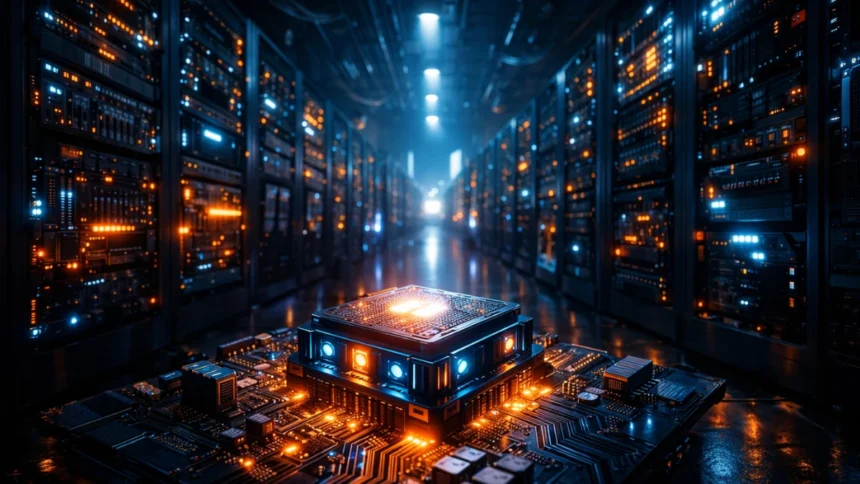
The first thing most people notice about artificial intelligence isn’t the hardware. It’s the output — the chatbot answering questions in seconds, the app recognizing faces, the recommendation system that somehow knows what you’ll click next. It feels almost weightless, like intelligence floating in the cloud.
But behind that illusion of effortlessness lies something very physical, very engineered — silicon chips working relentlessly, processing trillions of operations per second. Strip away the interface, and the reality becomes clear: none of this exists without the machines that power it. That’s precisely why AI chips matter.
The Moment Software Hit a Wall
There was a time when general-purpose processors could handle almost everything. Traditional CPUs powered personal computers, enterprise systems, and early internet infrastructure. But as machine learning models began to scale — especially deep learning — something changed.
Training a modern AI model isn’t like running a spreadsheet or browsing the web. It involves massive parallel computations, matrix multiplications, and data-heavy workloads that overwhelm conventional processors. The software evolved faster than the hardware built to support it.
That mismatch created a bottleneck. And like every technological bottleneck, it demanded a new kind of solution.
Why AI Chips Matter in Today’s Computing Landscape
The answer came in the form of specialized chips — processors designed specifically to handle AI workloads efficiently. This is where the conversation shifts from abstract intelligence to tangible infrastructure.
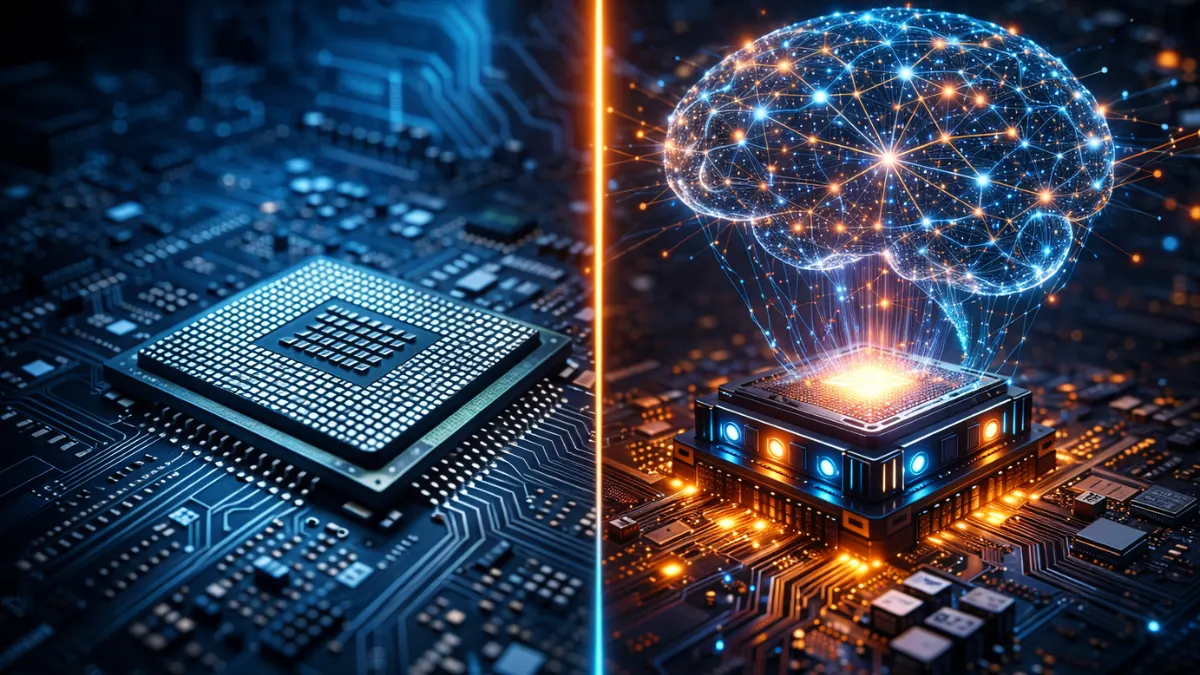
AI chips — including GPUs, TPUs, and custom accelerators — are optimized for parallel processing. Instead of executing one instruction at a time, they can perform thousands simultaneously. This capability is essential for training neural networks and running real-time AI applications.
That’s the core of why AI chips matter: they transform what’s theoretically possible into what’s practically achievable.
Without them:
- Training large AI models would take months instead of days
- Real-time applications like voice assistants would lag significantly
- Costs would skyrocket due to inefficiency
In other words, AI would remain a niche capability rather than a global utility.
From Gaming Hardware to Global Infrastructure
Interestingly, the rise of AI chips wasn’t entirely planned. Graphics Processing Units (GPUs), originally built for rendering video game visuals, turned out to be perfectly suited for AI tasks. Their ability to handle parallel workloads made them ideal for training neural networks.
What started as a workaround quickly became a cornerstone.
Today, entire data centers are built around AI chip architectures. Tech companies invest billions in designing custom silicon — chips tailored for their specific AI models and services. This isn’t just optimization; it’s strategic control over the future of computing.
The shift is subtle but profound: hardware is no longer a supporting player. It’s the stage itself.
The Business Angle: Power, Cost, and Control
There’s a reason major tech companies are racing to design their own AI chips. It’s not just about performance — it’s about economics and independence.
AI workloads are expensive. Training large-scale models requires enormous computational resources, and relying on third-party hardware can quickly become unsustainable. Custom chips offer:
- Lower long-term costs
- Better performance per watt
- Greater control over infrastructure
This is where the deeper layer of why AI chips matter emerges. They aren’t just technical tools; they are strategic assets.
Owning the chip stack means owning the pace of innovation.
It also explains the geopolitical tension surrounding semiconductor manufacturing. AI isn’t just a technology race — it’s an infrastructure race. Countries and corporations alike understand that whoever controls advanced chip production holds significant influence over the digital future.
Why AI Chips Matter for Everyday Users (Even If You Don’t See Them)
Most users will never think about AI chips. They don’t need to. But they experience their impact every day.
When a smartphone processes a photo instantly, when a navigation app predicts traffic, or when a streaming platform recommends content that feels uncannily accurate — AI chips are working in the background.
Even edge devices, like wearables and smart home systems, are now equipped with on-device AI processors. This shift reduces dependency on cloud computing and improves privacy and speed.
The result is simple: faster, smarter, more responsive technology — without the user ever noticing the complexity behind it.
The Psychology of Invisible Infrastructure
There’s something fascinating about how we perceive AI. We tend to attribute intelligence to software — algorithms, models, systems. Hardware rarely gets the same attention.
But this invisibility creates a blind spot.
We celebrate breakthroughs in AI capabilities without acknowledging the physical limits that shape them. Every advancement in AI is, in part, a story of hardware catching up — or pushing ahead.
Understanding why AI chips matter requires shifting perspective. Intelligence doesn’t exist in isolation. It’s grounded in physical systems, constrained by energy, heat, and silicon.
The “magic” of AI is, at its core, engineering.

The Future: Smaller, Faster, More Specialized
The next phase of AI development will likely be defined not just by better models, but by better chips.
Several trends are already emerging:
- Edge AI expansion: More processing happening directly on devices rather than in centralized data centers
- Energy efficiency focus: Reducing power consumption while increasing performance
- Custom silicon ecosystems: Companies designing chips tailored to specific AI applications
- Integration of AI into everyday hardware: From cars to appliances
This evolution reinforces the idea that why AI chips matter isn’t a temporary discussion — it’s foundational to the future of technology.
As AI systems become more embedded in daily life, the demand for efficient, scalable hardware will only intensify.
More Read

Conclusion: Intelligence Needs a Body
For all the conversation about artificial intelligence, we often forget a simple truth — intelligence, artificial or otherwise, needs a body to exist. In the digital world, that body is hardware.
AI chips are not glamorous. They don’t have interfaces or personalities. They don’t generate headlines the way AI models do. But they are the reason those models can exist at scale.
The next time an AI system responds instantly, predicts accurately, or adapts seamlessly, it’s worth remembering what made that moment possible.
Not just code — but silicon, power, and design working in perfect coordination.
That’s why AI chips matter. Not as a supporting detail, but as the foundation everything else is built on.
Final Insight
As AI continues to redefine industries, conversations will increasingly shift from “what AI can do” to “what makes AI possible.” The real competitive edge won’t just lie in algorithms — it will lie in infrastructure. And at the center of that infrastructure, quietly shaping the future, are AI chips.-Stay Updated Stay Imformed-The Vue Times
Frequently Asked Questions
What are AI chips?
AI chips are specialized processors designed to handle artificial intelligence workloads like machine learning, deep learning, and data processing more efficiently than traditional CPUs.
Why are AI chips important for modern technology?
They enable faster computation, lower energy usage, and real-time processing, making advanced AI applications practical and scalable across industries.
How are AI chips different from regular processors?
Unlike CPUs, AI chips are optimized for parallel processing, allowing them to perform multiple operations simultaneously — essential for training and running AI models.
Where are AI chips used in everyday life?
They power smartphones, voice assistants, recommendation systems, autonomous vehicles, and even smart home devices, often working invisibly in the background.
Will AI chips become more common in the future?
Yes. As AI adoption grows, AI chips will become more integrated into everyday devices, improving speed, efficiency, and on-device intelligence.