

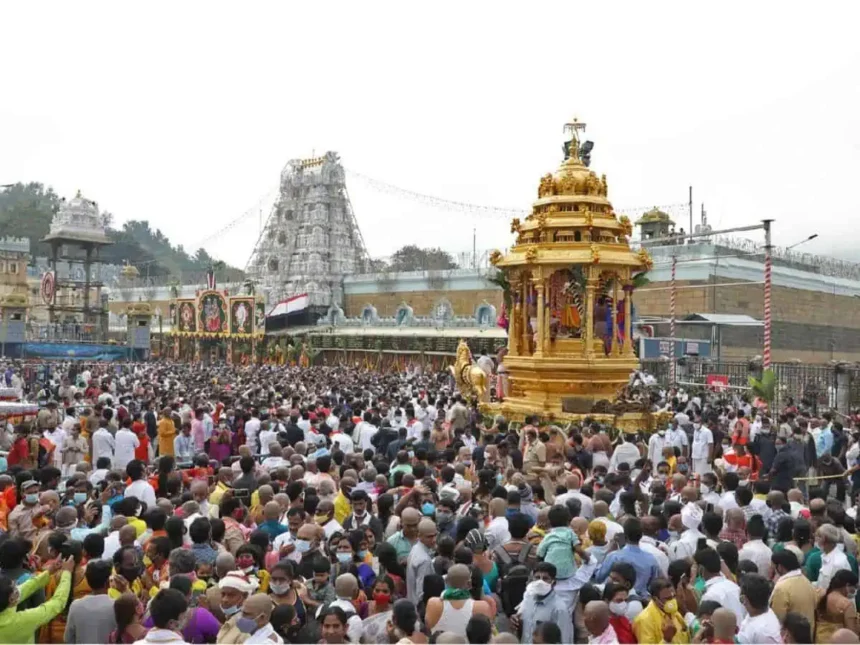
On a sacred day meant for peace and devotion, tragedy struck the Venkateswara Swamy Temple in Srikakulam, Andhra Pradesh. The Andhra Pradesh temple stampede on November 1, 2025, claimed nine lives, turning what was meant to be a spiritual gathering into a devastating human tragedy. This incident has once again raised serious questions about crowd management, temple safety, and the role of administration in handling large religious congregations in India.
The Srikakulam stampede news sent shockwaves across the nation as images and videos flooded social media showing chaos, grief, and confusion. It wasn’t just another local incident — it became a national affair, compelling the state and central governments to take immediate notice.
The Day of the Tragedy: What Happened at Kasibugga Temple
The Kasibugga temple accident occurred during Ekadashi, a day of great religious significance when thousands of devotees gather for prayers. The Venkateswara Swamy Temple Srikakulam, located in the small town of Kasibugga, saw a massive influx of worshippers early in the morning.
Eyewitnesses reported that around 11:30 AM, the crowd swelled beyond control. There was only one narrow entry and exit point, creating a dangerous bottleneck. As devotees tried to move closer to the sanctum for darshan, panic broke out. A railing collapsed, triggering a crowd surge. People began falling over each other, unable to move or breathe. Within minutes, nine people — including eight women and one boy — lost their lives.
Emergency teams and police rushed to the scene, but by the time order was restored, the damage was irreversible. Over a dozen others sustained injuries, some critical.
Why This Happened: The Root Causes Behind the Stampede
The Andhra Pradesh temple stampede was not just an accident — it was the result of systemic failures that plague many public gatherings in India. Here’s a detailed look at the five major causes that led to this tragedy.

1. Overcrowding Without Safety Measures
The temple had no formal crowd management plan. The number of devotees on Ekadashi was far beyond what the space could safely handle. No barricades or directional signs were in place, leading to uncontrolled congregation at one spot.
2. Lack of Structural Safety
Part of the temple area was reportedly under construction. The stairs and railings were weak, and when one of them gave way, it triggered mass panic.
3. Single Entry and Exit Point
The temple used the same gate for both entry and exit. In high-density crowds, this is one of the biggest risk factors for stampedes. When devotees tried to leave and others were pushing in, a crushing effect occurred in the middle.
4. Inadequate Police and Administrative Oversight
Unlike major temples under the state endowment department, the Venkateswara Swamy Temple in Kasibugga is privately managed. There were no official permissions, no government security arrangements, and no coordination with local authorities.
5. Poor Emergency Preparedness
There were no medical units or emergency exits nearby. Even ambulances struggled to reach the site because of blocked roads and dense crowds.
Voices from the Ground: The Human Impact
Behind every statistic is a story. Among the deceased were elderly women, a teenager, and families who had come from nearby villages for Ekadashi darshan. Survivors recall hearing screams, cries, and chaos as people tried to escape.
A local villager said, “We come here every year, but never saw such a crowd. There was no one to control. When one person fell, many others followed. It was unbearable.”
Volunteers and local youth worked alongside police to carry bodies, help the injured, and distribute water. The human chain of compassion that formed in those moments was a reminder of the resilience of ordinary Indians.
Government Response: Relief and Accountability
The Andhra Pradesh government and the Indian government responded swiftly after the tragedy.
- Prime Minister Narendra Modi expressed grief and announced ₹2 lakh ex-gratia for the families of the deceased and ₹50,000 for the injured.
- Andhra Pradesh Home Minister V. Anitha ordered an immediate inquiry into the incident, directing senior police officers to investigate crowd control lapses.
- The district administration has been tasked with submitting a report within seven days, focusing on structural safety, crowd management, and emergency readiness at private temples.
Officials have also pledged to introduce new temple safety guidelines, including mandatory safety audits during festivals and religious gatherings.
Lessons from History: Crowd Tragedies in India
The Andhra Pradesh temple stampede joins a long list of similar incidents in India’s history. Over the years, poor planning and unregulated gatherings have cost countless lives.
- Sabarimala Stampede (2011, Kerala) – Over 100 people died due to crowd surge during Makaravilakku festival.
- Ratangarh Temple (2013, Madhya Pradesh) – A bridge collapse led to 115 deaths.
- Kumbh Mela (2013, Allahabad) – A stampede at the railway station killed 36 pilgrims.
- Vaishno Devi Temple (2022, Jammu) – 12 people died due to overcrowding during New Year celebrations.
Each of these events highlights one common thread — lack of structured crowd control and infrastructure planning during major religious events.
The Broader Issue: Managing Faith and Safety
India, with its vast religious diversity, hosts thousands of festivals every year, drawing millions of devotees. However, the infrastructure often does not match the scale of these gatherings.
Experts from NITI Aayog and PIB reports have repeatedly emphasized the need for digital crowd monitoring systems, AI-based density tracking, and real-time communication networks between local administration and temple authorities.
The Venkateswara Swamy temple crowd surge could have been avoided if such systems were implemented. Using surveillance cameras, AI-based sensors, and mobile alerts can help authorities anticipate surges and deploy emergency teams faster.

Policy and Administrative Reforms Needed
To prevent future tragedies, India must look beyond temporary fixes and focus on long-term crowd safety reforms. Here are seven actionable steps that can reshape how religious gatherings are managed:
- Mandatory Safety Certification for all temples hosting more than 1,000 devotees during festivals.
- Crowd Simulation Software to predict high-risk congestion zones.
- Separate Entry and Exit Routes with proper signages and barriers.
- On-site Medical Units and Disaster Response Teams at all large gatherings.
- Periodic Structural Audits of old and private temples.
- Integration of Technology — CCTV, drones, and real-time crowd density maps.
- Public Awareness Drives on safe pilgrimage practices.
Such reforms align with India’s national development goals of making public spaces safer, resilient, and technology-enabled.
The Socio-Religious Context
The Venkateswara Swamy Temple in Srikakulam holds immense importance for local devotees. Situated in a small town, it serves as a spiritual center for villages across the district. On holy days like Ekadashi, attendance multiplies manifold.
Religious tourism is a major part of Andhra Pradesh’s economy, contributing significantly to local livelihoods. However, with increasing numbers of visitors, infrastructure and safety planning have not kept pace. This tragedy highlights the delicate balance between faith, tradition, and public safety in a modernizing India.

Expert Insights: What Needs to Change
Experts from disaster management authorities point out that India must treat crowd disasters as preventable, not as natural consequences of devotion.
According to one safety official, “Every stampede is predictable. If data and coordination are used properly, these incidents can be reduced to zero.”
Urban planners argue that temple towns should have dedicated disaster management cells, similar to those used in large events like the Kumbh Mela, where crowd flow is scientifically mapped.
The Role of Technology in Crowd Management
India’s Digital India initiative provides a strong foundation for tech-driven crowd control. The following innovations can transform religious event management:
- AI-based density monitoring systems can alert authorities when crowds exceed safe limits.
- Geo-tagged wristbands for large events can help track footfall and movement patterns.
- Mobile notification systems can guide devotees to alternate routes during peak hours.
- Drone surveillance can identify congestion spots and guide emergency services.
Integrating these into the Andhra Pradesh endowment department’s policy can prevent future tragedies like the Srikakulam stampede.
Emotional Aftermath and Healing
Beyond policies and reports, the human cost of the Andhra Pradesh temple stampede 2025 remains heavy. Families have lost loved ones who simply went for prayer. Survivors struggle with trauma, replaying the moments of chaos in their minds.
Counseling teams and local NGOs have stepped in to offer psychological support. Religious leaders have called for collective prayers and safety pledges to ensure such incidents never repeat.
This tragedy has also united the state, as citizens across Andhra Pradesh and India extend condolences and call for accountability.
India’s Path Forward: Turning Tragedy into Reform
The Ekadashi temple stampede 2025 is not just a story of loss — it’s a call for change. India stands at a critical point where modernization must meet tradition with responsibility and foresight.
The tragedy at Venkateswara Swamy Temple Srikakulam should serve as a turning point for policymakers, temple authorities, and citizens alike. By implementing sustainable safety measures, leveraging technology, and promoting public awareness, India can ensure that devotion never again becomes a cause for death.
Key Takeaways
- The Andhra Pradesh temple stampede revealed deep flaws in crowd management systems.
- Government policies and NITI Aayog recommendations must now focus on preventive safety frameworks.
- Technology, training, and coordination between departments can save lives in future religious events.
- Every citizen and devotee plays a role in maintaining order and safety during large gatherings.
More Read
Faith Must Never Turn Fatal
The Kasibugga temple accident is a stark reminder that faith must coexist with safety. India’s spiritual heritage draws millions each year, and with proper planning, devotion can remain peaceful and fulfilling.
This tragedy should lead to policy reforms, stricter oversight, and improved safety culture across all temples in India. The government’s response and citizen awareness will define how well the country learns from this painful episode.
As India continues its journey of national development and modernization, protecting lives during religious gatherings must become a national priority.