

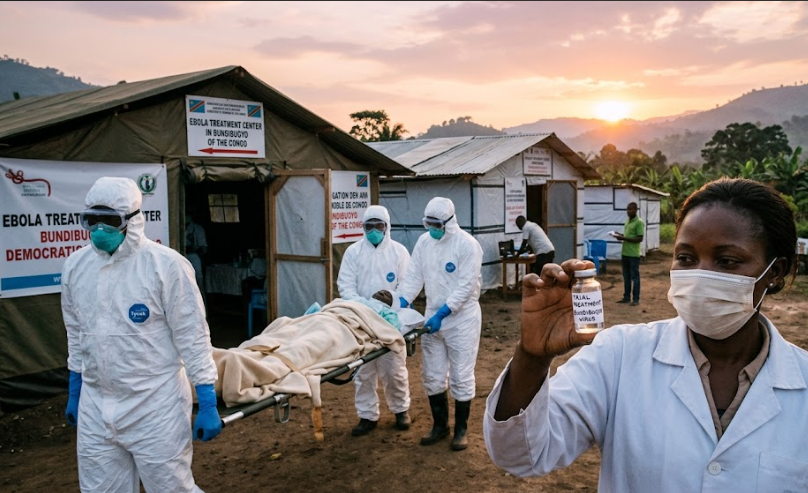
For decades, Ebola has remained one of the world’s deadliest infectious diseases.
Every major outbreak has highlighted the same challenge: while rapid diagnosis and supportive medical care have improved survival rates, treatment options remain limited for several strains of the virus.
Now, scientists are attempting to change that.
A landmark Ebola treatment trial has begun in the Democratic Republic of the Congo (DRC), marking the fastest clinical trial ever launched during an Ebola outbreak. Patients were enrolled just six weeks after the World Health Organization (WHO) declared the Bundibugyo virus outbreak a Public Health Emergency of International Concern (PHEIC), reflecting an unprecedented pace of international scientific collaboration.
The trial comes as the outbreak continues to spread.
As of 9 July 2026, the DRC had reported 1,792 confirmed cases and 625 deaths, making it one of the largest outbreaks caused by the Bundibugyo strain, for which there is currently no approved vaccine or treatment.
Health experts believe the research could become a turning point—not only for Ebola treatment but also for how the world responds to future disease outbreaks.
1. Scientists Have Started the Fastest Ebola Clinical Trial on Record
Clinical trials during infectious disease outbreaks are notoriously difficult.
Researchers must recruit patients, establish treatment centres, obtain ethical approvals, coordinate governments, and maintain scientific standards while responding to an active public health emergency.
This time, those steps happened in record time.
The Ebola treatment trial was launched just six weeks after WHO declared the Bundibugyo outbreak an international health emergency. Researchers say this is the fastest deployment of its kind for an Ebola clinical study, demonstrating how lessons learned from previous outbreaks and the COVID-19 pandemic have accelerated global research capabilities.
The trial is being coordinated by the WHO in partnership with the DRC’s National Biomedical Research Institute (INRB) and several international research organisations.
If successful, it could establish a new benchmark for responding to future emerging infectious diseases.
2. Two Experimental Drugs Are Offering New Hope
Unlike previous outbreaks where treatment focused primarily on supportive care, researchers are now testing two promising antiviral therapies.
Patients participating in the Ebola treatment trial are receiving remdesivir and MBP134, either individually, in combination, or alongside standard supportive treatment.
Both medicines have previously shown encouraging results in laboratory and animal studies against filoviruses, but neither has yet been approved specifically for the Bundibugyo strain affecting the current outbreak.
Researchers hope the study will determine whether these therapies can significantly reduce mortality while improving recovery among infected patients.
If the findings are positive, they could become the first evidence-based treatment options for this strain of Ebola.
3. This Ebola Strain Still Has No Approved Vaccine
One reason the current outbreak has attracted global attention is the virus responsible.
The outbreak involves the Bundibugyo virus, one of several Ebola virus species known to infect humans.
While vaccines have been developed for the more common Zaire Ebola virus, no licensed vaccine currently exists for Bundibugyo virus disease. That has made rapid diagnosis, isolation, contact tracing, and supportive care the primary tools for controlling transmission.
The absence of an approved vaccine also increases the importance of the ongoing Ebola treatment trial.
A successful therapy could dramatically improve survival rates while providing frontline healthcare workers with an effective clinical tool during future outbreaks.
4. Containing the Outbreak Remains a Race Against Time
Treating Ebola is only one part of the challenge.
Stopping the virus from spreading requires rapid case detection, contact tracing, isolation of infected patients, safe burials, and sustained community engagement. These measures have helped contain previous outbreaks, but they become more difficult in remote areas with limited healthcare infrastructure.
The current outbreak has also highlighted the importance of public trust.
Health officials say misinformation, delayed reporting of symptoms, and fear of seeking medical treatment can slow containment efforts, allowing the virus to spread further before infected individuals are identified.
The World Health Organization and local health authorities continue to deploy surveillance teams, laboratory testing facilities, and emergency response units to affected communities. Alongside the Ebola treatment trial, these public health measures remain critical to limiting transmission and protecting healthcare workers on the front lines.
5. The Trial Could Change How the World Responds to Future Outbreaks
Beyond the immediate goal of saving lives, researchers believe the Ebola treatment trial could reshape global outbreak response.
Historically, clinical research during epidemics has often begun after outbreaks were already declining, making it difficult to gather enough evidence to evaluate new medicines.
This time, international partners moved quickly to establish a scientifically rigorous trial while the outbreak was still unfolding.
That approach could become a model for responding to future public health emergencies.
Scientists argue that faster clinical trials allow promising treatments to be evaluated sooner, helping governments make evidence-based decisions while outbreaks are still active.
The experience gained in the Democratic Republic of the Congo may also improve preparedness for other emerging infectious diseases that require rapid international collaboration.
Why This Trial Matters Beyond Africa
Although the current outbreak is centred in the Democratic Republic of the Congo, its significance extends far beyond the region.
Infectious diseases do not recognise national borders.
The COVID-19 pandemic demonstrated how quickly local health emergencies can become global concerns, reinforcing the importance of early detection, international cooperation, and rapid scientific research.
The Ebola treatment trial reflects lessons learned over the past decade.
Global health agencies are no longer waiting until outbreaks expand before investing in research. Instead, they are integrating clinical trials into emergency response strategies from the outset.
For countries around the world, including those with no reported Ebola cases, the findings could strengthen preparedness for future epidemics by improving treatment protocols, accelerating regulatory cooperation, and encouraging greater investment in infectious disease research.
Scientists Remain Cautiously Optimistic
Researchers caution that it is too early to predict the outcome of the trial.
Clinical studies must demonstrate that treatments are both safe and effective before they can receive regulatory approval.
Even if the medicines show promising early results, additional analysis will be required before they become part of standard Ebola care.
Nevertheless, public health experts view the trial as an encouraging step.
The speed at which scientists, governments, and international organisations have collaborated reflects significant progress in global outbreak preparedness compared with previous Ebola emergencies.
Many researchers believe this coordinated approach may ultimately prove as important as the medicines themselves.
Readers interested in other major international developments can also explore our article on Understanding the 2025 Conflicts in Gaza and Ukraine: A Simplified Overview, which examines another global challenge with far-reaching humanitarian consequences. For the latest guidance on Ebola prevention, treatment, and outbreak response, visit the <World Health Organization (WHO).
Conclusion
The ongoing Ebola treatment trial represents one of the most significant developments in Ebola research in recent years.
By launching a clinical trial within weeks of the outbreak, scientists have demonstrated that global health responses are becoming faster, more coordinated, and increasingly driven by evidence rather than urgency alone.
For the Democratic Republic of the Congo, the study offers hope that effective treatments could improve survival rates during the current outbreak.
For the international community, it provides an opportunity to strengthen future responses to infectious diseases that continue to pose global health risks.
While researchers emphasise that more evidence is needed before any conclusions can be drawn, the trial marks an important milestone in the effort to develop effective therapies for one of the world’s most dangerous viral diseases.