
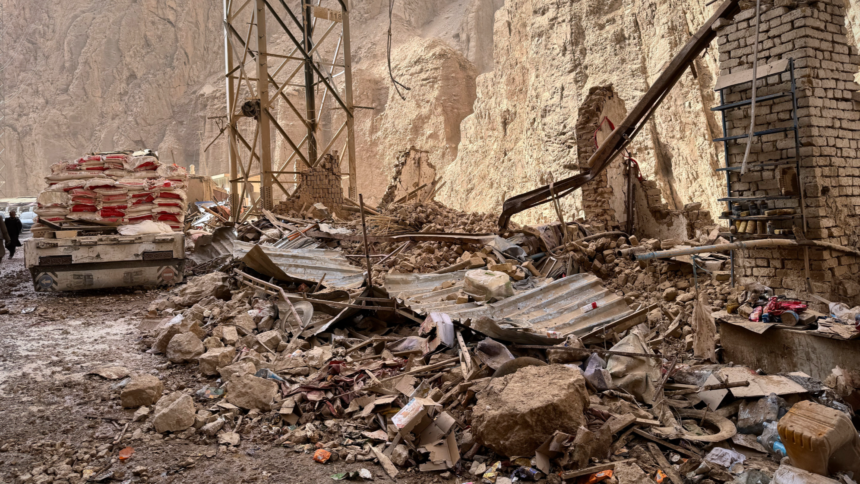
The Afghanistan Earthquake triggered widespread panic across North India on June 27, 2026, Saturday evening after a powerful magnitude 6.2 quake struck the Hindu Kush region at 7:04 pm IST. Although the epicentre lay deep beneath northeastern Afghanistan, residents in Delhi-NCR, Jammu and Kashmir, Punjab and several neighbouring regions reported noticeable tremors, prompting many to rush out of homes, offices and high-rise buildings as a precaution. Despite the widespread shaking, there were no immediate reports of casualties or significant structural damage in India, according to early assessments.
The earthquake originated at a depth of 215 kilometres, a factor that allowed seismic waves to travel across a much wider area than a shallower earthquake of similar magnitude. The National Centre for Seismology (NCS) identified the epicentre in Afghanistan’s Hindu Kush region, an area globally recognised for producing powerful deep-focus earthquakes that are often felt hundreds of kilometres away.
Afghanistan Earthquake Sends Tremors Across North India
The Afghanistan Earthquake was felt across several parts of northern India within seconds of the seismic event. Residents in Delhi, Noida, Gurugram, Ghaziabad and parts of Jammu and Kashmir reported buildings swaying briefly, leading many people to evacuate apartments and office complexes. Similar scenes unfolded in neighbouring Pakistan, where residents in Islamabad, Lahore and Khyber Pakhtunkhwa also experienced strong shaking.
Social media quickly filled with videos showing people gathering outside residential towers and commercial buildings. While the tremors caused understandable anxiety, emergency authorities confirmed that no major damage or injuries had been reported in India in the immediate aftermath. Officials continued to monitor the situation as precautionary inspections were carried out in sensitive areas.
Why the Afghanistan Earthquake Was Felt So Far Away
One of the most striking aspects of the Afghanistan Earthquake was the distance over which it was felt. Unlike shallow earthquakes that often cause severe local damage, this earthquake occurred more than 200 kilometres beneath the Earth’s surface. Deep-focus earthquakes generally lose less energy before seismic waves spread across vast regions, allowing tremors to be experienced far from the epicentre.
The Hindu Kush mountain range lies along one of the world’s most active tectonic zones, where the Indian Plate continues to push northward beneath the Eurasian Plate. This geological collision has been shaping the Himalayas for millions of years and remains responsible for frequent seismic activity across Afghanistan, Pakistan, Nepal and northern India. Scientists have long regarded the Hindu Kush as one of the most seismically active regions in Asia because of these ongoing tectonic movements.
A Region with a Long History of Powerful Earthquakes
The Afghanistan Earthquake is the latest reminder of the region’s seismic vulnerability. The Hindu Kush has experienced numerous powerful earthquakes over the past several decades, many of which have sent tremors across South Asia.
One of the most devastating examples remains the 2005 Kashmir earthquake, which killed more than 80,000 people across Pakistan-administered Kashmir and northern Pakistan after a magnitude 7.6 event struck the broader Himalayan region. More recently, repeated earthquakes centred in Afghanistan’s Hindu Kush have been felt across Delhi-NCR, Punjab and Jammu and Kashmir because of the region’s unique geological structure.
Earlier in 2026, another earthquake originating in Afghanistan was also felt across northern India, highlighting how frequently seismic activity in the Hindu Kush affects neighbouring countries.
Why Delhi-NCR Feels Earthquakes from Afghanistan
Although Delhi lies hundreds of kilometres from Afghanistan, the National Capital Region remains vulnerable to tremors generated by distant earthquakes. The alluvial soils beneath parts of Delhi can amplify ground motion, while the city’s growing skyline of high-rise buildings often makes even moderate tremors more noticeable.
Experts explain that residents frequently perceive long-period shaking from deep earthquakes because taller buildings naturally sway more than low-rise structures. As a result, even when the epicentre is located outside India, earthquakes originating in the Hindu Kush are often strongly felt across Delhi-NCR.
The latest Afghanistan Earthquake once again demonstrated how interconnected the seismic systems of South and Central Asia remain.
Authorities Continue Monitoring the Situation
Following the Afghanistan Earthquake, the National Centre for Seismology released the earthquake’s preliminary parameters, confirming a magnitude of 6.2 and a focal depth of 215 kilometres. Disaster management authorities continued to monitor aftershock activity while local administrations remained on alert as a precaution.
Authorities urged citizens to remain calm and follow standard earthquake safety practices rather than relying on unverified information circulating on social media. Although no significant damage has been reported, experts note that earthquake preparedness remains essential because aftershocks cannot always be ruled out following major seismic events.
Readers interested in understanding how geography influences natural events can also explore our article on Geography of India: A Comprehensive Guide, which explains the country’s diverse physical landscape and geological features. For official updates on earthquakes, seismic monitoring, and global hazard information, visit the U.S. Geological Survey (USGS) Earthquake Hazards Program.
Conclusion
The Afghanistan Earthquake served as another reminder that powerful seismic events occurring hundreds of kilometres away can still affect millions across northern India. While Saturday’s deep-focus earthquake fortunately caused panic rather than widespread destruction, it underscores the continuing seismic risks posed by the active tectonic boundary stretching from Afghanistan through the Himalayas.
As cities continue to expand and urban populations grow, experts believe investment in earthquake-resistant infrastructure, public awareness and rapid emergency response systems will become increasingly important. The latest Afghanistan Earthquake may have ended without major damage, but it has once again highlighted the importance of preparedness in one of the world’s most earthquake-prone regions.