

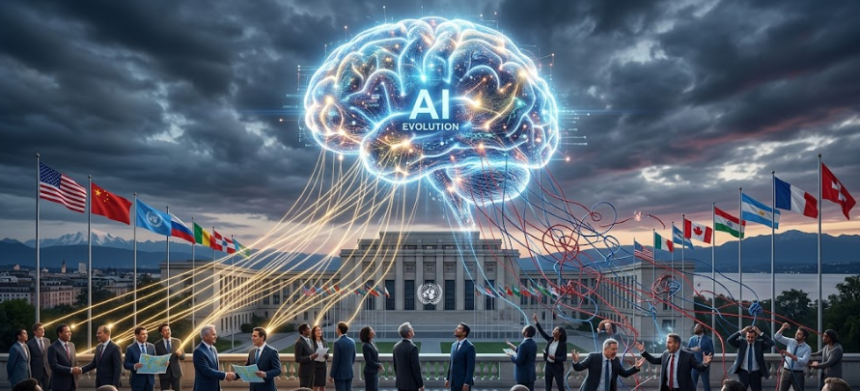
Artificial intelligence is evolving faster than governments can regulate it.
Every week brings more capable AI models, smarter virtual assistants, and new tools that are transforming education, healthcare, finance, software development, and scientific research. At the same time, concerns around misinformation, deepfakes, copyright, cybersecurity, and algorithmic bias continue to grow.
Those concerns have now moved beyond academic debate.
This month, governments, technology companies, researchers, and international organisations gathered in Geneva for the Global AI Governance Dialogue and the AI for Good Global Summit, where discussions focused on building international rules for the safe and responsible development of artificial intelligence. UNESCO has also made AI governance a central priority in its latest global initiatives, arguing that technological progress must be accompanied by stronger ethical frameworks and international cooperation.
The renewed focus on AI governance reflects a broader reality.
Artificial intelligence is no longer simply a technology story.
It has become a global policy issue affecting economies, national security, education, healthcare, and the future of work.
Here are five developments explaining why AI governance has become one of the world’s fastest-growing policy priorities.
1. Governments Are Moving From AI Innovation to AI Regulation
For several years, governments primarily focused on encouraging AI innovation.
Investment increased.
Research accelerated.
Technology companies introduced increasingly capable large language models.
Now, policymakers are turning their attention towards regulation.
The rapid adoption of generative AI has created new legal and ethical questions surrounding transparency, accountability, privacy, intellectual property, and online safety.
Instead of asking whether artificial intelligence should be regulated, governments are increasingly debating how it should be regulated without slowing innovation.
That shift marks one of the biggest changes in global technology policy over the past two years.
2. UNESCO Wants Global Rules Instead of National Rules
Artificial intelligence does not stop at national borders.
An AI system developed in one country can be deployed worldwide within days.
Recognising that challenge, UNESCO has continued promoting international cooperation on AI governance, encouraging governments to adopt common ethical principles rather than fragmented national standards.
During recent global meetings, UNESCO emphasised responsible AI development, digital inclusion, public-sector AI literacy, and international collaboration to reduce governance gaps as AI capabilities continue expanding.
The organisation argues that shared principles can help countries address common challenges while avoiding inconsistent regulations that could complicate international innovation.
3. AI Safety Has Become a National Security Issue
Artificial intelligence is increasingly influencing areas traditionally associated with national security.
Governments are evaluating AI’s role in cybersecurity, defence planning, intelligence analysis, critical infrastructure, and emergency response.
At the same time, concerns continue growing around AI-generated misinformation, sophisticated cyberattacks, election interference, and deepfake technology.
These developments have expanded the conversation beyond technology companies.
Today, discussions around AI governance increasingly involve defence agencies, regulators, universities, international organisations, and national security experts.
Many governments now view AI safety as an essential component of broader digital resilience rather than a standalone technology issue.
4. Businesses Want Clear AI Rules Before Investing More
Artificial intelligence has become a boardroom priority.
From banks using AI to detect fraud to hospitals deploying diagnostic tools and manufacturers automating production, companies are investing billions in AI-powered technologies.
Yet many executives say one challenge remains: regulatory uncertainty.
Businesses want to know what data can legally be used to train AI systems, who is responsible when AI makes a mistake, and what transparency standards should apply to high-risk applications.
Without clear regulations, organisations face legal, financial, and reputational risks.
This is why AI governance has become more than a government issue. It is now a business priority that influences investment decisions, product development, and customer trust.
Technology companies are increasingly working alongside policymakers to create practical frameworks that encourage innovation while reducing risks for consumers.
5. Global Cooperation Is Becoming More Important Than Ever
Artificial intelligence is developing at a pace no single country can manage alone.
Recognising this, governments are increasingly working through international forums rather than relying solely on national regulations.
At the inaugural UN Global Dialogue on AI Governance in Geneva, delegates from nearly every UN member state discussed shared principles for AI safety, accountability, transparency, and equitable access to emerging technologies. The discussions emphasised that AI governance should reflect the priorities of both advanced and developing economies rather than a handful of technology leaders.
The momentum continued after the summit. On 16 July, 29 countries signed an agreement to establish the World AI Cooperation Organization, a new international body aimed at strengthening cooperation on AI governance and policy coordination.
Although countries continue to differ on regulatory approaches, the trend is clear: AI is increasingly being governed through international cooperation rather than isolated national policies.
What AI Governance Means for Everyday Users
For many people, AI governance may sound like a discussion reserved for diplomats and technology executives.
In reality, it affects millions of users every day.
UN Secretary-General António Guterres has warned that AI is advancing faster than governments can regulate it and has urged countries to establish stronger global guardrails, particularly to protect children and vulnerable users.
As AI becomes integrated into search engines, smartphones, workplaces, schools, and public services, governance decisions made today will increasingly shape everyday digital experiences.
Readers interested in how AI is transforming industries can also explore our article on Top Viral AI Tools in 2025: ChatGPT Hacks, Canva AI Tricks & Midjourney Mastery, which highlights the latest AI innovations and their real-world applications. For international guidance on responsible AI development and governance, visit the OECD AI Policy Observatory, a leading resource on global AI policy and best practices.
Conclusion
The conversation around AI governance has entered a new phase.
What began as a discussion among technology experts has evolved into a global policy priority involving governments, businesses, researchers, and international organisations.
Recent UN meetings in Geneva demonstrated that countries increasingly recognise the need for shared principles on AI safety, transparency, and accountability while continuing to support innovation.
At the same time, initiatives such as the newly announced World AI Cooperation Organization highlight growing international efforts to coordinate AI policy beyond national borders.
The challenge ahead is not whether artificial intelligence will transform society, it already is.
The real question is whether governments, technology companies, and global institutions can establish governance frameworks that encourage innovation while protecting people from emerging risks.
The decisions made today are likely to shape how AI develops for years to come.