
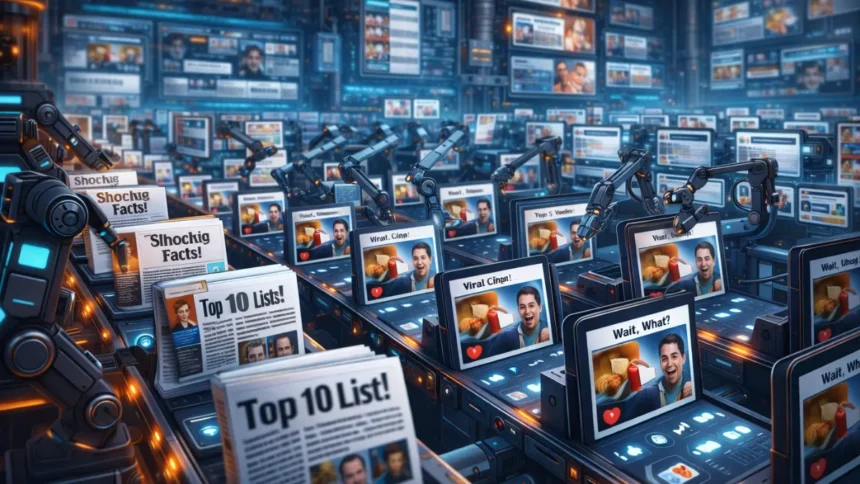
It usually begins the same way. A quick scroll meant to kill five minutes stretches into half an hour. You don’t remember what you watched — only that it all felt strangely similar. A recycled meme. A video stitched together from other videos. A “fact” you’ve seen phrased ten different ways. It’s not quite spam, not quite content — just something in between.
This is the texture of what people have started calling Internet Slop. Not offensive, not necessarily wrong — just relentlessly mediocre, endlessly duplicated, and impossible to escape.
What Exactly Is Internet Slop?
At its core, Internet Slop refers to the growing volume of low-effort, mass-produced digital content that floods online platforms. It’s the kind of material designed not to inform, entertain deeply, or provoke thought — but simply to exist long enough to grab attention.
Think of:
- AI-generated articles with surface-level insights
- Reposted videos slightly edited to avoid detection
- Clickbait headlines leading to hollow content
- Generic “top 10” lists that feel eerily identical
Unlike traditional spam, which is easy to identify and ignore, slop is more subtle. It looks legitimate. It mimics quality. But it rarely delivers anything meaningful.
And that’s precisely why it spreads so effectively.

The Origins: How the Web Got Here
The internet wasn’t always this saturated. Early digital spaces were slower, more intentional. Content had weight because creating and distributing it required effort.
Then came the algorithm.
Platforms began rewarding engagement — clicks, watch time, shares — over substance. The more content you produced, the more chances you had to be seen. Quantity started to quietly outrank quality.
Now layer in automation. With the rise of generative AI tools, content production has become almost frictionless. A single idea can be spun into dozens of posts, videos, and articles within minutes.
The result is a system that doesn’t just allow Internet Slop — it incentivizes it.
Why Internet Slop Feels So Hard to Avoid
There’s a reason you keep encountering the same kind of content, even if you don’t actively seek it out.
Algorithms don’t prioritize originality. They prioritize predictability.
If a certain format works — say, a dramatic headline paired with quick-cut visuals — it gets replicated. Then amplified. Then endlessly repeated.
Over time, your feed becomes less about discovery and more about reinforcement. You’re not seeing new ideas. You’re seeing variations of the same idea, optimized for maximum retention.
It creates a strange paradox: the internet feels bigger than ever, yet somehow narrower.
The Psychology Behind the Scroll
Internet Slop thrives because it aligns perfectly with how human attention works.
Short, repetitive, low-effort content is easy to consume. It doesn’t demand much thinking. It doesn’t challenge assumptions. It offers just enough stimulation to keep you engaged without asking anything in return.
That’s the hook.
Your brain doesn’t necessarily enjoy it — but it doesn’t resist it either.
Over time, this creates a subtle shift. You start expecting content to be effortless. Long-form, thoughtful material begins to feel like work. Depth becomes optional.
And attention — once a deliberate act — turns into a reflex.

The Business of Internet Slop
Behind the scenes, Internet Slop isn’t accidental. It’s highly strategic.
For creators and businesses, volume has become a growth tactic. More content means more visibility. More visibility means more traffic. And traffic, in many cases, converts into revenue.
The economics are simple:
- Low production cost
- High output
- Algorithm-driven distribution
Even if individual pieces of content perform poorly, the sheer volume ensures that something eventually sticks.
This approach has quietly reshaped entire industries — from digital marketing to media publishing. The focus is no longer just on creating something valuable. It’s on creating enough of everything.
The Cost: What Gets Lost in the Noise
At first glance, Internet Slop seems harmless. It’s just content, after all.
But its impact runs deeper.
When feeds are flooded with low-value material, genuinely insightful content struggles to stand out. Not because it’s less important — but because it’s less frequent.
Attention becomes diluted.
Creators who prioritize quality often find themselves competing with an overwhelming volume of faster, cheaper alternatives. Over time, the incentive to produce meaningful work weakens.
And for audiences, the consequence is subtle but significant: a gradual erosion of standards.
You begin to accept less — not because you want to, but because it’s what you’re consistently given.
Is AI Making It Worse — or Just Faster?
It’s tempting to blame AI for the rise of Internet Slop, but the reality is more complicated.
The demand for high-volume, low-effort content existed long before automation. AI has simply accelerated the process.
Instead of replacing human creativity, it has amplified existing patterns — both good and bad.
Used thoughtfully, AI can enhance quality, streamline workflows, and enable deeper research. Used carelessly, it becomes a tool for mass-producing mediocrity.
The distinction doesn’t lie in the technology itself. It lies in how it’s used — and what it’s used for.
Where This Is Heading
The trajectory is clear: more content, faster production, increasingly blurred lines between authentic and synthetic material.
But saturation has a tipping point.
As audiences become more aware of Internet Slop, their expectations begin to shift. Trust becomes a differentiator. Depth becomes valuable again. Originality, once optional, starts to matter.
There’s already a quiet pushback happening:
- Niche communities prioritizing quality over reach
- Creators focusing on fewer, more meaningful outputs
- Platforms experimenting with ways to highlight credible content
It’s not a reversal — at least not yet. But it signals something important.
The system may reward volume, but people still recognize value when they see it.
More Read

Conclusion
The rise of Internet Slop isn’t just a content problem. It’s a reflection of how digital ecosystems have evolved — and what they currently reward.
The internet hasn’t run out of ideas. It’s simply overwhelmed by repetition.
And somewhere beneath the noise, meaningful content still exists — quieter, harder to find, but ultimately more enduring.
The question isn’t whether the web will continue to produce slop. It will.
The real question is whether we, as users and creators, choose to accept it — or start demanding something better.
Final Insight
At The Vue Times, we believe the future of digital content won’t be defined by volume, but by clarity, depth, and trust. The shift may be slow, but it’s inevitable. The audiences of tomorrow won’t just consume content — they’ll filter it more critically than ever before.-The Vue Times
Frequently Asked Questions
What is Internet Slop?
Internet Slop refers to low-quality, repetitive, and mass-produced online content designed primarily to attract attention rather than provide real value.
Why is Internet Slop increasing?
It’s driven by algorithmic platforms that reward volume and engagement, along with AI tools that make content creation faster and easier.
Is Internet Slop harmful?
While not directly harmful, it reduces content quality overall, making it harder for meaningful information to stand out and affecting attention spans.
How can users avoid Internet Slop?
Curating feeds, following trusted sources, and prioritizing long-form or niche content can help reduce exposure to low-value material.
Will Internet Slop continue to grow?
Yes, but increasing awareness may push platforms and creators to focus more on quality and authenticity over time.