Why this topic matters in today’s exams
Many students study seriously and cover the full syllabus, yet their results remain uneven. Marks rise and fall, and feedback often feels unclear. This happens because exams today are no longer testing memory alone. Today’s Exam topic focus on how a student understands a question, chooses points, and explains ideas. Knowing facts is not enough if answers do not match what examiners expect. Exams are set by evaluators, not learners. When students do not see questions from the examiner’s side, they misunderstand what is being asked. Learning to think like an examiner helps reduce confusion and improves results.
How examiners actually think about this area
Examiners don’t just jump into writing questions based on the subject matter. They actually begin by thinking about the overall goal. Before a single question is even phrased, an examiner typically has a clear idea about three key things:
- What specific skill or knowledge they want to test.
- What level of understanding or judgment they’re looking for.
- How they will be able to tell the difference between good and not-so-good answers, especially when they have to mark lots of them quickly.
From the examiner’s point of view, a question isn’t just a way to get information out of you. It’s more like a filter – something designed to show specific things about the person answering.
Each question is carefully crafted to reveal:

- If you can figure out what’s truly important.
- If you can organize your thoughts in a clear, logical way.
- If your response matches the importance of the question.
- If you can tell the difference between things that seem similar, without needing extra hints.
This is why many questions might feel a bit “indirect.” They aren’t necessarily asking for everything you’ve learned; they’re looking for proof that you can make sound judgments.
Examiners also have to think about efficiency. They need to mark potentially hundreds or thousands of answers, and they need to do it fairly and consistently. This definitely influences how they write the questions. They need clear expectations, ways to easily spot good answers, and different levels of quality that stand out.
Because of this, you might notice that:
- Questions sometimes have deliberate ambiguity.
- Instructions are usually brief rather than detailed explanations.
- The scope of the question is often hinted at, rather than being listed out fully.
This isn’t meant to deliberately confuse students. Instead, it’s a way to see who can accurately understand and respond to the subtle cues in the question.
When students answer without realizing this underlying intention, they often end up writing around the question, missing the core point, rather than addressing it directly.


How the same concept appears across different papers
Once you understand examiner intent, an important pattern becomes visible: the same thinking skill is tested in different formats using different disguises.
Essay-style questions
When it comes to essay exams, the people grading them look at a few key things. They notice how well students define the main problem. They also check how candidates decide which points are more important. And they see if the essay’s organization shows clear thinking. Even if the topic is very broad, what matters most is choosing the right points and putting them in a logical order. An essay that jumps around and covers too many ideas without a clear direction usually doesn’t get as good a score as one that focuses on fewer points but presents them in a well-organized and thoughtful way.

Objective or short-answer formats
In shorter exams, the goal isn’t just to see if you can remember information. It’s really about checking how accurate your understanding is. The wrong answer choices are made to trip up students who spot the key words but miss the subtle details. Getting the right answer often means figuring out what the question is ruling out, not just what it’s asking about.
Case-based questions
Here, the examiners are testing how well the application works under pressure. The information provided in the case study often contains more details than you actually need. Your main goal is to figure out what’s relevant, not to just summarize everything. Candidates who simply repeat information from the case instead of analyzing it show they didn’t quite grasp what was being asked.
Interviews or personality assessments
During interactive sessions, the evaluators are looking at how well your ideas connect with what you say and how you judge things. There aren’t any perfect answers. What really counts is if your response shows clear thinking, self-awareness, and logical reasoning instead of just repeating things you’ve memorized. No matter the format, the evaluator is always checking the same thing: how you think when you don’t have much guidance.
Where most students go wrong
Most mistakes do not come from ignorance. They come from misalignment.
Treating questions as content prompts
Many students see a question as an invitation to display everything they know. This leads to lengthy but unfocused answers.
The examiner, however, is not awarding marks for volume. They are looking for decision-making.
Ignoring implicit limits
Questions often have unspoken boundaries. Students who cross them—by adding unnecessary background or unrelated points—dilute their answers.
This happens because students focus on topic familiarity rather than question intent.
Confusing explanation with evaluation
Explaining a concept is not the same as applying it or assessing it. Many answers remain descriptive when the question expects judgment.
This mistake persists because students are rarely trained to identify the mode of thinking required.
Assuming correctness guarantees marks
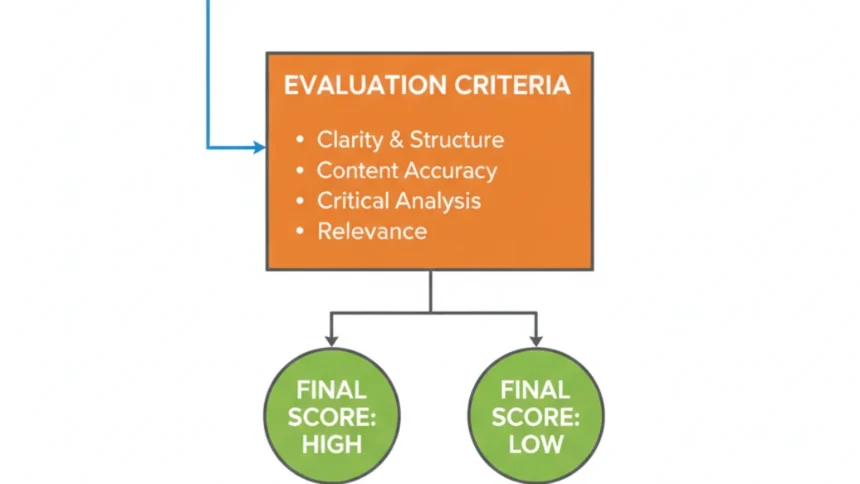
Students are often surprised when factually correct answers score poorly. This usually happens when the answer does not align with the examiner’s priority—such as structure, relevance, or clarity.
These mistakes are not signs of weak preparation. They are signs of preparation that has not been aligned with evaluation logic.

How toppers approach this differently
High-scoring students are not necessarily more knowledgeable. They are often more selective.
Difference in thinking style
Toppers think in terms of intent. Before answering, they implicitly ask:
- Why is this being asked?
- What is the examiner likely trying to observe?
This pause shapes everything that follows.
Difference in answer framing
Their answers are structured to make evaluation easy. Key ideas appear early. Transitions are clear. Each paragraph serves a defined purpose.
This is not about presentation tricks. It reflects clarity of thinking.
Difference in prioritisation
Toppers decide what not to include. They resist the urge to demonstrate everything they know and instead focus on what the question demands.
This restraint is often what separates average scores from high ones.
A practical framework students can reuse
Thinking like an examiner does not require guessing or intuition. It can be approached systematically.
Identify the core demand
Ask yourself:
What ability is this question trying to test—understanding, judgment, application, or prioritisation?
Locate implicit boundaries
What is the question not asking for?
What would be excessive or irrelevant?
Decide the evaluation lens
Is the answer being judged on:
- Clarity?
- Balance?
- Logical flow?
- Precision?
Different questions emphasise different lenses.
Structure before writing
Mentally outline:
- Opening focus
- Key arguments or points
- Logical conclusion
This reduces drift.
How this way of thinking helps beyond exams
Thinking like an examiner helps build skills that are useful in many areas of life, not just for tests. It makes you better at:
- Writing clearly by making sure your points are always relevant.
- Making smart decisions by helping you focus on what’s most important.
- Communicating effectively by matching what you mean with what you say.
In both work and school, being clear is often more valued than giving too much information. This way of thinking trains you to focus on what’s expected, not just what you assume. Over time, students notice they think more clearly, write more directly, and communicate with a clearer purpose.
Final takeaway
Tests aren’t just about how much you can remember—they’re about showing how you think, even when you’re not sure what’s expected. If you only study from the student’s point of view, you’re missing half the picture. Thinking like an examiner doesn’t make exams simpler, but it does make them less confusing. Once you replace guessing with clarity, your studying becomes more focused, your results become more reliable, and your confidence feels solid, not just forced.

FAQs
Is this approach useful across different competitive exams?
Yes. Because it focuses on evaluation logic rather than subject matter, it applies across formats, levels, and disciplines.
Can this help students who feel stuck despite regular study?
Often, yes. Many plateaus occur not due to lack of effort but due to misalignment with evaluation expectations.
Why do correct answers still score poorly?
Because correctness is only one criterion. Relevance, structure, and prioritisation often carry equal or greater weight.
How long does it take to see improvement using this approach?
Some improvement is immediate—especially in answer clarity. Deeper consistency develops with repeated application.
Can beginners apply this way of thinking?
Absolutely. In fact, adopting this mindset early prevents the formation of unhelpful habits later.
For more analytical exam perspectives, readers may explore related explainers on The Vue Times.