
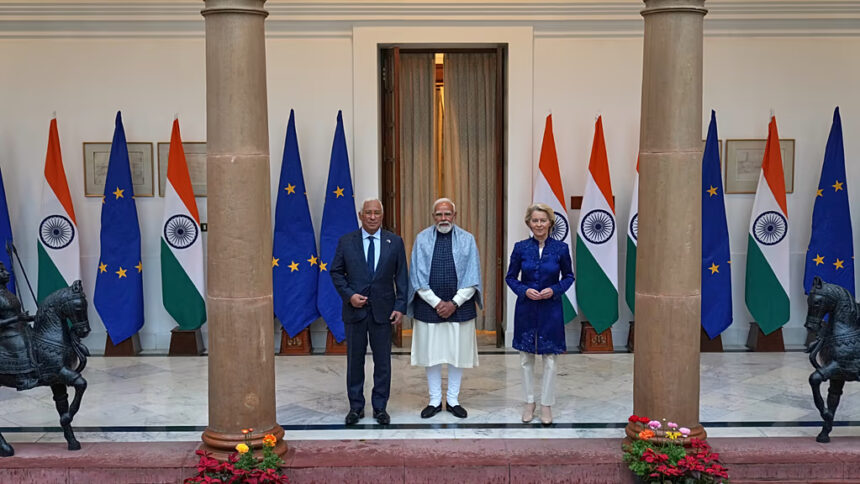
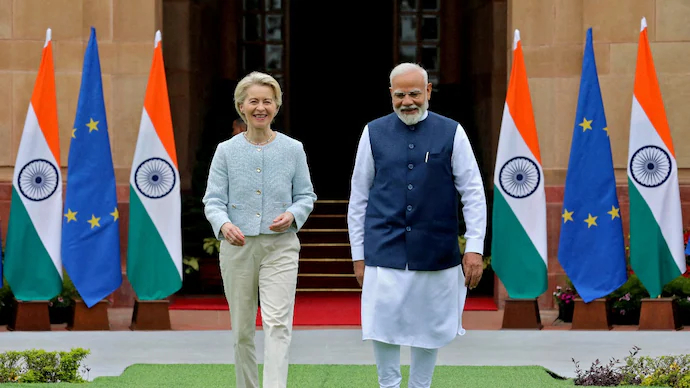
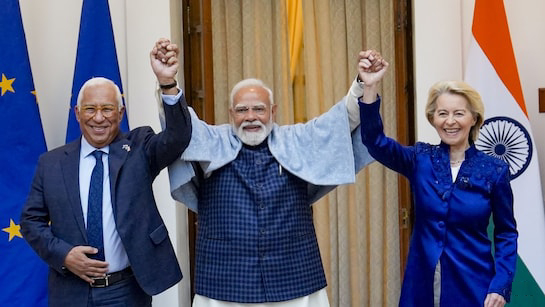
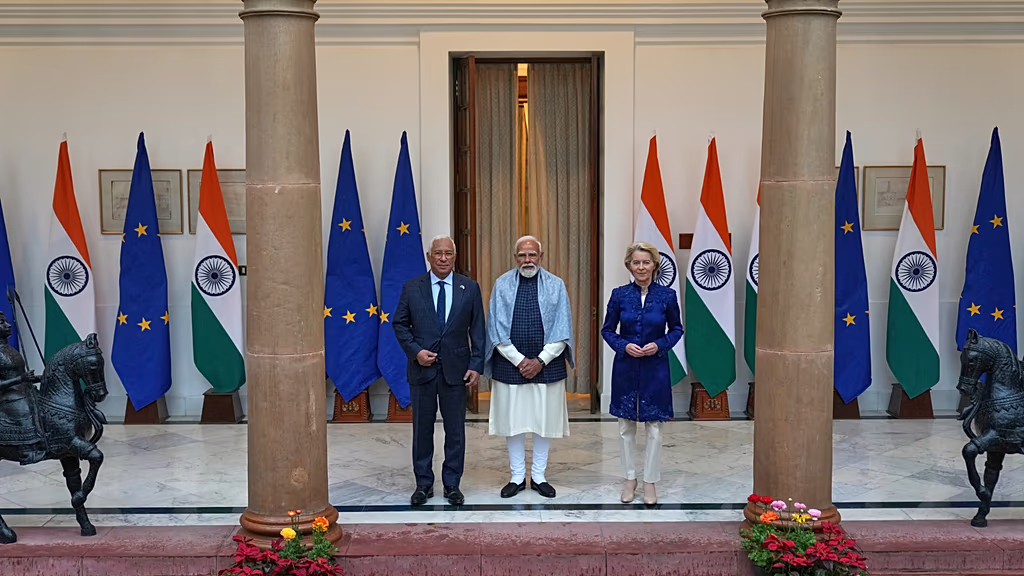
The moment that India and the European Union took the strong step in order to bring to a close the long anticipated India-EU Trade Deal in 2026 was not any other milestone in the field of diplomacy. It signified a historic re-set in world trade politics, economic accommodation and strategic confidence between the two largest democratic blocs of the world.
What diplomats and policymakers call the mother of all trade deals, this agreement has attracted the interest of not only businesses and investors but also such global superpowers as the United States and China. As an Indian, the deal has come at a gaping time- when it is also reshaping itself as a manufacturing centre, digital economy and bedrock player in a crumbly global system.
This article describes the India- Europe Trade Deal 2026 in detail- its background, architecture, perspective, the economic implications, and the long term world implications- in a simple, exam-ready and readable style.
The India-EU Trade Deal and why It Matters Now
Trading agreements do not exist in the vacuum. They mirror the political tone, economic interests and the safety worries of their period. India-EU trade agreement is placed against the background of slowing global growth, supply-chain shocks, protectionism, and geopolitical tussles.
To India, this accord is not just about tariffs. It is regarding access to the market, transfer of technology, creation of employment, co-operation of climate and strategic independence. To the European Union, India is a developing market with tremendous potential, a stable democratic ally, and an alternative to excessive dependence on China.
The EU and India share an immense proportion of the world population, consumption, and innovation potential. Enhancing India-EU trade relations thus transforms not only bilateral relationships but also the world economy system.
It has a Long and Complex History of India-EU Trade Negotiations
The negotiations between India and Europe on trade did not start immediately. Mutual negotiations on a complete free trade deal can be traced to 2007 when both parties began negotiating on a Broad-based Trade and Investment Agreement.
But the talks collapsed over years because of disagreements between:
- Automobile, wine, dairy products tariff cuts.
- Pharmaceutical patents and intellectual property rights.
- Cybersecurity and online trade regulations.
- Environmental clauses and labour standards.
India being a developing economy was not willing to open sensitive sectors at a rapid rate. EU, in their turn, insisted on closer regulation and more environmental commitments.
This new impetus followed the period after 2021 when geopolitics, a post-pandemic recovery imperative, and plans to cease dependence on China, re-orientated both parties to the negotiation table in a more practical sense.
What Will Be Different in 2026: The Strategic Reset
The India-EU Trade Deal 2026 is an expression of grown-up and sensible reflection of limitations and aspirations of each other. The agreement is compromising ambition with flexibility as opposed to the one-size-fits-all approach.
The major developments that enabled the deal to occur entail:
- The emerging assurance of India as a manufacturing and a digital economy.
- Accessibility of developmental priorities of India by EU.
- One commonality in robust supply chains.
- Getting ahead on climate action without destroying growth.
This U-turn of India-EU relations changed the transactional relationship to a long-term strategic partnership.
The India-EU Trade Deal 2026 Pillars
The India-EU free trade agreement consists of a number of pillars in its most basic sense that intersect to create the scope and vision of the agreement.
Market Access and Liberation of tariff
The tariff minimization of a broad variety of goods is only one of the most apparent elements of the accord. The Indian exporters are able to have better access to the EU market in the areas of textiles, leather goods, engineering products, pharmaceuticals, and agricultural products.
To the EU, India would liberalize some of its industries such as automobiles, high-end machinery, and renewable energy equipment, but guard the domestic industries by a gradual process.
Services and Mobility
The strength of India in service, especially, IT, digital services, and professional consultancy is recognized in the deal. We have simplified visa regimes and qualification recognition that facilitates access of skilled Indian professionals to European markets.
This aspect is especially important among the youth, start-ups and service exporters of India.
Cooperation in Investment and Technology
The India European Union trade agreement places great focus on investment liberalization and technology transfer. Policy stability and transparency are granted to European investments in India manufacturing, clean energy, semiconductors and infrastructure.
In its turn, India obtains access to superior technologies and value chains all over the world, and speeds up the progression on the manufacturing ladder.
Sustainability and Climate Pledges
Sustainability is not an appendage as it was in the previous trade accords. The accord fuses climate objectives and economic expansion, which will assist India to change to renewable energy, electric vehicle markets, and clean production.
Notably, the deal does not involve punitive action, as it encourages collaboration, finance, and capacity building.
Most Implications of Strategic Implications of India
The India-EU strategic partnership by this trade agreement extends much more than the economic world. It redefines the geopolitical location of India in several aspects.
First, it enhances the bargaining power of India within the world trade forums. India has solid relations in the East and West blocs making it avoid over-reliance on one bloc.
Second, it strengthens the position of India with regard to influencing international regulations on digital trade, data governance and sustainable development-historically the domain where the EU has been the world leader in setting norms.
Third, the deal would add to the interests of the wider Indian foreign policy, such as its alignment with the Quad, Indo-Pacific strategy, and Global South leadership.
Indian Industries Economic Impact
The effect of the India-EU trade agreement is likely to be immense in all sectors, albeit in a short-term uneven manner.
Manufacturing and MSMEs
The advantages of a potential ease of entry into the market and technological transfer will be experienced through Indian manufacturing, particularly MSME. Industries like fashion, vehicle parts, and electronics are the ones that are enjoying the integration in the European supply chain.
An exporter of a textile in Tiruppur can now easily meet the standards of the EU and this can be done through shared certification frameworks at a lower cost and enhances their competitiveness as well.
Food Processing and Agriculture
Selective liberalisation can focus on Indian agricultural products export e.g. spices, processed foods and organic produce, whilst protecting delicate domestic industries.
Startups and Digital Economy
Cross-border digital provisions of trade, data adequacy, and cooperation in artificial intelligence and cybersecurity are new strategic opportunities in India to build a booming digital ecosystem.
The Deal and the implications of the Deal on Employment and Skills
Trade agreements are said to be abstractive yet the actual effects of this are manifested at the ground through employment, wages and skills.
The India-EU trade agreement will create the jobs by:
- Diversification of export manufacturing.
- Professional and IT services increased.
- More foreign direct investment.
- Partnerships in the development of skills.
According to government statistics by policy think tanks, millions of indirect jobs will be available especially to the youth and women especially in case it is properly implemented.
Relevance of India-EU Trade Deal and UPSC Current Affairs
The current affairs relevance of India-EU trade deal to the aspirants of the UPSC are boundless. It is touching several syllabus topics:
- Bilateral relations and international relations.
- Trade policy and economic reforms.
- Sustainable development and climate change.
- The Indian participation in world governance.
The deal can be connected with such ideas as strategic autonomy, inclusive growth, and multilateralism through answer-writing.
Why America Is On the Edge of Its Seat
Washington’s interest in the India-EU trade deal is one of the most interesting things. The agreement is an indication of a re-shuffling of global trade partners, and the US is repacking its own trade policy.
To the US, the agreement points to the increasing centrality of India in world supply chains and its capacity to interact with major powers unilaterally.
Challenges and Criticisms
There is no trade deal that can go without difficulties. Critics object to the following issues:
- Small business compliance expenses.
- The non-tariff barriers are environmental standards.
- The pressures on changing some domestic industries.
These issues highlight how essential the backing of domestic policy, capacity development, and a gradual process are.
Future Globally Topical Implications
The trade agreement between India and EU may be a model of future trade agreements- balancing between growth, sustainability as well as strategic trust in the long run.
It is an indicator of the transition to values-based economic alliances rather than the demand and supply orientated market, where democracy, strength, and mutual accountability are important.
Practical Conclusions to Students, Professionals, and Business
Policymakers are not the only ones who can benefit with the India-EU Trade Deal 2026. It can be actively used by different groups of people.
The students versed in competitive exam preparation should be able to monitor the updates of implementation and influence in the sector. The new avenues that professionals can seek are export-oriented industry, sustainability consulting, and new digital services. To access the new markets, entrepreneurs and MSMEs ought to match their products and processes to European standards.
More Read

Summary: The Indian Global Economic Moment
India-EU Trade Deal 2026 is an historic turning point in Indian economic diplomacy. It is a sign of confidence, maturity and futuristic vision. Though still difficult, the agreement is improving India as a central force in developing a fairer, stronger, and more inclusive globalized trade system.
To India, the trade does not only concern trade, it concerns the type of global power that this nation wants to acquire in decades to come.