

There’s a quiet moment most people ignore.
You open your phone, check your email, maybe log into your bank app. Everything feels routine. Seamless. Safe, even. But behind that ordinary interaction, thousands of automated scripts are scanning networks, probing systems, and testing vulnerabilities. Not aimed at you specifically—just waiting for someone to slip.
That’s the nature of Cybersecurity Threats today. They don’t always announce themselves with alarms or flashing warnings. They operate quietly, persistently, and often successfully.
Understanding Cybersecurity Threats Beyond Headlines
When people hear about cybersecurity, they often think of dramatic events—massive data breaches, ransomware attacks on governments, or large corporations losing millions overnight. But the reality is more layered.
Cybersecurity threats aren’t just about large-scale attacks. They exist on a spectrum. At one end, there are sophisticated state-backed operations targeting infrastructure. At the other, there are everyday phishing emails designed to trick someone into clicking a link.
What connects them is intent.
The goal isn’t always destruction. Increasingly, it’s access—access to data, systems, behavior patterns, and even decision-making processes.
And that’s what makes modern cybersecurity threats fundamentally different from earlier forms of cybercrime. They are no longer just technical challenges. They’re psychological, economic, and sometimes geopolitical.
Why Cybersecurity Threats Are Increasing Rapidly
A decade ago, digital dependency was growing. Today, it’s unavoidable.
Work, banking, healthcare, communication—almost every essential activity has moved online or relies heavily on digital infrastructure. This expansion has created a massive attack surface.
But that’s only part of the story.
1. The Explosion of Connected Devices
From smartphones to smart TVs, wearables to IoT devices, everything is connected. Each device is a potential entry point. Most aren’t designed with strong security in mind.
2. Data as the New Currency
Data isn’t just valuable—it’s strategic. Personal data, business intelligence, behavioral patterns—these can be monetized, manipulated, or weaponized.
3. Automation of Attacks
Cybercriminals no longer need to manually execute attacks. Automated tools can scan millions of systems in minutes, identify weaknesses, and exploit them at scale.
4. Remote Work and Cloud Dependency
The shift toward remote work has blurred traditional security boundaries. Employees access systems from home networks, personal devices, and unsecured environments.
The result? A landscape where cybersecurity threats are not just increasing—they’re evolving.
Cybersecurity Threats and the Human Factor
Technology often gets the blame. But in many cases, people are the weakest link.
Not because they’re careless—but because attackers understand human behavior better than ever.
A well-crafted phishing email doesn’t look suspicious anymore. It mimics urgency. It uses familiar branding. It creates just enough pressure to bypass rational thinking.
A message that says “Your account will be locked in 10 minutes” doesn’t give you time to analyze—it pushes you to react.
This is where cybersecurity intersects with psychology.
Attackers aren’t just hacking systems. They’re hacking trust.
And that’s why cybersecurity threats today often succeed not through brute force, but through subtle manipulation.
The Business Impact: More Than Just Financial Loss
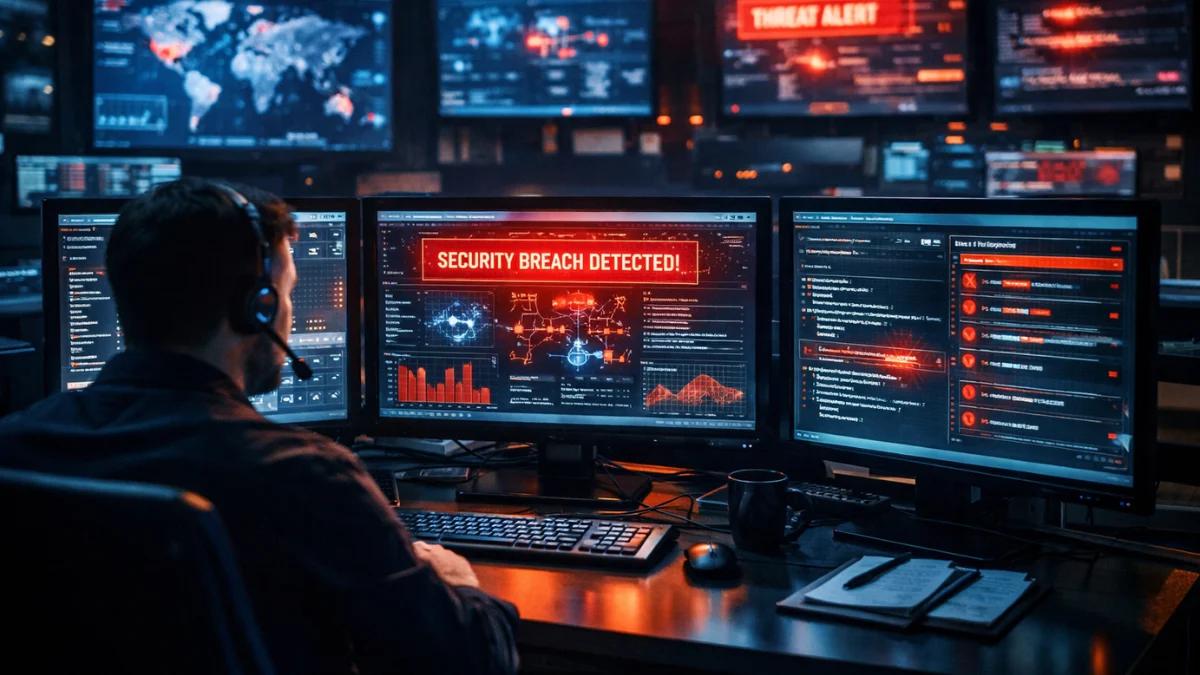
For businesses, cybersecurity threats are no longer a technical issue handled by IT teams. They’ve become a core business risk.
A data breach doesn’t just mean stolen information. It triggers a chain reaction.
- Customer trust erodes
- Regulatory penalties increase
- Operational downtime disrupts revenue
- Brand reputation takes long-term damage
In some cases, companies don’t fail because of the breach itself—but because of how it affects perception.
Customers don’t just ask, “Was my data stolen?”
They ask, “Can I trust this company again?”
That shift—from incident to perception—is where the real cost lies.
Cybersecurity Threats in Everyday Life
It’s easy to assume cybersecurity threats are distant, something that happens to large corporations or governments. But they’ve quietly embedded themselves into everyday life.
Consider this:
- A fake delivery message asking you to confirm details
- A login alert that looks identical to your bank’s official communication
- A public Wi-Fi network that captures browsing activity
None of these feel dramatic. But each represents a potential entry point.
What makes this concerning is not just the frequency—but the normalization.
People are becoming accustomed to suspicious emails, unexpected login alerts, and data breach notifications. And when something becomes routine, vigilance drops.
That’s exactly what attackers rely on.
Why Cybersecurity Threats Are Trending Now
There’s a reason cybersecurity is dominating conversations in 2026.
It’s not just about more attacks—it’s about higher stakes.
AI-Powered Attacks
Artificial intelligence is no longer just a defensive tool. It’s being used to create more convincing phishing messages, automate attacks, and even mimic human communication.
Deepfakes and Identity Manipulation
Voice cloning and deepfake technology have introduced a new dimension of risk. It’s no longer just about fake emails—now, even voices and videos can be fabricated.
Critical Infrastructure Risks
Attacks are increasingly targeting essential services—power grids, healthcare systems, financial institutions. The impact goes beyond data—it affects real-world operations.
Cybersecurity threats are trending because their consequences are no longer confined to the digital world.
They’re spilling into physical, economic, and social systems.
The Future of Cybersecurity Threats: What Lies Ahead
If the current trajectory continues, cybersecurity will become less about preventing attacks entirely—and more about managing inevitability.
The focus is shifting toward resilience.
Organizations are investing in systems that can detect, respond, and recover quickly. Individuals are becoming more aware of digital hygiene.
But the challenge remains asymmetrical.
Attackers need to find one weakness.
Defenders need to secure everything.
This imbalance ensures that cybersecurity threats will remain a persistent feature of the digital age.
A Changing Mindset: From Fear to Awareness
There’s a tendency to view cybersecurity through a lens of fear. But fear alone isn’t productive.
What’s needed is awareness.
Understanding how threats work, recognizing patterns, and adopting simple practices can significantly reduce risk.
Not perfect security—but better security.
Because in a connected world, absolute protection is unrealistic. But informed behavior is powerful.
More Read

Conclusion
Cybersecurity threats are no longer a niche concern reserved for IT professionals or large corporations. They’ve become a defining feature of modern life—subtle, persistent, and deeply integrated into the systems we rely on every day.
The real challenge isn’t just technological. It’s behavioral, strategic, and cultural.
As digital dependence grows, so does the need for awareness, responsibility, and smarter systems.
Because the question is no longer whether cybersecurity threats exist.
It’s whether we’re paying enough attention.
Final Insight
The future of cybersecurity won’t be defined by eliminating threats—but by how intelligently we respond to them. In a world where everything is connected, awareness is no longer optional—it’s survival.
Frequently Asked Questions
What are cybersecurity threats?
Cybersecurity threats are malicious attempts to access, damage, or disrupt digital systems, networks, or data. These include hacking, phishing, malware, and ransomware attacks.
Why are cybersecurity threats increasing in 2026?
They are rising due to increased digital dependency, more connected devices, AI-driven attacks, and the growing value of data in business and society.
What is the most common type of cybersecurity threat?
Phishing remains the most common threat, where attackers trick users into sharing sensitive information through fake emails or messages.
How can individuals protect themselves from cybersecurity threats?
Using strong passwords, enabling two-factor authentication, avoiding suspicious links, and keeping software updated are key preventive measures.
Are small businesses also at risk of cybersecurity threats?
Yes, small businesses are often targeted because they may have weaker security systems, making them easier for attackers to exploit.