It begins with something small.
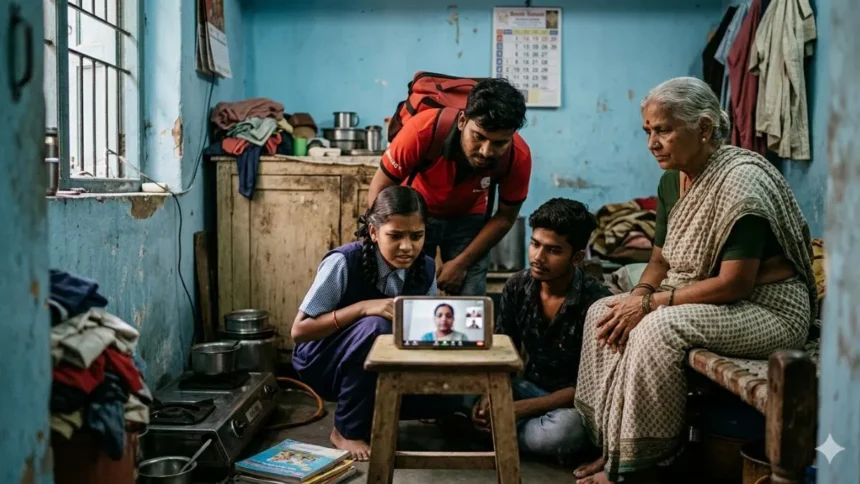
A student is sitting outside a closed shop late in the evening, not because the shop is open – but because the Wi-Fi still works. A delivery worker refreshes an app several times hoping that the network will be stable for just long enough before accepting the next order. Somewhere else, there is a family where there is only one smartphone; they pass it around like a resource that has to be rationed.
No one refers to this as a “digital divide” at that moment.
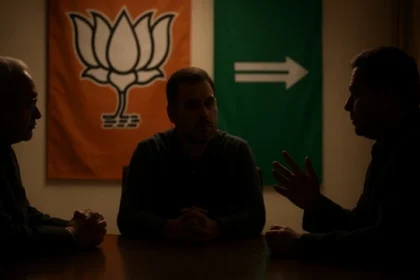
But this is precisely the gap Raghav Chadha About India’s Digital Divide has been drawing attention to – in ways that sometimes go beyond statistics, and into lived reality.

When discussions started building around Raghav Chadha About India’s Digital Divide, these were not solely about infrastructure. It was about access, activity, and a tacit inequality that is being deepened alongside India’s development of its digital applications.
On the surface, India is made to look more connected than ever. We are talking about Make In India Moment but where we are leading is a serious issue.
But that’s only part of the story.
The Context Behind Raghav Chadha About Indians Digital Divide
The transformation of India in the digital domain has been nothing short of extraordinary.
From low-cost data plans to the exploding use of smart phones, millions have been brought online over the past decade. Platforms have flourished. Payments have digitized. Services have gone app driven. The story is nowadays often a story of success and rightfully so.

But when Raghav Chadha discussed the digital divide in India he brought in a necessary counter-point.
And he focused on a very, very simple but powerful truth:
Access to the internet is no more a meaningful access to opportunity.

This distinction is important, more important than it sounds.
A person might have a smartphone, however if the connection is not solid and/or the device is outmoded and/or the information again limited, one’s digital experience is completely different from that of a person with seamless access.
And that difference compounds over time.
Raghav Chadha About India’s Digital Divide: What did he mean by digital divide?
When we examine Raghav Chadha About India’s Digital Divide in detail, it is not just about a technical argument – it is about a structural one.
He has stressed that India is not dealing with one divide, but up to multiple layers:
1. Access Divide
Who can get online–and who still can’t.
2. Quality Divide
Who gets high-speed internet – reliable internet – and who undergoes patchy connectivity.
3. Usage Divide
Who knows how to take advantage of the internet to grow – and who uses it only passively.
4. Outcome Divide
Who does and doesn’t benefit economically, educationally, or socially – who gets stuck.
What is more interesting is that these layers frequently overlap.
Also Read: Ayushman Bharat Scheme: India’s Quiet Health Revolution Under Scrutiny
A rural student may unpack the first barrier (basic access) but will still be restricted in terms of quality and usage. An urban worker could have good connectivity but not have the skills to convert it into economic mobility.
So the divide is not binary.
It’s deeply nuanced.
Why This Feels Like It Teaches a lot of things Invisible to Many People
There’s a reason why the issue is not on the table of daily discussion.
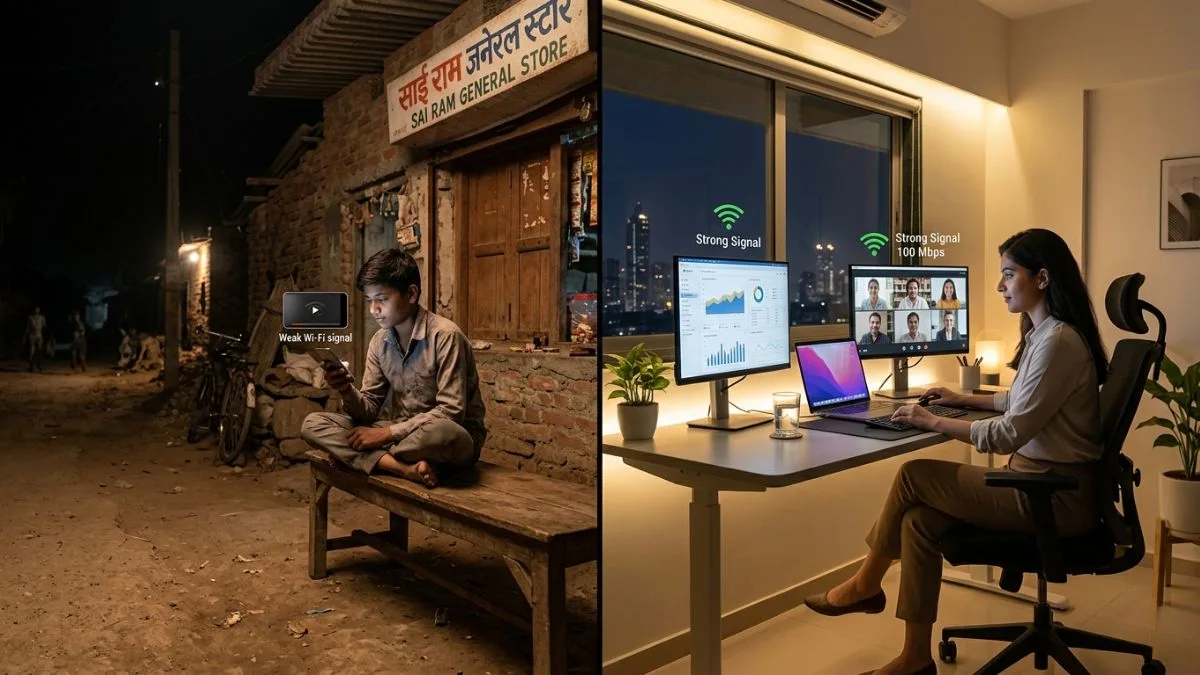
If you live in a well-connected world, the digital world is a breeze. Video calls load instantly. Payments happen in seconds. You can never go wrong when information is at your fingertips.
That experience is now taken as the default assumption.
But in much of India connectivity is still negotiated – moment by moment.
Persons move physically to gain better signals. They schedule tasks on the network based on when it is available online. They avoid data-heavy content, not from choice, but from necessity.
And since these experiences are localized, many times they do not make it into the mainstream narrative.
That’s where voices like Raghav Chadha play an important role – highlighting what is easy to miss otherwise.
The Gap Real Painfully Clear
Let’s get away from the theory for a moment.
Consider education.
During the pandemic, the concept of online learning came into play and became the norm. But to many students, “attending class” meant:
- Borrowing a Device from a Parent
- Log on to the internet on the shedding for better signal
- Skipping out of the lectures because of buffering
Now compare that to students who had:
- Personal laptops
- Stable broadband
- Access to recorded sessions & additional resources
Both groups were technically “online.”
But their results were woefully different.
Then there’s employment.
Gig work is dependent on apps for income. But erratic connectivity can mean:
- Missed job opportunities
- Delayed responses
- Lower ratings
In a system where algorithms love speed and consistency even small issues of connectivity then can have real financial consequences.
This is the sort of embedded multidimensional inequality in the digital economy.
The Psychological Aspect of the Digital Divide
This is the part that is rarely talked about – but it does matter.
When people have repeated friction in accessing digital tools, this forms behavior.
- They become cautious.
- They avoid experimenting.
- They adhere to simple patterns of usage.
Over time, this produces a subtle sort of exclusion – not based on policy, but experience.
Meanwhile, the ones with seamless access explore, learn, adapt and grow faster.
The gap goes broader not just in opportunity – but confidence.
And that’s much more difficult to measure.
Why This Shift Is Difficult to Detect at First
This is where the problem becomes more complicated.
Digital inequality doesn’t necessarily come in the guise of inequality.
There are no obvious markers.
Everyone seems to have a smart phone. Data is cheap. Apps are widespread.
So the assumption comes to be: The problem is solved.
But look closer.
The divide has moved from presence to performance.
It’s not a question of being online anymore, it’s a question of how effectively you can operate once you are there.
And this shift is subtle enough to not be noticed.
That’s exactly why timelines like Raghav Chadha About India’s Digital Divide are relevant to India right now – not from yesterday.
Because the nature of the problem has changed.
Raghav Chadha About Digital Divide in India and its Policy Implications
When policymakers do deal with this issue, the approach cannot be one-dimensional.
Building infrastructure is vital – but not good enough.
What’s needed is a multi-layered approach:
- Infrastructure Expansion
Better networks also in rural and semi-urban areas. - Device Accessibility
Capable and affordable ones — not just basic smart phones. - Digital Literacy
Training people to use digital to be productive, not merely to use it for consumption. - Platform Inclusivity
Apps and services for the low-bandwidth environment. - Economic Integration
Qualifying digital access means qualifying real income opportunities.
This is where the talk turns into action.
Because identifying the divide is only the first step.
Closing it requires between-sector coordination.
The Contribution of Private Sector and Start-ups
Interestingly, some of the most innovative solutions are emerging out of government systems.
Startups are:
- Building lightweight apps
- Providing for vernacular content
- Creating offline-first experiences
These innovations are based on a simple fact:
Not all users work in ideal conditions in the digital world.
And when companies have designed for constraints, they have often opened up completely new markets.
This is where the digital divide becomes an opportunity space.
Where the Idea Breaks Down
There should be an introduction of a reality check here.
Not every issue with the term “digital divide” falls into the narrative.
Sometimes access is there but engagement is not.
Some users will choose to limit digital interaction for the following reasons:
- Trust issues
- Privacy concerns
- Cultural preferences
So the divide is not always enforced – it can also be selective.
This nuance matters.
Because solutions have to distinguish between lack of access and lack of adoption.
Treating both as alike leads to ineffective policy.
A Closer Look at Long-Term Impact
Left unattended, the digital divide has the potential to alter the structure of the economy and society in subtle ways.
Education Gap
Students with increased digital access get compounding advantages.
Income Inequality
Digital platforms: reward those that can engage consistently.
Information Asymmetry
Access to knowledge is facilitated, or hindered.
Regional Imbalance
The cities increase at a faster rate than the countryside.
With time, these gaps strengthen each other.
And since they build gradually, they seldom cause immediate alarm.
The Future Direction: What Is Bait to Change
Looking into the future, the discourse surrounding Raghav Chadha About India’s Digital Divide will most likely change.
The focus will shift toward:
- Quality metrics, and not just coverage
- Other User Capability B other (and possibly or only if in addition) User Capability – User function NOT just access
- Outcome measurement, rather than usage statistics
This is a more mature stage of digital policy.
One that acknowledges complexity not simplifying this complexity.
An Unwavering, yet Less Important Perspective Shift
This is a thought that is worth thinking about.
The goal is not just connecting people to the internet.
The idea is to make sure that the internet works for them.
That is a distinction that changes everything.
Because connectivity is not enough to create opportunity – effective connectivity is.
And that is in need of never-ending refinement.
Closing Reflection
The digital divide in India is no longer a gap, at least not obviously, waiting to be filled.
It’s a changing landscape-a changing landscape that evolves as technology improves.
What Raghav Chadha has done is bring attention to this evolution and gayatri chakravort achieve that, from the a to the m, things don’t necessarily progressive, that things don’t necessarily get better right away for all of us.
And also perhaps the most significant takeaway is this:
The next phase of the digital development of India will not be measured by the number of people on the internet – but the number that truly can participate.
That’s a harder challenge.
But also a much more meaningful one.
More Read

Stay Ahead with The Vue Times
If this blog about Raghav Chadha About India’s Digital Divide elicited some innovative thinking, you can consider there’s a lot extra getting beyond this piece.
At The Vue Times, the emphasis is much more than just headlines. Each story is intended to reveal patterns, explain changes and link together ideas that are often undetected in regular news cycles.
What you can expect:
- Insight driven analysis on emerging national & global issues
- Human-centered explanations for complex topics
- Stories that go beyond “what happened” to explore “why it matters”
If you prefer clarity (as opposed to noise), and depth (as opposed to pace), then this is where you stay informed.
Explore more. Think deeper. Surpass the competition — only with The Vue Times.
General Commonly Asked Questions
1. What did Raghav Chadha say about the Digital divide in India?
Raghav Chadha emphasized on the fact that the digital divide in India is not solely an issue of internet access but also a matter of quality, usage, and outcomes. He stressed that in order to be truly inclusive, digital inclusion in technology does not mean simply access, but meaningful access.
2. Why does the India Digital Divide exist even when you have cheap internet?
Affordable data has led to greater access but challenges such as poor connectivity, lack of digital skills, and limited device capabilities still exist and are creating an imbalance of how people are benefiting from internet access.
3. What is the impact on students in India because of the digital divide?
Students with limited internet access or with shared devices experience difficulty in attending classes, accessing resources, and competing equivalently with the students having better digital infrastructure.
4. What are the main types of Digital divide in India?
The main types of key are access divide, quality divide, usage divide, and outcome divide. Each layer has an impact on how people interact with and benefit from digital technology.
5. How can India reduce the digital divide?
Solutions include bad internet infrastructure, making the devices affordable, digital literacy and ensuring platforms are accessible in even low bandwidth environments.
6. Is the digital divide a rural problem in India only?
No, although rural areas are a particular source of difficulty, urban populations also lack digital equality and in particular in terms of skills, quality of devices and effective use.
7. Why Is Digital Literacy Important to Bridge the Divide?
Digital literacy makes people productive users of the internet – for education, jobs and business rather than simply passive consumers, so digital literacy is a crucial factor in decreasing inequality.