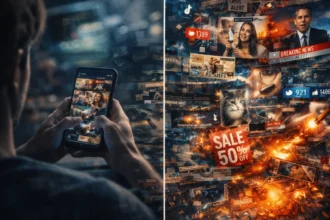

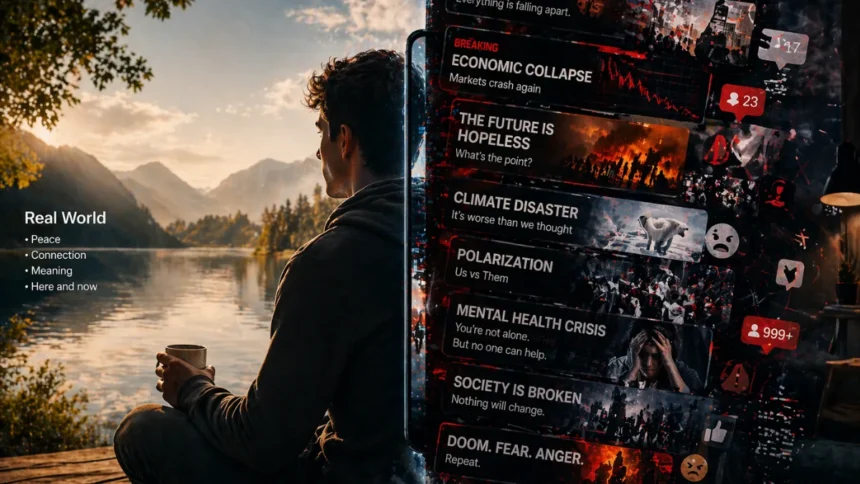
There’s a familiar rhythm to late-night scrolling now. A few harmless memes, a trending video, and then—almost abruptly—the tone shifts. Headlines turn darker. Tweets grow sharper. Comment sections spiral into cynicism. By the time you put your phone down, the world feels slightly worse than it did an hour ago.
Not because something changed overnight—but because of how it was presented.
This is the ecosystem where Doomposting thrives.
What Doomposting Really Means
At its simplest, Doomposting is the act of sharing excessively negative, pessimistic, or catastrophic content online—often framed as inevitable or beyond control. It’s not just reporting bad news. It’s amplifying a sense that everything is spiraling downward, with little room for nuance or recovery.
Unlike traditional pessimism, Doomposting carries a certain tone—half-resigned, half-performative. It doesn’t always aim to inform. Sometimes, it exists to resonate emotionally, to validate a shared sense of dread.
And that’s precisely why it spreads so easily.
From Doomscrolling to Doomposting: A Subtle Shift
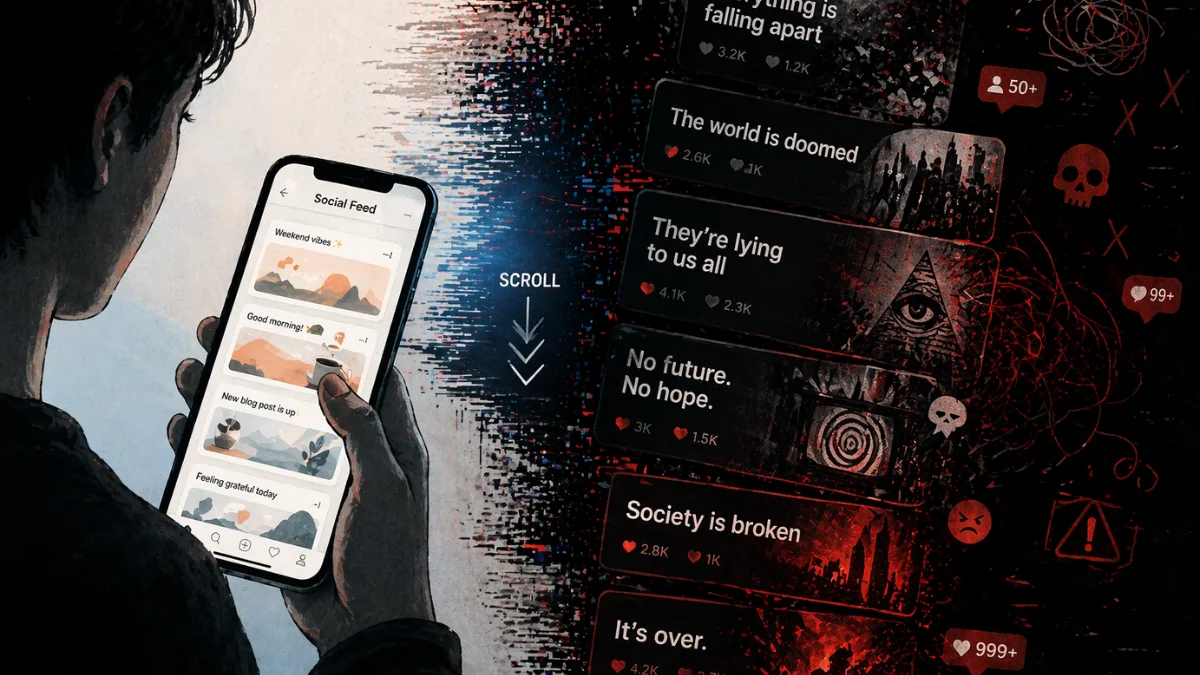
For years, people talked about “doomscrolling”—the passive consumption of negative news. But Doomposting marks a transition from consumer to participant.
You’re no longer just reading about crises. You’re sharing them, commenting on them, reshaping them through your own lens.
A student posts about job market collapse. A professional tweets about burnout and economic instability. A meme page jokes about climate anxiety with dark humor. Each post, individually, may feel justified. Together, they create an overwhelming narrative: things aren’t just bad—they’re getting worse, and there’s nothing you can do about it.
That narrative sticks.
Why Doomposting Feels So Natural
Part of Doomposting’s power lies in psychology. Humans are wired with what researchers call a negativity bias—the tendency to pay more attention to negative information than positive.
Bad news feels urgent. It demands attention. It triggers emotion.
Social media platforms amplify this bias. Content that provokes strong reactions—anger, fear, frustration—tends to get more engagement. More engagement means more visibility. And visibility shapes perception.
So even if the world is a mix of progress and problems, your feed might suggest a very different reality.
Doomposting doesn’t distort facts as much as it distorts proportion.
The Algorithm Isn’t Neutral
It’s tempting to blame users for spreading negativity, but the infrastructure matters just as much. Platforms are designed to maximize attention, not emotional balance.
A hopeful post about incremental change rarely competes with a sharply worded take predicting collapse. One is reassuring. The other is gripping.
And attention, in the digital economy, is currency.
This creates a feedback loop:
- Negative content gets engagement
- Engagement boosts visibility
- Visibility normalizes pessimism
Over time, Doomposting stops feeling like an outlier. It becomes the baseline tone.
When Humor Turns Heavy
Interestingly, not all Doomposting is serious on the surface. A large portion is wrapped in humor—memes, ironic captions, exaggerated despair.
“Nothing matters.”
“We’re all doomed anyway.”
“Just waiting for everything to collapse.”
On the surface, it reads as satire. But repeated exposure blurs the line between joke and belief.
Humor becomes a coping mechanism—but also a delivery system.
It allows difficult emotions to circulate without resistance. You laugh, share, move on. But the underlying message lingers.
The Emotional Cost of Doomposting
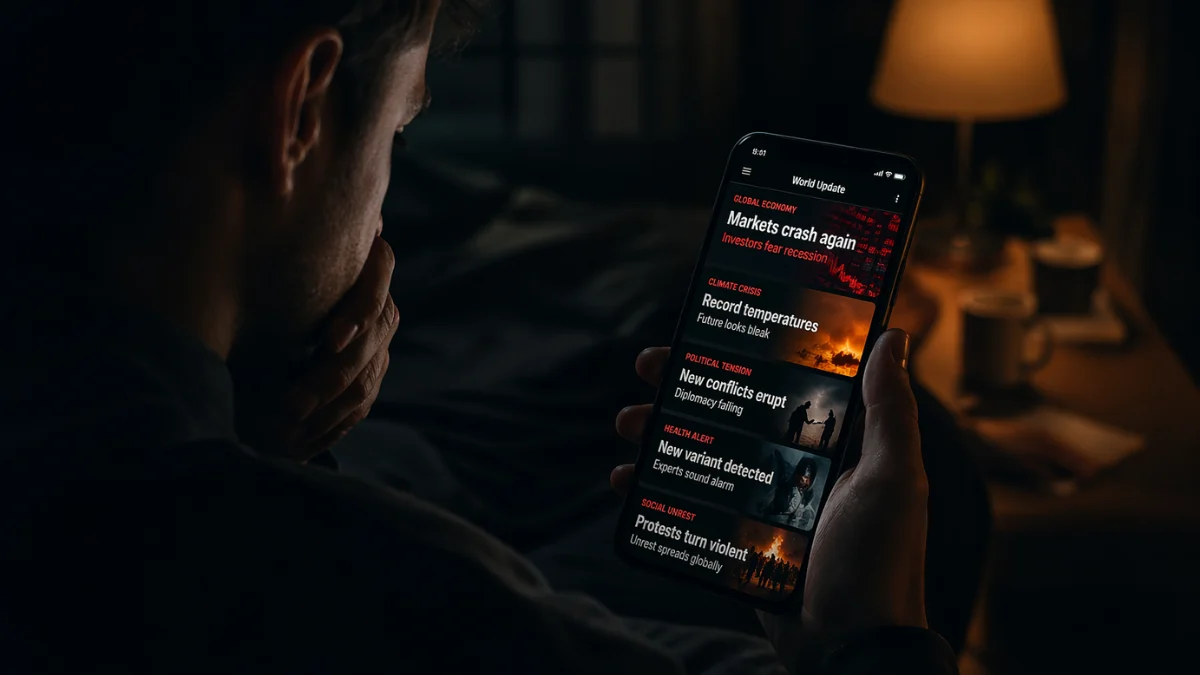
Spending time in a Doomposting-heavy environment doesn’t just inform you—it shapes your internal state.
People often report:
- Increased anxiety about the future
- Reduced motivation to act or plan
- A sense of helplessness or fatigue
This is where Doomposting becomes more than a trend. It becomes an emotional climate.
If every major issue is framed as unsolvable, action starts to feel pointless. Why try if the outcome is already decided?
That quiet shift—from concern to resignation—is one of the most significant effects.
Why It’s Trending Now
Doomposting isn’t new, but its intensity has increased in recent years. Several factors are converging:
Information Overload
There’s more access to global news than ever before. Crises that once felt distant now appear in real time.
Economic Uncertainty
Job insecurity, rising costs, and changing career landscapes create fertile ground for pessimistic narratives.
Climate Anxiety
Environmental concerns are no longer abstract. They feel immediate and personal, especially to younger audiences.
Digital Fatigue
After years of constant online engagement, many users feel overwhelmed—and that exhaustion often expresses itself as cynicism.
Doomposting, in this context, isn’t random. It reflects genuine anxieties—but presents them in a compressed, amplified form.
The Business Angle No One Talks About
There’s also an uncomfortable truth: negativity performs well.
Media outlets, influencers, and even independent creators quickly learn what gets clicks. A headline suggesting crisis will often outperform one suggesting stability.
This doesn’t mean everything is manipulated—but it does mean incentives are skewed.
Over time, the line between awareness and amplification becomes blurred. Are we informing audiences—or feeding an algorithm that rewards intensity?
Doomposting sits right at that intersection.
Is Doomposting Entirely Bad?
Not necessarily.
At its best, it can:
- Draw attention to overlooked issues
- Create shared awareness
- Push conversations into mainstream spaces
But the problem arises when it lacks balance. When complexity is reduced to inevitability. When problems are highlighted without any discussion of solutions, progress, or context.
Awareness without agency can quickly turn into apathy.
What Comes Next
The trajectory of Doomposting depends on how both users and platforms evolve.
There’s already a subtle shift emerging—people becoming more aware of how content affects their mental state. Some are curating feeds more intentionally. Others are seeking out balanced perspectives.
Platforms, too, are under increasing scrutiny. Questions around ethical algorithm design, digital well-being, and responsible content amplification are no longer niche—they’re central.
But change is slow.
For now, Doomposting remains a defining tone of the internet—one that reflects real concerns, but often magnifies them beyond proportion.
More Read

Conclusion
Doomposting isn’t just about negativity—it’s about narrative control.
When enough people share the same pessimistic outlook, it starts to feel like reality rather than perception. And once that shift happens, it influences how we think, act, and plan for the future.
The challenge isn’t to ignore problems. It’s to resist the idea that they are already beyond repair.
Because the moment we accept that, the outcome becomes less uncertain—and more self-fulfilling.
Final Insight
At The Vue Times, we believe the internet doesn’t just reflect reality—it shapes it. Doomposting may capture the mood of the moment, but it shouldn’t define the limits of possibility. The real conversation lies in understanding the problem without surrendering to it.
Frequently Asked Questions
What is Doomposting?
Doomposting refers to sharing overly negative or pessimistic content online, often presenting problems as inevitable or unsolvable.
How is Doomposting different from doomscrolling?
Doomscrolling is passively consuming negative content, while Doomposting involves actively sharing and amplifying it.
Why does Doomposting spread so quickly?
Negative content triggers strong emotional reactions, which leads to higher engagement and visibility on social media platforms.
Is Doomposting harmful to mental health?
Yes, repeated exposure can increase anxiety, stress, and feelings of helplessness, especially when content lacks balance or solutions.
Can Doomposting ever be useful?
It can raise awareness about serious issues, but it becomes problematic when it promotes hopelessness without context or constructive discussion.