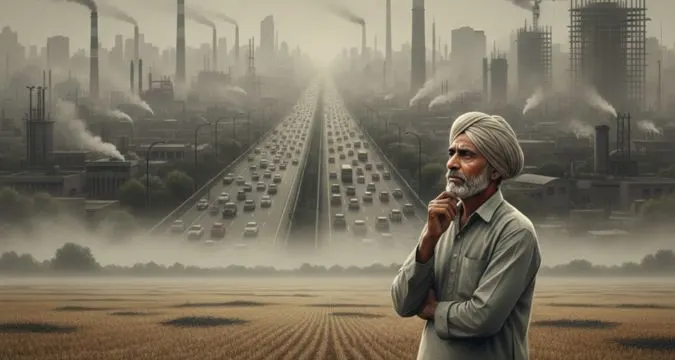
Every year, as winter approaches North India, a familiar narrative dominates news headlines, social media debates, and classroom discussions. Thick smog blankets cities like Delhi, visibility drops, flights are delayed, schools close, and health advisories are issued. Almost immediately, fingers point in one direction: stubble burning.
But is stubble burning really the sole villain behind North India’s smog? Or has the issue been simplified to the point where deeper, more uncomfortable truths are being ignored?
This article aims to answer the questions that naturally arise in people’s minds. It also serves as a clear, conceptually strong resource for students who want to understand the issue beyond slogans and surface-level explanations. Written in simple language, this is a myth versus reality exploration of one of India’s most debated environmental challenges.
Understanding Smog: The Basics
Before discussing stubble burning, it is important to understand what smog actually is.

Smog is not just smoke. It is a complex mixture of air pollutants, including particulate matter, gases, and chemical compounds that react with each other under specific weather conditions. In North India, winter smog is primarily a mix of:
- Fine particulate matter, especially PM2.5
• Nitrogen oxides from vehicles and industries
• Sulphur dioxide from coal-based power plants
• Carbon monoxide
• Ammonia from fertilizers and waste
• Smoke particles from burning activities
Smog becomes severe when these pollutants get trapped close to the ground due to low wind speed, temperature inversion, and high moisture in the air.
This means smog is not created by a single source. It is the result of multiple emissions interacting with unfavourable weather conditions.
What Is Stubble Burning?
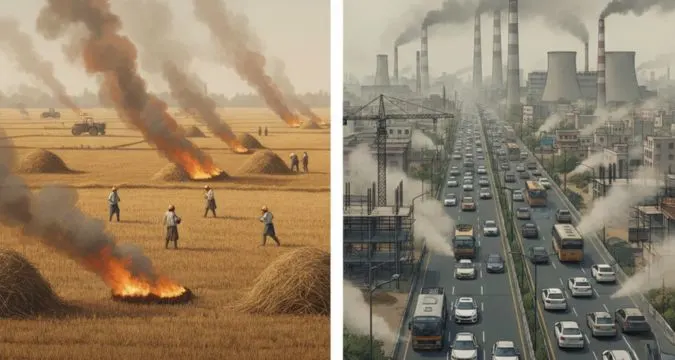
Stubble burning refers to the practice of setting fire to crop residue left on fields after harvesting, mainly rice and wheat. Farmers burn stubble to quickly clear fields for the next crop, especially when time, labour, and machinery are limited.
In states like Punjab, Haryana, and western Uttar Pradesh, rice harvesting ends around October and November. Farmers have a narrow window before wheat sowing begins. Burning the leftover stubble is often seen as the fastest and cheapest option.

From a scientific perspective, stubble burning releases:
- PM2.5 and PM10
• Carbon monoxide
• Methane
• Volatile organic compounds
• Black carbon
These emissions undeniably contribute to air pollution.
The Popular Myth: Stubble Burning Is the Only Cause of Smog
One of the most widespread beliefs is that stubble burning alone causes Delhi and North India’s smog. This narrative is repeated so often that it has almost become accepted as fact.

Let us examine why this belief exists.
Satellite images during October and November clearly show fire spots in agricultural regions. At the same time, pollution levels in Delhi spike. The timing appears to match, making it easy to assume a direct and exclusive link.
However, correlation does not always mean complete causation.
Reality Check: How Much Does Stubble Burning Actually Contribute?
Scientific studies, including those by government agencies and independent research institutions, show that stubble burning is a contributor, but not the sole or even dominant source throughout the smog season.
On peak burning days, stubble burning can contribute between 10 percent and 40 percent of PM2.5 levels in Delhi, depending on wind direction and weather conditions. This contribution is significant but temporary.
On many severe smog days, especially in December and January, stubble burning contribution drops sharply, while pollution levels remain dangerously high.
This raises an important question for students and citizens alike.
If stubble burning stops after November, why does smog persist?

Major Contributors Often Ignored in the Debate
Vehicular Emissions
Delhi has one of the highest vehicle densities in the world. Cars, trucks, buses, two-wheelers, and diesel-powered commercial vehicles emit nitrogen oxides, carbon monoxide, and fine particles daily.
Traffic congestion, old vehicle fleets, and inadequate public transport amplify this air pollution problem. Even when stubble burning is minimal, vehicle emissions continue unabated.
For students, this highlights an important concept: continuous sources often outweigh seasonal ones.
Construction Dust
Rapid urbanisation has turned Delhi and surrounding regions into constant construction zones. Dust from construction sites, unpaved roads, and demolition activities contributes heavily to PM10 and PM2.5 levels.
Unlike stubble burning, construction dust is a year-round problem.
Industrial and Power Plant Emissions
Coal-based power plants, brick kilns, and small-scale industries release sulphur dioxide, nitrogen oxides, and particulate matter. Many units operate with outdated pollution control technologies.
These emissions do not pause during winter. In fact, increased electricity demand often leads to higher emissions.
Biomass Burning Within Cities
Burning of wood, coal, garbage, and even cow dung for heating and cooking becomes more common during winter. These local sources contribute significantly to neighbourhood-level pollution.
This is an often overlooked reality that challenges the idea that pollution only comes from outside the city.
Role of Weather: The Silent Amplifier
Weather plays a critical role in turning pollution into smog.
During winter, North India experiences temperature inversion. Cold air near the ground gets trapped under a layer of warmer air above it. This prevents pollutants from dispersing upward.
Low wind speeds mean pollutants accumulate rather than move away. High humidity causes particles to grow larger, making smog denser and more visible.
Students should understand that emissions create pollution, but weather determines how severe it becomes.
Why Farmers Become Easy Targets
Blaming stubble burning offers a simple narrative with a visible culprit. Farmers burning fields are easy to photograph and criticise.
However, this approach ignores the systemic pressures farmers face:
- High cost of residue management machines
• Lack of affordable alternatives
• Tight cropping cycles
• Limited financial incentives
For many farmers, stubble burning is not a choice made lightly. It is often a decision made under economic and time constraints.
Does Banning Stubble Burning Solve the Smog Problem?
Bans alone have repeatedly failed this Smog problem.
Despite legal prohibitions and fines, stubble burning continues because enforcement does not address root causes. Even in years when burning incidents reduce, smog still occurs.
This proves an important lesson for students.
Environmental problems cannot be solved through bans alone. Structural solutions are required.
Real Solutions: Looking Beyond Myths
Supporting Farmers
Providing affordable machinery, subsidies, and crop diversification options can reduce stubble burning more effectively than punishment.
Urban Emission Control
Stricter vehicle emission norms, better public transport, promotion of electric mobility, and phasing out old vehicles are essential.
Construction Regulation
Dust control measures, green barriers, and strict enforcement at construction sites can significantly reduce particulate pollution.
Clean Energy Transition
Reducing dependence on coal and promoting renewable energy directly lowers industrial emissions.
Why the Myth Persists
The stubble burning narrative persists because it shifts responsibility away from urban lifestyles, policy failures, and governance challenges.
It is easier to blame seasonal rural activity than to confront structural urban pollution sources.
This insight is particularly valuable for students studying environmental policy, civics, and economics.
Myth vs Reality Summary
Myth: Stubble burning alone causes North India’s smog.
Reality: Stubble burning is one contributor among many, and its impact is seasonal and variable.
Myth: Stopping farmers will solve Delhi’s pollution crisis.
Reality: Smog will persist unless vehicular, industrial, construction, and urban biomass emissions are addressed.

Why This Understanding Matters
Oversimplifying complex environmental problems leads to ineffective solutions and social division. A balanced understanding encourages cooperation between rural and urban stakeholders.
For students, this topic is a living example of how science, society, economy, and governance intersect.

Final Thoughts
Stubble burning is neither a harmless practice nor the single cause of smog. Treating it as the sole villain distracts from deeper systemic failures.
The real solution lies in acknowledging complexity, sharing responsibility, and implementing long-term reforms across agriculture, transport, energy, and urban planning.
Clean air is not the responsibility of farmers alone. It is a collective outcome shaped by daily choices, policy priorities, and political will.
When myths are replaced with facts, solutions become clearer. Only then can North India hope to breathe easier in the winters to come.