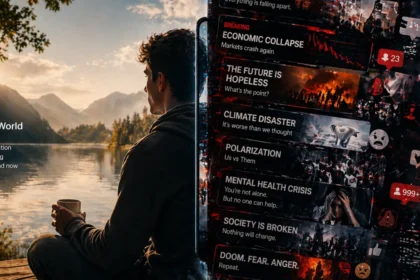
The phrase usually arrives mid-scroll.
A creator posts a 40-part thread about a TV finale. Someone else turns a minor disagreement into a blood feud. A stranger writes 900 words under a joke tweet with the intensity of a constitutional lawyer. Then, almost inevitably, a reply appears: touch grass.
It is dismissive, funny, rude, and, at times, weirdly accurate. What began as a blunt internet taunt has evolved into something larger than slang. Touch Grass now works as a shorthand critique of digital excess — too much screen time, too much outrage, too much identity wrapped around online performance. It is the language of a culture that knows it is chronically online and is not entirely proud of it.
That is part of what makes the phrase so durable. It sounds unserious, but it points to a serious tension at the center of modern life: we live through screens, but we do not fully trust what too much screen-life does to us.

What “Touch Grass” Really Means
At face value, the phrase is simple. It tells someone to go outside, reconnect with the physical world, and regain perspective. But that literal meaning only explains part of its power.
Online, Touch Grass usually means: you are too emotionally invested, too detached from ordinary life, or too deep inside a digital feedback loop to see clearly. It can be aimed at anyone — fandom warriors, conspiracy posters, overzealous debaters, or people turning niche online disputes into existential struggles.
The phrase works because it is visual. It does not say “log off temporarily and recalibrate your relationship with mediated reality.” It says: go stand on the ground. Feel something real. Breathe air that has not passed through an algorithm first.
That contrast matters. The internet is abstract, frictionless, endless. Grass is ordinary, physical, and stubbornly offline. One is optimized for attention. The other does not care whether you are trending.

The Rise of a Phrase That Captured a Mood
Internet slang often burns bright and disappears. Touch Grass lasted because it arrived at exactly the right cultural moment. It spread in an era shaped by lockdown habits, hyper-online work culture, always-on news cycles, and social platforms that reward maximum reaction. People were spending more time online than ever, often for reasons that felt unavoidable. Work happened there. Social life happened there. Politics, entertainment, shopping, friendships, identity-building — all of it converged on the same glowing rectangle.

Naturally, language evolved to describe the consequences.
“Touch grass” became a compact way to call out digital overreach. It could be used jokingly among friends, but it also carried a broader social critique. A lot of online behavior, the phrase implied, is not just excessive; it is subtly unreal. It distorts scale. A minor disagreement starts to feel historic. A niche subculture mistake becomes a moral emergency. A person with a ring light and a strong opinion can become a temporary authority on almost anything.
The phrase spread because many users recognized themselves in it, even when it was aimed at someone else.

Why “Touch Grass” Resonates So Strongly
There is a reason the insult lands harder than older internet commands like “calm down” or “get a life.” Touch Grass does not just accuse someone of being wrong. It accuses them of being disconnected.
That distinction is important. Most people already sense that prolonged online immersion changes how they think and feel. It can sharpen anxiety, flatten nuance, and create the illusion that attention equals importance. The brain adapts quickly to environments built around novelty, conflict, and instant validation. After a while, the online world starts to feel more urgent than the physical one, even when the stakes are lower.
This is where the phrase gets uncomfortably insightful. It points to the psychological cost of being constantly mediated. Not every screen habit is unhealthy, of course, and not every intense online conversation is pointless. But there is a recognizable shift that happens when a person spends too long inside digital loops. Reactions become faster, identities become more performative, and disagreement starts to feel less like conversation and more like combat.
Telling someone to touch grass is a crude way of saying: your sense of proportion may be slipping.
A Joke, an Insult, and a Wellness Signal
Part of the phrase’s success lies in its flexibility. It can function as mockery, but it can also sound like advice. Sometimes it is harsh. Sometimes it is affectionate. Friends use it on each other after an absurdly long gaming session or a needlessly intense argument about football transfers, Marvel timelines, or celebrity drama.
That ambiguity keeps the phrase alive. It belongs to meme culture, but it also overlaps with the broader wellness vocabulary that now saturates public life. People speak more openly than they once did about burnout, digital fatigue, doomscrolling, overstimulation, and the need for boundaries. “Touch grass” is what happens when self-care language gets stripped of softness and thrown into internet combat.
That is why the phrase can feel both shallow and profound. On one level, it is a meme. On another, it captures a real desire for reconnection — not just with nature, but with scale, texture, silence, and unperformed life.
The Business of Keeping People from Touching Grass
There is also a structural reason the phrase matters: the modern internet is not neutral. Major platforms are designed to hold attention, extend session time, and encourage repeat engagement. The more activated users feel, the better those systems often perform. Anger travels. Anxiety lingers. Identity-driven content sticks.
That makes Touch Grass more than a personal lifestyle suggestion. It becomes a small rebellion against a business model.
The point is not that technology companies are forcing every bad habit on unwilling users. People participate willingly, even enthusiastically. But it would be naive to ignore how digital environments shape behavior. If a platform constantly rewards outrage, certainty, and visibility, users eventually absorb those incentives. The result is a culture where taking a walk can feel oddly radical because it interrupts the machine.
Seen this way, “touch grass” is a folk critique of the attention economy. It names a problem without using academic language. It suggests that some online intensity is not just embarrassing; it is engineered.

When the Phrase Misses the Mark
Still, the expression is not always wise. Like many internet catchphrases, it can flatten complexity.
Sometimes people are deeply invested online because online spaces are where real communities exist. For freelancers, remote workers, activists, niche hobbyists, gamers, diaspora communities, and marginalized groups, the internet is not a fake world; it is part of real life. Dismissing someone with “touch grass” can become a lazy way to avoid engaging with serious arguments or genuine concern.
There is also a smugness built into the phrase. It lets the speaker pretend they are above the chaos even while participating in it. After all, the person saying “touch grass” is also online, also commenting, also inside the same ecosystem. It is the classic digital move: perform detachment publicly while remaining fully plugged in.
That hypocrisy is part of the joke, but it is also part of the truth. Nearly everyone is negotiating the same problem. Some are simply better at disguising it.
Why Touch Grass Is Bigger Than a Meme
What makes the phrase worth examining is not its comedic value alone. It captures a deeper cultural realization: many people no longer believe constant connectivity is automatically good. The old optimism of the social media era — more sharing, more posting, more engagement, more access — has cooled. In its place is a messier, more skeptical mood.
People still want connection. They still want information, entertainment, and community. But they are also more aware of the tax these systems impose. Exhaustion is no longer an accidental side effect of digital life; it is one of its defining conditions.
That helps explain why analog habits have regained symbolic weight. Walking without headphones. Reading physical books. Gardening. Running. Cooking without filming it. Leaving the phone in another room. None of these things are revolutionary. Yet they now carry a faint aura of resistance, as if ordinary offline life has become a countercultural act.
In that environment, Touch Grass stops being only an insult. It becomes a compressed philosophy.
Where the Phrase Goes Next
Like all internet language, this phrase may eventually fade, mutate, or get replaced by something newer and sharper. But the sentiment behind it is likely to outlast the wording. The pressure of digital saturation is not disappearing. If anything, it is intensifying as feeds become more personalized, media becomes more immersive, and online identity becomes more economically valuable.
That means the pushback will continue too. The future of digital culture will not be defined simply by who stays online the longest. It may be shaped by who learns to step away without disappearing, who can use the internet without being fully absorbed by it, and who can tell the difference between participation and captivity.
That is the hidden seriousness inside the joke. “Touch grass” sounds like a throwaway insult, but it reflects a growing hunger for reality that does not need to be posted to count. In a culture trained to react instantly and publicly, the ability to leave the feed, recover perspective, and return on your own terms may be one of the few forms of freedom that still feels genuinely modern.
More Read

Conclusion
Touch Grass endures because it says something many people already suspect: being online too much does not just consume time, it can distort judgment, emotion, and scale. The phrase may be flippant, but the condition it points to is real. A world mediated by screens still leaves people craving texture, distance, and ordinary physical life. That tension is not going away. It is becoming one of the defining stories of digital culture.
Final Insight
At The Vue Times, we track the ideas, phrases, and digital shifts shaping how people think, work, and live. If internet culture is changing the way society behaves, it is worth looking past the meme and asking what it reveals.
Frequently Asked Questions
- What does Touch Grass mean?
Touch Grass is an internet phrase used to tell someone they are too absorbed in online life and need to step back, go outside, and regain perspective. - Why is Touch Grass so popular online?
It became popular because it captures a common frustration with extreme online behavior, especially during a time when people were spending more of their lives on screens. - Is Touch Grass always an insult?
Not always. It can be sarcastic or dismissive, but it is also often used humorously among friends to suggest someone needs a break from the internet. - Where did the phrase Touch Grass come from?
The phrase emerged from internet slang culture and gained traction on social media as a quick, visual way to criticize overly intense online behavior. - Why does Touch Grass matter beyond meme culture?
It reflects a broader concern about digital overload, attention-driven platforms, and the psychological effects of spending too much time in online spaces.