There was a time when students carried highlighters like survival kits. Notes stacked up. Browser tabs multiplied. Group chats turned into panic rooms the night before exams.
Now the atmosphere looks different. A student preparing for a government exam in Delhi might summarize an entire policy report using AI before breakfast. An engineering student in Bengaluru can generate practice quizzes in seconds. A medical aspirant revises anatomy through AI-powered visual explanations instead of static textbooks.
Something fundamental has shifted in the relationship between students and information.
The rise of AI tools in education is no longer experimental. It’s becoming infrastructure. Quietly, rapidly, and in ways many schools still haven’t fully processed.

And that’s why the conversation around Jobs & Education is changing so quickly. The real question is no longer whether students should use AI tools. The better question is whether students understand how to use them intelligently.
Because there’s a massive difference between learning with AI and outsourcing thinking to AI.
Why AI Tools Suddenly Matter So Much in Jobs & Education
AI tools became incredibly popular with students for a straightforward reason: education itself has become overwhelming.
Today’s students aren’t just focused on their subjects. They’re constantly dealing with information overload, notifications, online classes, recorded lectures, PDFs, competitive exams, skill certifications, internship pressure, LinkedIn pressure, and placement pressure.
At the same time, the job market is changing much faster than traditional educational systems can keep up.

Students increasingly feel like they’re preparing for industries that don’t even fully exist yet.
This uncertainty is precisely why AI tools entered the scene.
At first, students used AI casually for things like quick answers, summaries, and grammar checks. But by 2026, these tools have developed into personalized study systems. They can explain difficult concepts in different ways, catering to a student’s individual learning style. They can simulate interviews, create practice tests, and translate complex academic language into simpler terms.

For many students, AI now acts less like a search engine and more like an tireless study partner.
The Smartest Students Aren’t Using AI the Way Most People Think
It’s often assumed that students primarily use AI to “get homework done faster.” While that does happen, a more significant change is occurring among dedicated learners.
Top students are increasingly turning to AI to enhance the structure of their work, rather than to avoid putting in the effort.
For instance, a law student might use AI to compare judicial decisions across various cases. Someone preparing for the UPSC exam could ask an AI tool to generate counterarguments for an essay topic. Business students might use it to distill complex economic theories into relatable, practical examples.
The benefit here isn’t about laziness; it’s about efficiency.
AI effectively bridges the gap between confusion and understanding.
In highly competitive academic environments, speed is crucial. Students who can organize information more quickly often find they have more time available for in-depth analysis and critical thinking.
This is precisely why discussions about the future of jobs and education now recognize AI literacy as a genuine skill, rather than merely a passing technological fad.
AI Tools Are Changing the Way Students Take Notes
Here’s a look at one of the most significant shifts occurring in how we take notes.
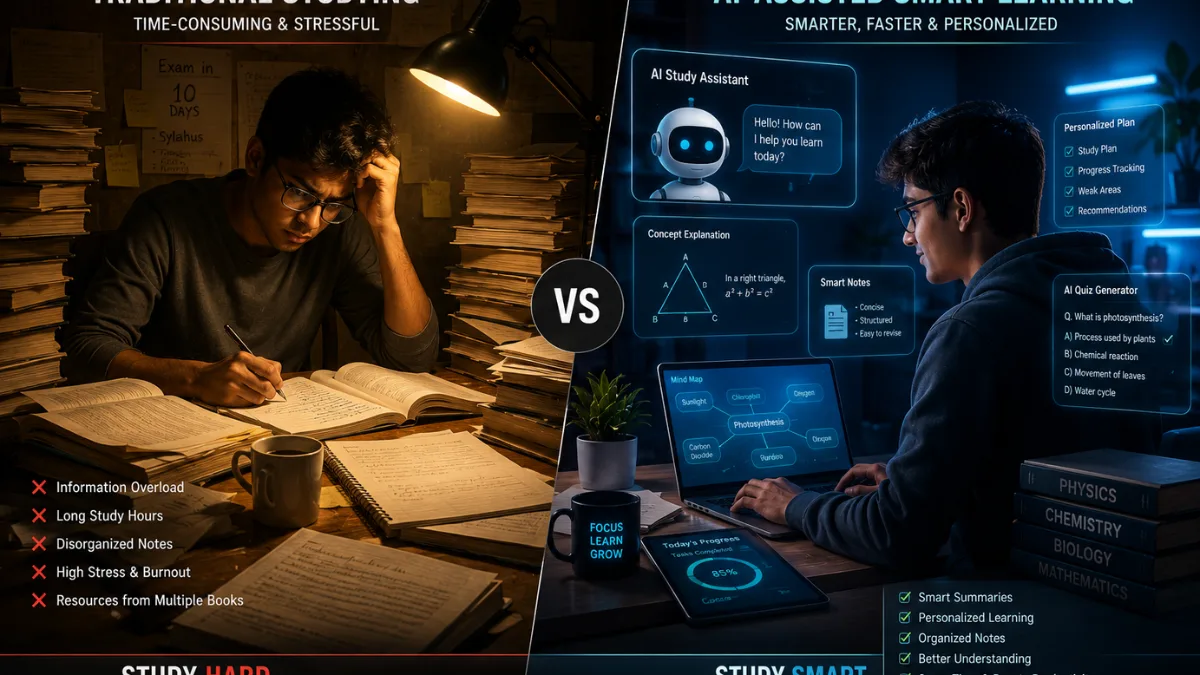
Historically, note-taking was mostly about manual repetition. Students would write things down to help them remember. However, contemporary AI tools are transforming this practice into a more interactive experience.
Nowadays, students can upload lecture transcripts and use them to create:
* Concise summaries
* Flashcards
* Revision sheets
* Timeline breakdowns
* Question-and-answer formats
Some tools even pinpoint potential exam questions by highlighting frequently discussed concepts.
While this doesn’t inherently boost intelligence, it certainly makes studying more efficient.
The significant risk, though, lies in passive consumption.
When students merely read AI-generated summaries instead of grappling with the material themselves, their retention suffers. Forming memories still requires cognitive effort. Struggling is an integral part of the learning process.
AI can speed up comprehension, but it can’t entirely substitute for active mental engagement.
This distinction is more crucial than most students might understand.
The Rise of Personalized Learning in Jobs & Education
AI tools feel so potent, partly because traditional classrooms have never really been personalized.
Imagine a single teacher trying to manage forty or even a hundred students, all expected to learn at the same speed, despite their diverse learning styles and paces. The quick learners often end up bored, while those who need more time risk falling behind.
AI completely shifts this dynamic.
If a student is struggling with calculus, for instance, they can ask for:
* A simpler explanation
* A visual approach
* A real-life analogy
* Detailed, step-by-step breakdowns
* Examples designed for beginners
And the AI system can provide this instantly, adapting to the student’s needs.
This is one of the most significant transformations currently underway in the realms of Jobs and Education. AI is fundamentally changing education from a static model to an adaptive one.
This evolution could eventually lessen our reliance on the rote memorization methods that are so prevalent in many of today’s examination systems.
However, it also carries the risk of increasing inequality.
Students who have access to better devices, more reliable internet, and a higher level of AI literacy are likely to gain a significant advantage. The gap in education might soon extend beyond just the quality of schools; it could become a matter of access to intelligent tools.
Students Are Using AI for Career Preparation Too
Education and employment are becoming more and more like a single, continuous flow.
Students aren’t waiting until they graduate to start thinking about their careers anymore. They’re getting ready much sooner, and AI tools are becoming a part of that preparation process.
By 2026, it’s expected that students will regularly use AI for things like:
* Building their resumes
* Conducting mock interviews
* Getting ready for aptitude tests
* Practicing coding
* Getting feedback on their portfolios
* Improving their communication skills
* Drafting emails
* Applying for internships
Imagine a student who’s naturally shy and finds interviews challenging. They can now practice over and over with AI simulations before they ever have to talk to a real recruiter.
That can make a huge difference in their confidence.
Overall, the job and education landscape is shifting towards hiring based on skills. Employers are starting to value adaptability, communication, and problem-solving abilities more than just memorized knowledge.
It’s interesting that AI tools might actually push education away from traditional, rote learning faster than the educational institutions themselves.
The Psychological Side Nobody Talks About
Education and employment are increasingly blending into a single, ongoing path. Students aren’t waiting until they graduate to consider their careers anymore; they’re starting to prepare much earlier, and AI tools are becoming a part of this preparation process.
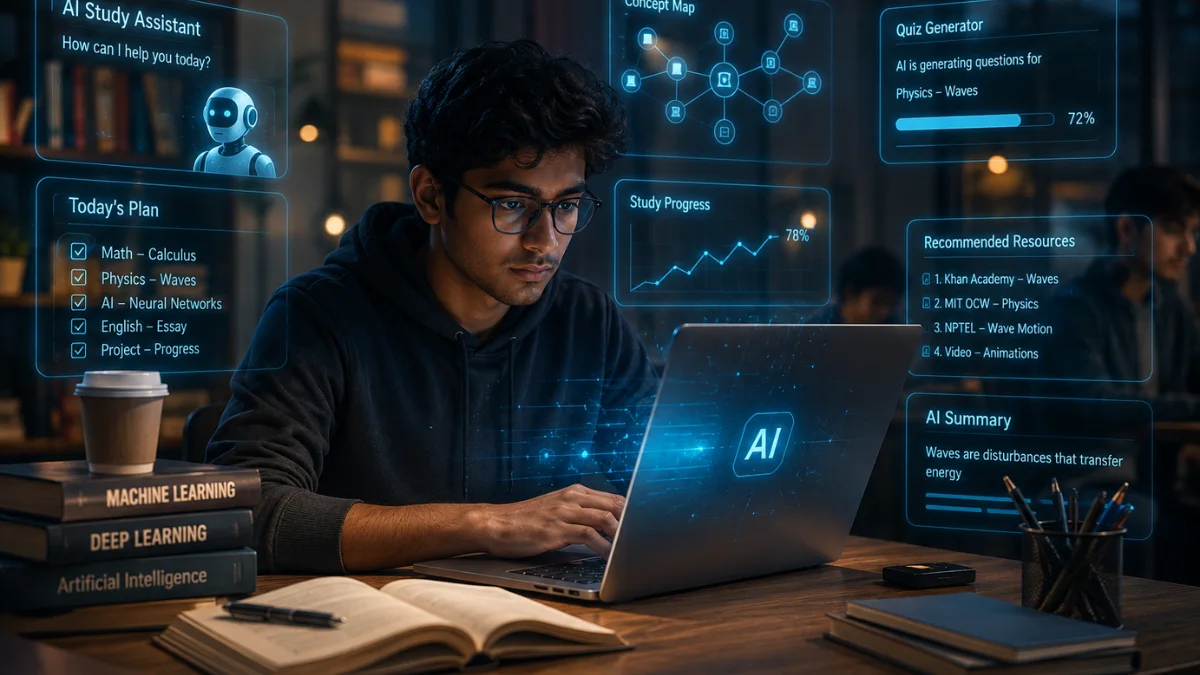
There’s also a more subtle psychological change occurring. Students are starting to rely on immediate help. Facing a tough paragraph? You can ask AI. Confused by homework? Ask AI. Struggling to structure an answer? Ask AI. This convenience, however, can gradually diminish our capacity for patient intellectual effort.
This is a point where educators find themselves at odds. Some feel that AI improves learning, while others worry it hinders deep thought and genuine creativity. Both perspectives hold some truth.
AI tools can be incredibly beneficial when students utilize them as:
* Aids for understanding complex topics
* Tools for organizing information
* Systems for generating ideas
* Helpers for refining their work
However, they become detrimental when students cease trying to think for themselves altogether.
The future will likely favor students who can effectively integrate both human intellect and AI’s efficiency. This synergy is emerging as the key academic advantage.
Which AI Tools Are Students Commonly Using in 2026?
The ecosystem has really grown quite a bit.
Instead of sticking to just one platform, students are now using AI for all sorts of different things.
Some of the most common ways they’re using it are:
* Getting explanations from AI chatbots
* Generating notes with AI
* Creating flashcards using AI
* Solving math problems with AI
* Getting help with coding from AI
* Summarizing research with AI tools
* Improving their language skills with AI
* Building presentations with AI assistance
The Future of Jobs & Education Will Reward AI Literacy
The truth is, AI literacy is fast becoming career literacy.
Over the next five years, students entering the job market will probably need to:
work with AI systems
check the accuracy of AI-generated content
formulate better questions
manage information effectively
think critically even with automation
Schools that still prioritize only memorization might end up preparing students for a declining job market.
On the other hand, students who learn to work together with intelligent systems could adapt more quickly across various fields.
This doesn’t mean traditional knowledge is no longer important.
It just means that raw information isn’t the scarce resource it once was.
What’s valuable now is interpretation.
Judgment.
Creativity.
Critical thinking.
And, perhaps surprisingly, the widespread adoption of AI might actually increase the value of uniquely human skills.
Conclusion
The debate around AI in education often becomes unnecessarily dramatic. Some people describe it as the death of learning. Others treat it like a magical academic shortcut.
Reality sits somewhere in between.
AI tools are neither educational saviors nor intellectual disasters. They are amplifiers. They magnify existing habits.
A curious student becomes faster.
A disciplined student becomes more organized.
A distracted student becomes even more distracted.
That’s the uncomfortable truth beneath the hype.
The future of Jobs & Education will likely belong to students who know when to use AI, when to question it, and when to think independently without it.
Because the most valuable skill in the AI era may not be getting answers faster.
It may be knowing which questions still deserve human thought.
Final Insight CTA
As AI reshapes classrooms, exams, careers, and learning systems, students are entering one of the biggest educational transitions in modern history. The challenge is no longer access to information. The challenge is learning how to think clearly in a world overflowing with automated answers.
For more deep-dive explainers on technology, digital culture, education trends, and the future of work, keep reading The Vue Times.
Frequently Asked Questions
What are AI tools for students?
AI tools for students are software platforms that help with studying, note-making, revision, writing assistance, coding, research, and exam preparation using artificial intelligence.
Can students use AI tools for homework?
Yes, but responsibly. AI tools can help explain concepts and improve understanding, but students should avoid relying entirely on generated answers without learning the topic themselves.
Are AI tools replacing teachers in education?
Not really. AI tools assist learning, but teachers still provide guidance, emotional understanding, classroom interaction, and critical evaluation that AI cannot fully replicate.
Which AI tools are best for exam preparation?
Students commonly use AI chat assistants, flashcard generators, mock test creators, note summarizers, and AI-based learning apps for exam preparation and revision.
How is AI changing Jobs & Education?
AI is changing education by making learning more personalized, interactive, and skill-focused. It’s also influencing hiring trends by increasing the importance of adaptability and AI literacy.