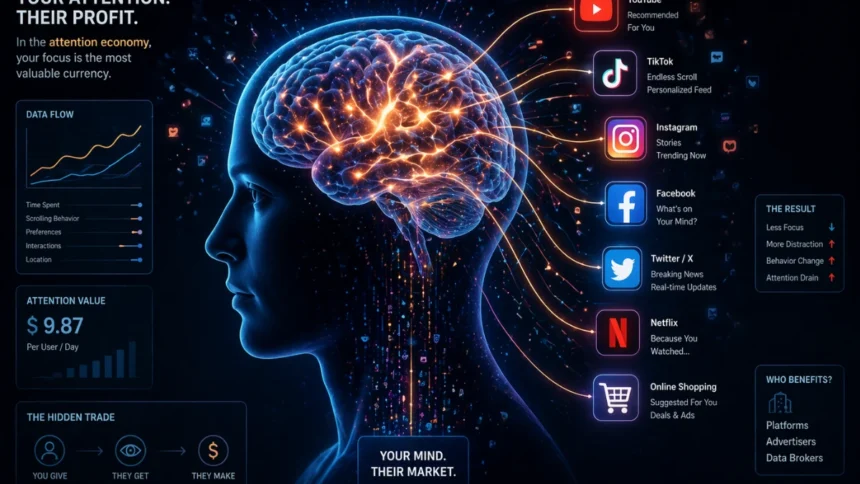
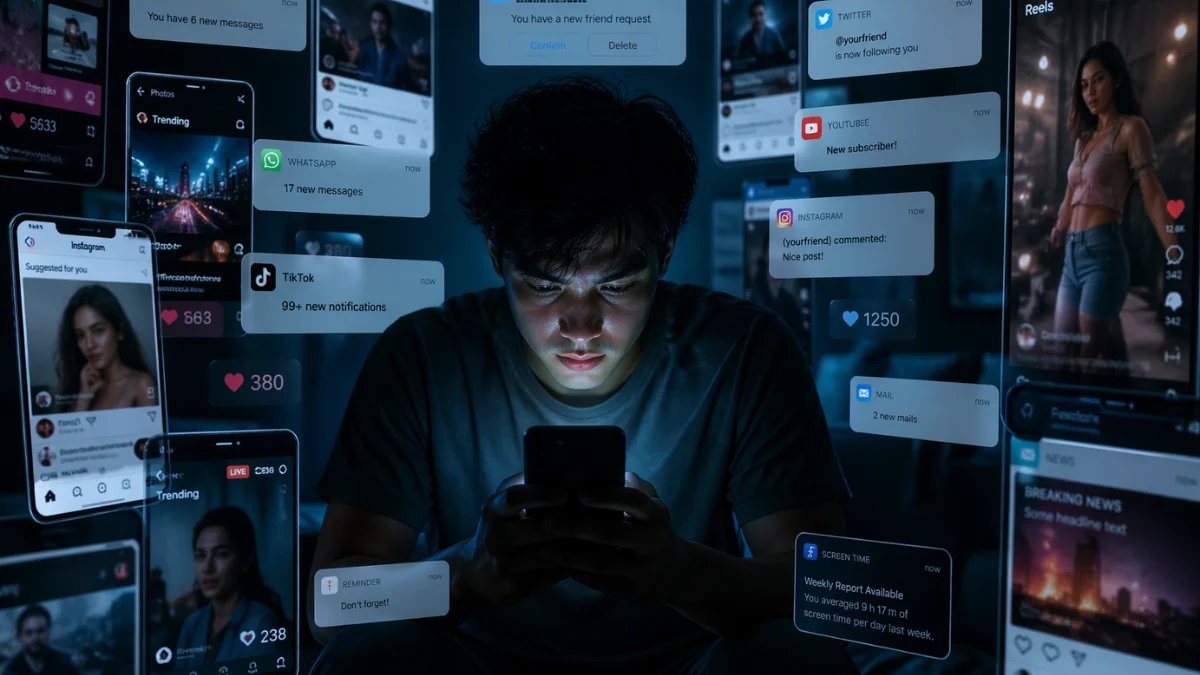
Every time you pick up your phone, a quiet battle for your focus is underway. It’s not obvious, but it never lets up. Your screen lights up with notifications, videos start playing on their own, and headlines scream for your immediate attention. Suddenly, you look up and realize that a chunk of time—fifteen minutes, maybe even an hour—has vanished.
What’s really at stake here isn’t money. It’s something far more precious and limited: your attention.
What Is Attention Economy?
So, what exactly is the Attention Economy? Fundamentally, it’s a system where human attention is seen as a precious, limited resource. Businesses then compete intensely to grab that attention, keep it, and turn it into profit.
This is quite different from traditional economies that focus on selling goods or services. In the attention economy, the real currency is visibility and engagement. Companies don’t just provide information; they carefully craft experiences specifically designed to make you watch longer, scroll endlessly, and react frequently.

Just consider social media. These platforms are typically free to use, yet they bring in billions of dollars. What you’re really trading isn’t cash; it’s your time, your focus, and your mental energy.
How We Got Here
And with the sheer amount of information bombarding us daily, attention has truly become one of the most sought-after and valuable assets around.
This idea isn’t entirely fresh. Way back in the 1970s, economist Herbert A. Simon noted that “a wealth of information creates a poverty of attention.” Back then, it was more of a theoretical point. But these days, it feels like something we all experience every day.
The rise of the internet, then smartphones and social media, didn’t just make information easier to get—it blew it up exponentially. Platforms like Facebook, Instagram, and YouTube took this even further, treating how much time users spend engaged as something they could actually measure and sell.
The more time you spend on these sites, the more ads you see. And the more ads you see, the more money they make.

It’s a straightforward setup, but it leads to some really complicated outcomes.
Why Attention Became the New Currency
The value of something often comes down to how scarce it is. Think about attention—it’s a limited resource we all have each day, and because of that, it’s become a fiercely contested prize.
Unlike cash, you can’t stockpile attention. Once you use it up, it’s gone forever. This sense of urgency makes it extremely precious for companies trying to connect with people right now.

Just picture all the different ways we’re vying for your focus on a single device: streaming services battle social media, which contends with news apps, which then competes with games. The struggle isn’t just between different industries anymore; it’s happening right there on your own screen.
And more and more, who wins that battle is decided by algorithms.
The Psychology Behind It
Understanding What Is Attention Economy? requires looking beyond business models and into human behavior.
Digital platforms are designed to tap into psychological triggers—curiosity, validation, fear of missing out (FOMO), and reward anticipation.
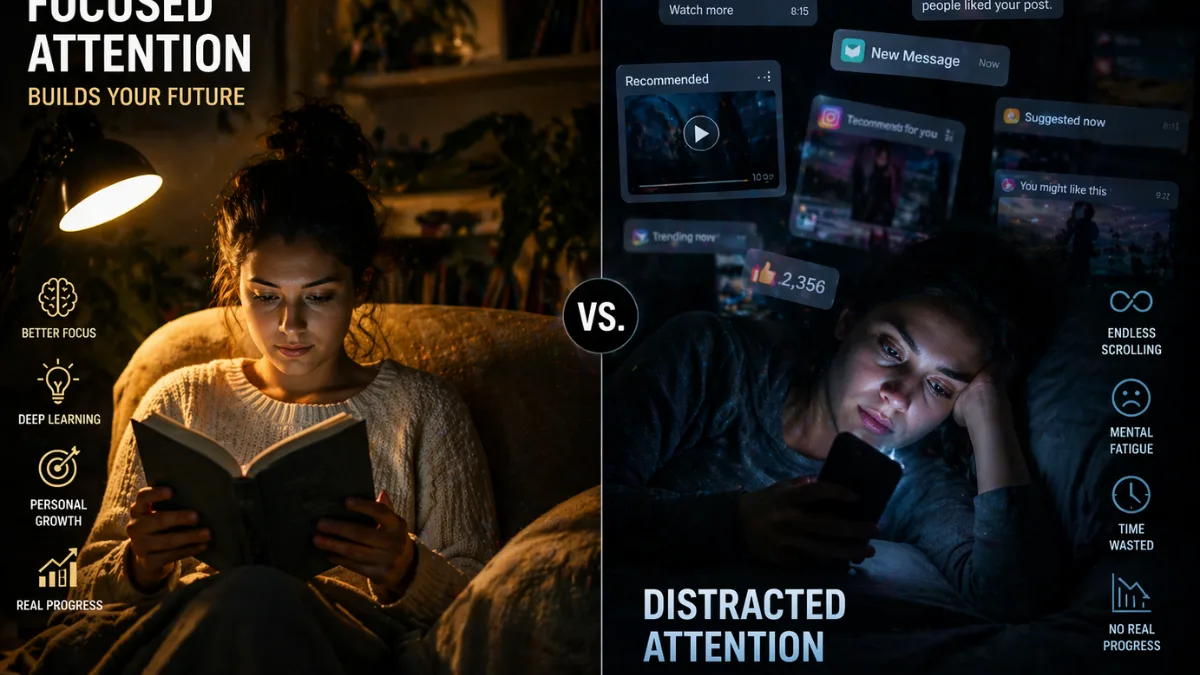
Endless scrolling, for example, removes natural stopping points. Notifications create urgency. Likes and comments offer instant feedback loops that feel rewarding, even addictive.
The system doesn’t force engagement. It subtly encourages it.
And that’s what makes it effective.
Over time, users begin to develop habits shaped not by intention, but by design.
The Business of Capturing Attention
If attention is currency, then data is the exchange rate.
Every click, pause, or swipe tells platforms something about you. These signals are used to refine algorithms, making content more personalized—and harder to ignore.
Advertisers don’t just pay for space anymore; they pay for targeted attention. A brand doesn’t need millions of viewers. It needs the right viewers, at the right moment, in the right mindset.
This shift has redefined marketing. It’s no longer about broadcasting messages—it’s about inserting them seamlessly into attention streams.
And the more precise the targeting, the more valuable that attention becomes.
Why It’s Trending Now
The conversation around attention economy has intensified in recent years, and not without reason.
First, there’s the sheer volume of digital consumption. People are spending more time online than ever before, especially post-pandemic. Remote work, online education, and digital entertainment have blurred boundaries between work and leisure.
Second, there’s growing awareness. Users are beginning to question how much control they actually have over their time and focus.
Documentaries, research studies, and public debates have started highlighting the cost of constant engagement—not in financial terms, but in mental clarity and well-being.
Third, businesses are evolving. Companies are no longer just competing for customers—they’re competing for attention spans that are shrinking by the day.
The Hidden Cost of Constant Engagement
The attention economy isn’t inherently negative. It has enabled innovation, connectivity, and access to information on an unprecedented scale.
But it comes with trade-offs.
When attention becomes fragmented, depth often suffers. Long-form reading declines. Concentration becomes harder to sustain. Even decision-making can be influenced by what captures attention first, rather than what deserves it most.
There’s also an emotional dimension. Constant exposure to curated content can shape perceptions, expectations, and even self-worth.
The impact isn’t always visible immediately. But over time, it accumulates.
The Shift Toward Intentional Attention
Interestingly, the same awareness that fuels concern is also driving change.
Users are becoming more selective. Features like screen time tracking, focus modes, and digital detox trends reflect a growing desire to reclaim control.
Some platforms are even experimenting with design changes that prioritize well-being—though often in tension with their revenue models.
The future of the attention economy may not be about capturing more attention, but about earning it more meaningfully.
What Comes Next
Looking ahead, the attention economy is likely to become more sophisticated—and more subtle.
Artificial intelligence will play a bigger role in predicting and influencing user behavior. Content will become increasingly personalized, sometimes to the point where it feels almost intuitive.
At the same time, there’s a rising demand for authenticity. Users are beginning to value content that respects their time rather than exploits it.
This creates an interesting paradox: the more attention becomes valuable, the more users may resist giving it away freely.
And that tension could reshape how platforms, brands, and creators operate.

Conclusion
Understanding What Is Attention Economy? isn’t just about technology or business—it’s about recognizing how modern life is structured around focus, distraction, and choice.
Every swipe, every click, every pause is part of a larger system that runs quietly in the background.
The question isn’t whether attention is valuable. It clearly is.
The real question is who controls it—and how consciously we choose to spend it.
Final Insight
In a world where everything is competing for your attention, awareness becomes a form of power. The ability to decide what deserves your focus—and what doesn’t—may soon matter more than any algorithm trying to predict it.
Because in the end, attention isn’t just currency.-The Vue Times
Frequently Asked Questions
What is attention economy in simple terms?
→ It refers to a system where human attention is treated as a valuable resource, and companies compete to capture and monetize it through digital content and platforms.
Why is attention considered a currency?
→ Because it’s limited and highly valuable. Businesses earn revenue by capturing user attention and converting it into ad views, engagement, or conversions.
How do social media platforms use the attention economy?
→ Platforms use algorithms, notifications, and personalized content to keep users engaged longer, increasing exposure to ads and boosting revenue.
Is the attention economy harmful?
→ Not inherently, but excessive engagement can impact focus, productivity, and mental well-being if not managed consciously.
How can individuals manage their attention better?
→ By setting boundaries, using screen time tools, limiting notifications, and being intentional about digital consumption.