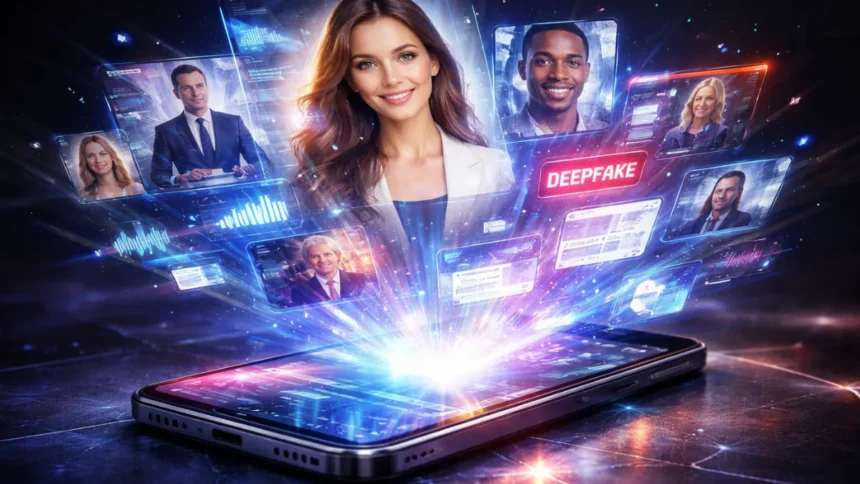
A campaign video goes viral hours before an election. A singer releases a new track decades after death. A customer service agent appears on screen, smiling, speaking flawlessly in six languages at once — except the agent does not exist. For years, digital media mostly helped record reality, edit it, polish it, and distribute it. Now it can manufacture it.
That shift is what makes the question What Is Synthetic Media? more urgent than it first sounds. This is not just another niche tech phrase trying to sound futuristic. It describes a fast-expanding category of media — video, audio, images, text, avatars, voices — generated partly or entirely by artificial intelligence. Sometimes the results are useful, efficient, even impressive. Sometimes they are deceptive. Often they are both.
Synthetic media sits at the center of one of the most important cultural transitions of the AI era. It changes not only how content is made, but how trust works. And once trust becomes unstable, every image, every voice note, every clip that lands on a screen starts carrying a new question: did this actually happen?
What Is Synthetic Media?
Imagine this: a campaign video suddenly goes viral just hours before election day. Or think about a singer releasing brand new music decades after they’ve passed away. How about a customer service agent appearing on screen, looking cheerful, and speaking flawlessly in six languages all at once — except, here’s the catch: that agent doesn’t actually exist.

For years, digital technology was mainly used to capture real events, tweak them, make them look better, and share them around. But now? It can actually create things from scratch.
That big shift is why the question “What is Synthetic Media?” feels so much more pressing than it might seem at first glance. It’s not just another fancy tech buzzword trying to sound cutting-edge. It’s actually describing a huge and rapidly growing area of media – think videos, audio clips, images, written text, digital avatars, and even voices – that’s made, at least partly or sometimes completely, by artificial intelligence.
The results? Well, sometimes this tech is genuinely useful, efficient, or even pretty amazing. Other times, it can be downright misleading. And often, it’s a bit of both.
Synthetic media is right at the heart of one of the most significant cultural shifts we’re seeing in the age of AI. It’s not just changing how content gets made; it’s fundamentally altering how trust works. And once trust starts to feel shaky, suddenly every picture, every voice message, every video clip we see starts carrying a nagging question: Did any of this really

Why Synthetic Media Is Suddenly Everywhere
Part of the answer is obvious: the tools got much better, very fast. What once required specialist teams, large budgets, and serious computing infrastructure can now be done on consumer platforms with a laptop and a subscription. The barrier to entry collapsed. So did the distinction between amateur and professional production.

But capability alone does not explain the speed of adoption. The media economy was already primed for something like this. Platforms reward constant output. Brands need content across multiple channels. Audiences expect personalization, speed, and novelty. Synthetic media fits that environment almost perfectly. It can generate scale without a proportional increase in cost.
A marketing team can produce ten ad variations in an afternoon. A gaming studio can prototype dialogue faster. A news outlet can experiment with multilingual audio. A startup can create presenter-style videos without building a physical set. In practical terms, synthetic media offers what every digital business wants: more content, faster workflows, lower production friction.
That is why it is trending far beyond tech circles. The question What Is Synthetic Media? now matters to advertisers, educators, filmmakers, political strategists, journalists, regulators, musicians, and anyone whose work depends on public attention.

From Novelty to Infrastructure
It’s easy to see synthetic media as just a flashy bonus, something related to “AI creativity.” But that view doesn’t do justice to what’s really happening. This technology is slowly turning into the essential backbone of many systems.
Consider how many digital interactions we have that depend on generated elements. Customer service bots craft responses, translation tools produce speech, video platforms experiment with AI dubbing, retail brands design product visuals before they even have physical stock, and entertainment companies utilize digital look-alikes. Influencer culture has already gotten us used to polished, artificial realities; synthetic media takes this a step further by allowing the performer, the face, or even the emotional vibe to be adjusted on a large scale.
This is significant because when a tool becomes infrastructure, people tend to stop noticing it. It shifts from being a spectacle to just part of the background. Rarely do users think about compression algorithms when streaming a movie. Similarly, future viewers might stop wondering if media includes synthetic parts because the answer will more and more be “yes.”
So, the real cultural change isn’t just that fully artificial content exists. It’s that mixed reality is becoming commonplace. A video could have a real presenter, audio cleaned by AI, synthetic background graphics, translated speech, and a segment generated by an avatar. Authenticity won’t depend on whether something is completely “pure.” Instead, it will come down to whether the blending of elements is clear and fittin
The Deepfake Problem — and Why It Dominates the Conversation
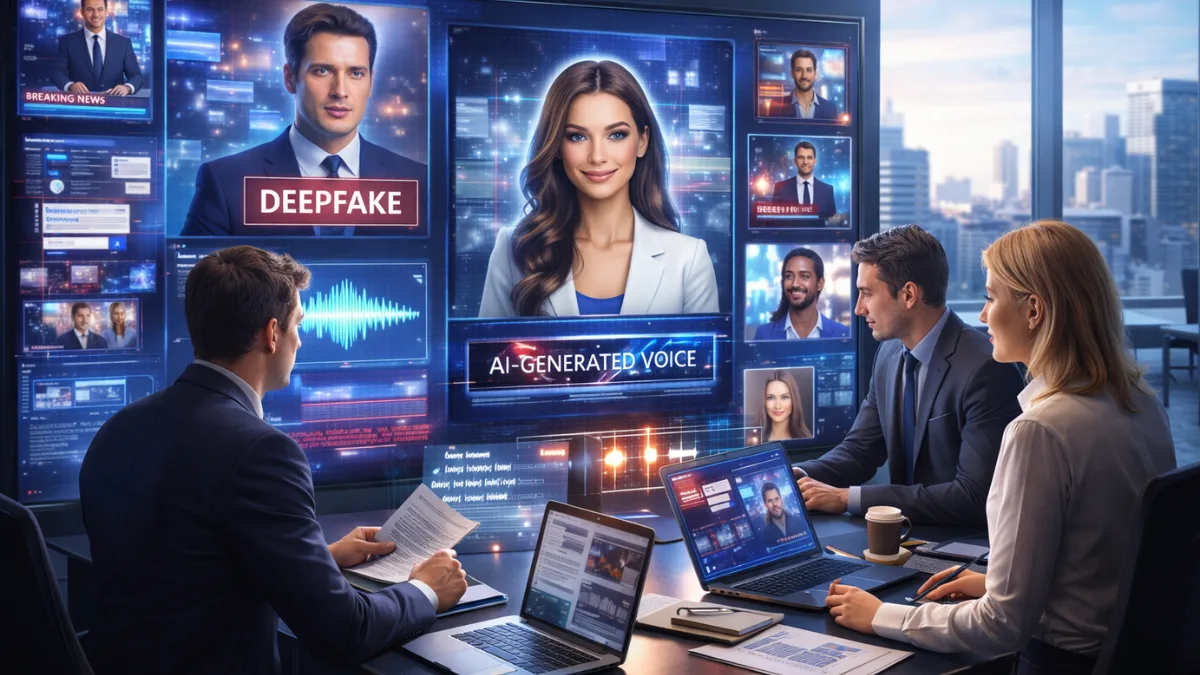
Whenever people ask What Is Synthetic Media?, the conversation usually heads straight to deepfakes. That is understandable. Deepfakes are dramatic, unsettling, and easy to explain. A politician appears to say something inflammatory. A celebrity’s face is inserted into explicit or fabricated footage. A scammer mimics a family member’s voice on a call. These cases are vivid because they turn the human face and voice — the things people instinctively trust — into editable assets.
The problem is not hypothetical. The social harm is obvious: reputational damage, fraud, harassment, disinformation, and confusion at scale. Even when a fake is quickly debunked, the damage may already be done. A lie with audiovisual realism travels fast.
Yet deepfakes also cast such a long shadow that they can obscure the rest of the synthetic media landscape. Not every AI-generated presenter is malicious. Not every cloned voice is fraudulent. Some of these tools help people speak after illness, localize education, or make content more accessible. The challenge is that the same underlying capability can serve both humane and predatory uses.
That dual-use nature is what makes regulation difficult and public understanding messy. Society prefers technologies that sort neatly into good or bad. Synthetic media refuses to cooperate.
Why Synthetic Media Hits a Nerve
There is a psychological dimension here that goes beyond misinformation. Synthetic media unsettles people because it destabilizes one of modern culture’s quiet assumptions: that seeing and hearing are still, at some basic level, evidence.
For most of human history, forged realities were expensive and imperfect. Editing existed, propaganda existed, staged imagery existed — but there were limits. Now those limits are weaker. The result is not just fear of fakery. It is a low-grade erosion of confidence.
That erosion has consequences. Journalists need stronger verification practices. Courts and investigators face new evidentiary complications. Ordinary people become more suspicious, sometimes rationally and sometimes excessively. Public trust, once damaged, does not neatly return.
There is another irony. Synthetic media can make authentic material easier to deny. If convincing fakes are common, real footage can be dismissed as fabricated. Scholars sometimes call this the liar’s dividend: the mere existence of deepfakes gives bad actors a ready-made excuse. That may prove as socially damaging as the fake content itself.
The Business Case Is Too Strong to Ignore
For all the legitimate concern, synthetic media is not going away, largely because the business incentives are overwhelming.
The economics are hard to miss. Synthetic media reduces production costs, shortens timelines, and increases localization options. A single campaign can be adapted for different markets without reshoots. Training videos can be updated without recalling talent. Product explainers can be personalized. Games, films, e-commerce, education, and customer support all stand to gain efficiency.
There is also a labor question buried inside the optimism. If AI can generate voices, faces, scripts, and presenters on demand, what happens to the people who once supplied those services? Some roles will evolve. Some will become more specialized. Others may shrink. The same technology that expands creative possibility also threatens to commodify creative labor.
That tension is already visible in entertainment, advertising, and media production. Consent, licensing, royalties, and digital likeness rights are becoming serious business issues, not abstract ethical debates. A voice is no longer just a voice. It is an asset class.
The Next Phase: Labeling, Watermarking, and a New Literacy
The future of synthetic media will likely not be defined by a simple battle between real and fake. It will revolve around systems of disclosure, provenance, and digital literacy.
Audiences will need better habits: checking sources, reading context, resisting instant belief. Platforms will need clearer policies. Companies will need permission frameworks that are not laughably vague. And the media industry will need a stronger standard for labeling synthetic content, especially when realism is high and stakes are public.
Watermarking and provenance tools may help, though they are not a magic fix. Bad actors rarely volunteer labels. Still, the push for transparency matters because it signals a broader shift. The future may belong not to media that pretends to be untouched, but to media that is honest about how it was made.
That is where the debate becomes more mature. The right question is not whether synthetic media should exist. It already does. The real question is what kinds of synthetic media society wants to normalize — and under what rules.
More Read
Conclusion
Synthetic media is not merely a new content format. It is a new condition of public life. It changes how stories are produced, how identities are represented, how businesses operate, and how people decide what to trust. Some uses will be undeniably useful. Others will be corrosive. Most will sit somewhere in between, forcing institutions and audiences to develop sharper judgment than they have needed before.
The age of synthetic media is not arriving. It is already here, woven into marketing, entertainment, politics, communication, and everyday digital experience. The harder task now is learning how to live with manufactured realism without surrendering the idea of reality itself.
Final Insight
At The Vue Times, we look beyond the buzzwords to examine how emerging technologies reshape culture, business, and public trust. Synthetic media is not just changing content creation — it is redefining what credibility looks like in the digital age.
Frequently Asked Questions
- What is synthetic media?
Synthetic media is digital content such as images, audio, video, text, or avatars created or significantly altered using AI and related technologies. It can be useful, creative, or misleading depending on how it is used. - Is synthetic media the same as deepfake?
No. Deepfakes are one form of synthetic media, usually focused on realistic face or voice manipulation. Synthetic media is the broader category that also includes AI images, cloned voices, avatars, and generated text. - Why is synthetic media important?
It matters because it affects trust, communication, marketing, entertainment, and public information. As synthetic content becomes more realistic, people need better ways to verify what they see and hear. - What are examples of synthetic media?
Examples include AI-generated images, voice clones, virtual influencers, deepfake videos, AI avatars in training videos, machine-generated music, and text produced by large language models. - Is synthetic media harmful?
It can be harmful when used for scams, misinformation, impersonation, or harassment. It can also be beneficial in education, accessibility, customer service, translation, and creative production.