Why GDP Still Shapes National Conversations
Every time headlines mention economic growth, slowdown, recovery, or resilience, one figure dominates the discussion: GDP. For India, now among the world’s largest economies, this number carries weight far beyond charts and reports. It influences government policy, investor confidence, job creation debates, welfare planning, and even how citizens perceive national progress.
In recent years, GDP has taken on added significance. Pandemic disruptions, global inflation, supply-chain shifts, and digital transformation have forced policymakers and analysts to look deeper into how growth is measured, not just how fast it appears. For students, professionals, and informed readers, understanding GDP today means understanding both its power and its limits.
This article takes an explainer approach. It unpacks what GDP really represents, how India calculates it, why the methodology matters, and what signals readers should watch in the years ahead.
Understanding GDP: The Core Idea in Simple Terms
At its most basic level, GDP refers to the total monetary value of all final goods and services produced within a country’s borders during a specific period, usually a year or a quarter.

The emphasis on final goods is important. It avoids double counting by excluding intermediate products already used in producing other goods.
In practical terms, GDP answers one central question:
How much economic activity is happening within the country?
What GDP Measures, and What It Deliberately Leaves Out
GDP is designed to capture economic output, not overall well-being. This distinction is critical, especially in analytical exam questions.
Included in GDP
- Goods and services produced legally
- Output within national boundaries
- Market-based activities
- Government services valued at cost
Excluded from GDP
- Household and unpaid work
- Black or informal economy activities not recorded
- Environmental degradation
- Income distribution and inequality
- Quality of life indicators
GDP is a powerful indicator, but it is not a complete picture of development.
India’s GDP Framework: Who Calculates It and Why It Matters
In India, GDP is calculated and released by the National Statistical Office (NSO) under the Ministry of Statistics and Programme Implementation.

The NSO follows internationally accepted standards while adapting them to India’s economic structure, which includes:
- A large informal sector
- Agriculture-dependent livelihoods
- Rapidly expanding services
- Increasing digital economic activity
This balance between global comparability and local relevance shapes India’s GDP methodology.
The Three Approaches to Calculating GDP in India
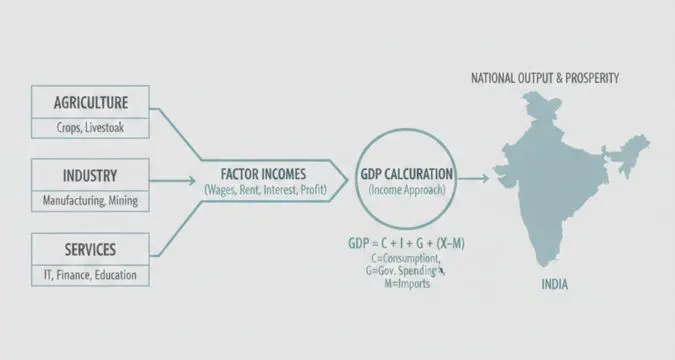
India uses three conceptual approaches to estimate GDP. Each looks at the economy from a different angle, yet all should theoretically arrive at the same final value.

1. The Production (Value Added) Approach
This is the primary method used in India.
Under this approach, GDP is calculated by adding the gross value added (GVA) across all sectors of the economy.
GVA represents the value of output minus the cost of intermediate inputs.
Key Sectors Covered
- Agriculture, forestry, and fishing
- Industry (manufacturing, mining, construction)
- Services (trade, transport, finance, public administration)
This approach highlights where growth is coming from.
2. The Income Approach
This method calculates GDP by summing all incomes earned by factors of production.
It includes:
- Wages and salaries
- Profits earned by firms
- Rent from land
- Interest on capital
- Taxes minus subsidies on production
While conceptually strong, this approach is harder to apply fully in India due to informal employment and income underreporting.
3. The Expenditure Approach
This approach measures GDP by adding total spending on final goods and services.
It includes:
- Private consumption
- Government expenditure
- Investment
- Net exports (exports minus imports)
This method is useful for analyzing demand patterns but depends heavily on reliable consumption and trade data.
From GVA to GDP: Understanding the Link
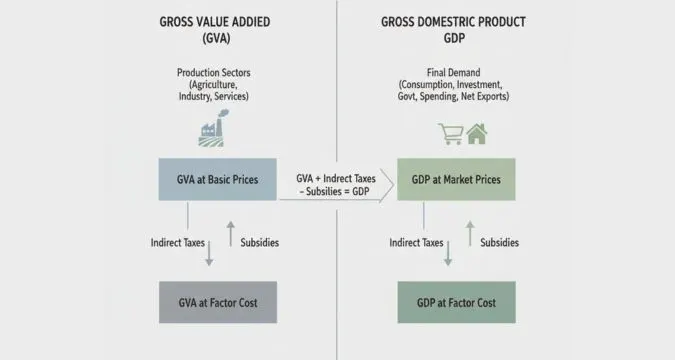
In India’s statistical framework, GVA plays a central role.
The relationship is simple:
GDP = GVA + Taxes on products – Subsidies on products
GVA shows sector-level performance, while GDP reflects the overall economic output at market prices.
This distinction is frequently tested in competitive exams and policy discussions.
Base Year and GDP Calculation: Why the Reference Point Matters
GDP estimates are calculated using a base year to measure real growth, adjusted for inflation.
India periodically updates this base year to reflect structural changes in the economy, such as:
- Growth of services
- Expansion of digital transactions
- Changes in consumption patterns
Revising the base year improves accuracy but often sparks debate, especially when growth trends appear to shift after recalibration.
Quarterly and Annual GDP: How Data Is Released
India releases GDP data in stages:
- Quarterly estimates (early signals of trends)
- Provisional annual estimates
- Revised and final estimates
Each revision incorporates more comprehensive data sources, improving reliability over time.
This layered release structure explains why GDP figures sometimes change months after initial publication.
Historical Context: How India’s GDP Measurement Has Evolved
India’s GDP calculation methods have evolved alongside its economy.
Early Years
- Heavy reliance on agriculture data
- Limited industrial and service-sector tracking
- Manual surveys and delayed reporting
Post-Liberalisation Era
- Expansion of service-sector coverage
- Improved corporate data collection
- Integration with global statistical standards
Recent Developments
- Use of digital tax records
- Better tracking of formal enterprises
- Ongoing efforts to capture informal activity
These shifts reflect India’s transition from an agrarian economy to a diversified, services-led one.
Current Trends in India’s GDP Measurement
Several forces are reshaping how economic output is tracked:
- Digital payments and formalisation
- Platform-based service delivery
- Better tax compliance data
- Improved survey techniques
At the same time, challenges remain in accurately measuring small enterprises and informal workers.
These dynamics are central to understanding recent GDP trends and debates.
Why GDP Numbers Matter for Policy and Society
GDP figures influence decisions across multiple levels.
For Policymakers
- Budget planning
- Fiscal deficit targets
- Welfare allocation
- Infrastructure investment
For Businesses and Investors
- Market confidence
- Expansion planning
- Risk assessment
For Citizens
- Employment prospects
- Income growth expectations
- Public spending priorities
GDP shapes narratives, but its interpretation matters as much as the number itself.
Common Misconceptions About GDP
Misconception 1: Higher GDP Means Everyone Is Better Off
GDP measures total output, not income distribution. Growth can occur alongside inequality.
Misconception 2: GDP Growth Equals Development
Development includes health, education, environment, and social outcomes, areas GDP does not capture fully.
Misconception 3: GDP Is a Perfectly Accurate Number
GDP is an estimate, based on available data. Revisions are a feature, not a flaw, of statistical systems.
GDP and India’s Global Position
GDP also shapes India’s standing in the global economy.
- It influences credit ratings
- Affects foreign investment perceptions
- Determines weight in international institutions
However, comparisons must consider population size and per capita indicators to avoid misleading conclusions.
What to Watch Next: Signals That Matter Going Forward
Readers and exam aspirants should track:
- Changes in base year methodology
- Shifts between sectoral contributions
- Relationship between growth and employment
- Integration of digital economy data
Understanding these signals offers deeper insight than headline growth rates alone.
For readers exploring related economic concepts, analyses published on The Vue Times often examine how macroeconomic indicators connect with everyday realities and policy choices.
Key Takeaways for Clear Understanding
- GDP measures the value of final goods and services produced within India.
- India uses production, income, and expenditure approaches, with emphasis on value added.
- GVA and GDP are closely linked but not identical.
- GDP is essential for policy, planning, and comparison, but has clear limitations.
- Interpreting GDP requires context, not just numbers.
A nuanced understanding of GDP helps readers move beyond headlines and engage meaningfully with economic debates.
More Read

Frequently Asked Questions (FAQs)
Why is GDP such a central indicator for India today?
GDP remains central because it offers a standardized way to track economic activity across time and countries. For India, it helps policymakers assess growth momentum, allocate resources, and communicate economic direction. While imperfect, it provides a common reference point for planning and comparison in a complex, diverse economy.
How does India account for its large informal sector in GDP?
India uses surveys, indirect indicators, and administrative data to estimate informal activity. While this approach captures broad trends, it cannot fully reflect every transaction. As formalisation increases through digital payments and compliance, measurement accuracy is gradually improving.
What is the difference between nominal and real GDP?
Nominal GDP measures output at current prices, while real GDP adjusts for inflation using a base year. Real GDP offers a clearer picture of actual growth by removing price-level changes, making it more useful for long-term analysis and policy evaluation.
Can GDP growth occur without job creation?
Yes. Growth driven by capital-intensive sectors or productivity gains may not generate proportional employment. This is why policymakers increasingly examine employment data alongside output figures to assess the quality and inclusiveness of growth.
What role will technology play in future GDP measurement?
Technology is expected to improve data accuracy through real-time reporting, digital transaction tracking, and better survey integration. However, capturing platform-based and gig economy activity remains a challenge that statistical systems worldwide continue to address.