

There’s a familiar ritual in many Indian households every financial year. Spreadsheets open, salary slips scattered, tax-saving investments hurriedly checked in the last quarter. For most middle-class families, tax filing is not just a compliance exercise—it’s a negotiation with limited income and rising expenses.
Now imagine a different scenario: instead of filing taxes individually, a husband and wife—or even a broader family unit—file a single combined return. The idea, often referred to as Joint Tax Filing in India: Will It Benefit the Middle Class?, is quietly entering policy discussions and economic debates.
At first glance, it sounds like a technical tweak. In reality, it could reshape how Indian families plan income, savings, and financial decisions.
Understanding Joint Tax Filing in India: Will It Benefit the Middle Class?
India currently follows an individual-based taxation system. Each earning person files separately, regardless of marital status. A salaried employee, a freelancer spouse, or even a senior citizen parent—all are treated as independent taxpayers.
Joint tax filing, if introduced, would allow married couples (or families) to combine incomes and file a single tax return. This system is already in place in countries like the United States, where it offers certain tax advantages, particularly for households with uneven income distribution.
The central question is not whether it can be implemented—it’s whether it makes economic and social sense for India.
Why the Idea Is Gaining Attention
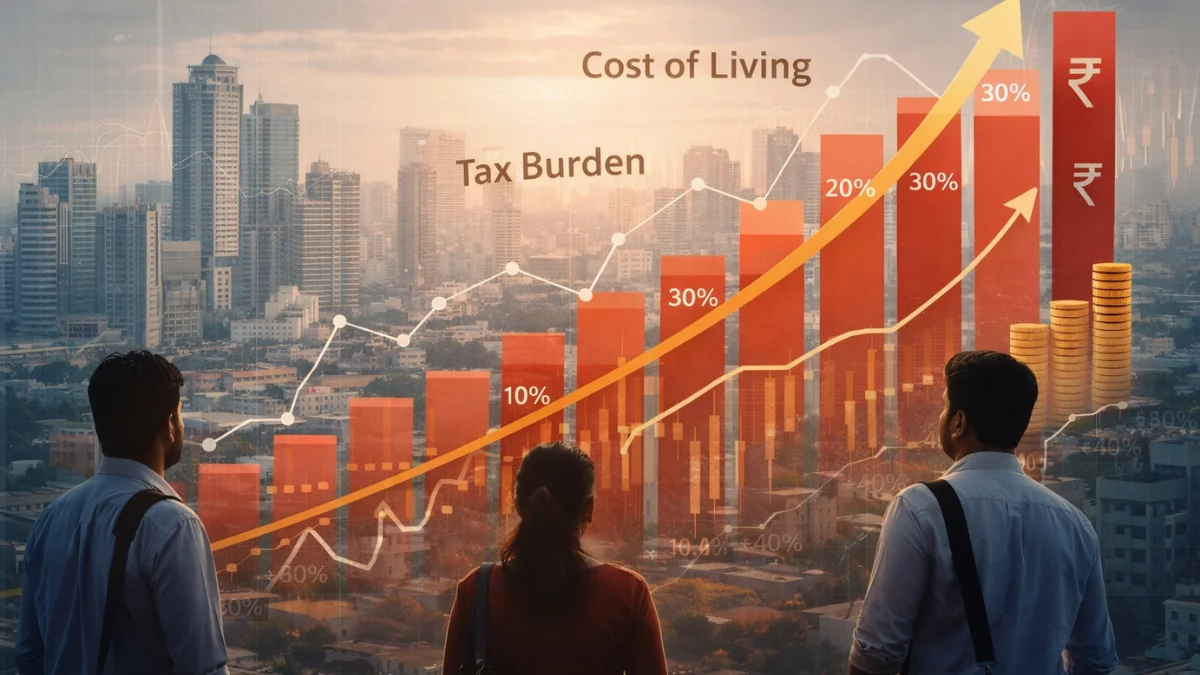
The middle class in India is under visible financial pressure. Salaries have grown, but so have housing costs, education fees, healthcare expenses, and lifestyle inflation. At the same time, tax relief mechanisms feel increasingly limited.
Policy experts have begun revisiting older ideas. Joint tax filing is one of them—not because it’s new, but because the current system is beginning to show its constraints.
There are three major reasons this debate is resurfacing:
- Rising dual-income households
- Increasing cost of living in urban India
- Demand for more equitable tax structures
For many couples, especially where one partner earns significantly more than the other, individual taxation can feel inefficient.
How Joint Tax Filing Could Benefit the Middle Class
The most obvious benefit lies in tax optimization through income balancing.
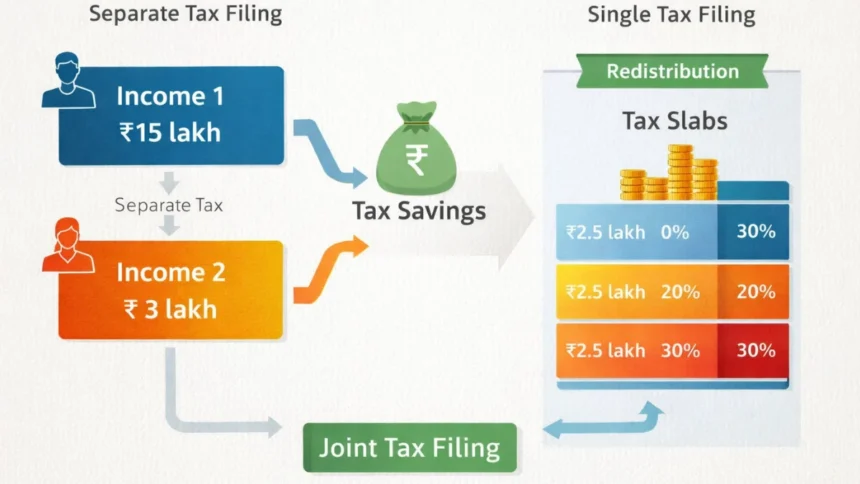
Consider a typical urban household. One spouse earns ₹15 lakh annually, while the other earns ₹3 lakh or is not earning at all. Under the current system, the higher earner pays tax at a much higher slab, while the lower earner’s exemption limits go underutilized.
Joint filing could combine incomes and apply tax slabs more evenly, potentially reducing the overall tax burden.
1. Better Use of Tax Slabs
Instead of one person being pushed into higher tax brackets, income gets distributed across slabs more efficiently. This is especially helpful in households with a single primary earner.
2. Incentive for Formal Financial Planning
Joint filing encourages couples to plan finances together—investments, insurance, and tax-saving strategies become more structured rather than fragmented.
3. Relief for Single-Income Families
India still has a large number of households where only one person earns. Joint filing could provide indirect relief by recognizing the economic reality of dependent family members.
4. Reduced Compliance Complexity
A single tax return instead of multiple filings could simplify documentation and reduce administrative burden—at least in theory.
But the Picture Isn’t That Simple
The idea of Joint Tax Filing in India: Will It Benefit the Middle Class? becomes more complex when you examine its side effects.
1. The Marriage Penalty Risk
In some countries, joint filing has led to what economists call the “marriage penalty.” If both spouses earn similar incomes, combining them could push the total income into a higher tax bracket, increasing the overall tax liability.
For India’s growing urban workforce—where dual-income couples are becoming the norm—this could backfire.
2. Impact on Women’s Financial Independence
There is also a social dimension. Individual taxation reinforces financial independence, especially for working women. Joint filing, if not carefully designed, could dilute that autonomy by merging financial identities.
3. Administrative and Policy Complexity
India’s tax system is already layered with deductions, exemptions, and multiple regimes (old vs new tax regime). Introducing joint filing would require a complete redesign of slabs, rebates, and compliance frameworks.
4. Potential for Tax Avoidance
If not regulated properly, joint filing could be used to manipulate income distribution artificially—shifting earnings to lower-taxed family members to minimize liability.

A Middle-Class Perspective: Who Gains More?
The benefits of joint tax filing are not evenly distributed.
Likely Winners
- Single-income households
- Families with large income disparity between spouses
- Households with dependents and limited tax-saving options
Limited or No Gain
- Dual-income couples with similar salaries
- High-income households already in top tax brackets
- Individuals benefiting from existing deductions and exemptions
In other words, while the policy is marketed as “middle-class friendly,” its real beneficiaries would be a specific segment within that group.
The Psychological Shift It Brings
Beyond numbers, taxation influences behavior.
Joint tax filing could subtly change how families view income—not as individual achievement but as collective financial strength. This might encourage:
- More collaborative financial decisions
- Long-term investment planning
- Better household-level wealth management
However, it also raises a deeper question: should taxation reflect individual identity or family structure?
India has historically leaned toward individual accountability in taxation. Changing that philosophy is not just a policy decision—it’s a cultural shift.
Global Lessons: What India Can Learn
Countries that use joint filing systems have spent years fine-tuning them.
For example:
- The U.S. offers both joint and separate filing options
- Some European countries use family-based taxation models with adjustments
The key lesson is flexibility. A rigid system rarely works. If India introduces joint filing, it would likely need to offer taxpayers a choice—file individually or jointly, depending on what suits them.
What Could a Balanced Approach Look Like
Rather than a full shift, India could experiment with hybrid models:
- Optional joint filing for married couples
- Adjusted tax slabs for combined incomes
- Safeguards to protect financial independence
- Clear rules to prevent misuse
Such a model would allow taxpayers to decide what works best without forcing a structural change on everyone.
Future Implications: Reform or Distraction?
Tax reform in India is always a politically sensitive subject. While joint tax filing sounds promising, it may not be a silver bullet.
The real issues—limited deductions, rising indirect taxes, and stagnant real incomes—require broader structural solutions.
Joint filing, at best, is a targeted relief mechanism. At worst, it risks becoming a symbolic reform that doesn’t significantly change outcomes for most taxpayers.
More Read

Conclusion
The debate around Joint Tax Filing in India: Will It Benefit the Middle Class? is less about tax mechanics and more about economic fairness.
For some households, it could mean meaningful savings. For others, it may change nothing—or even increase their burden. The success of such a policy depends entirely on how it is designed, implemented, and balanced against social realities.
Taxation is not just about revenue collection; it’s about reflecting how a society organizes its economic life. And in India, where family structures are diverse and evolving, a one-size-fits-all approach rarely works.
Final Insight
If joint tax filing ever becomes a reality in India, its true test won’t be in policy documents or budget speeches. It will be in the quiet calculations happening at dining tables across the country—where families decide whether the system finally understands how they live, earn, and survive.-The Vue Times
Frequently Asked Questions
What is joint tax filing in India?
→ It is a proposed system where married couples can combine their incomes and file a single tax return instead of filing individually.
Will joint tax filing reduce taxes for everyone?
→ Not necessarily. It benefits households with uneven incomes but may not help—or could even hurt—dual-income couples with similar salaries.
Is joint tax filing currently allowed in India?
→ No, India currently follows an individual taxation system. Joint filing is only a proposal under discussion.
Who benefits most from joint tax filing?
→ Single-income families or households where one partner earns significantly more than the other are likely to benefit the most.
Can joint tax filing affect financial independence?
→ Yes, it could potentially reduce individual financial identity, especially for working women, unless safeguards are introduced.