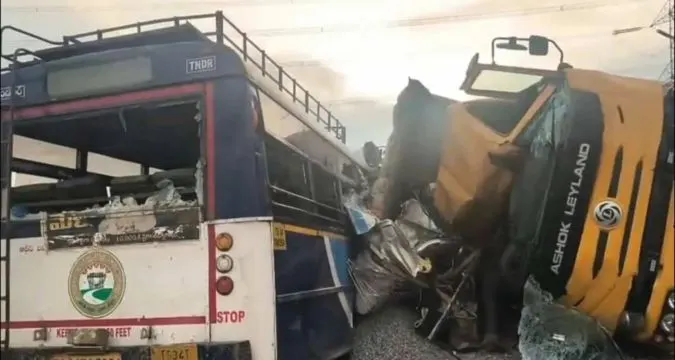
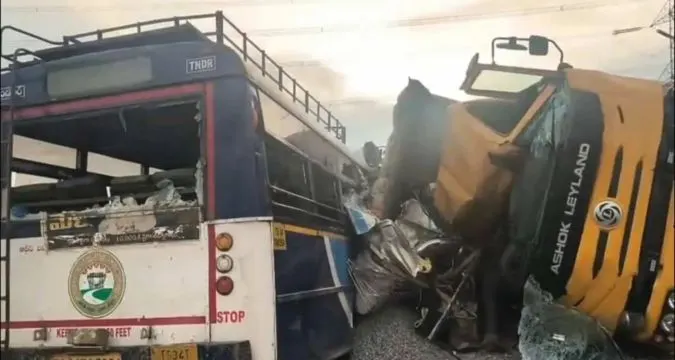
The peaceful Monday morning claimed the lives of dozens of commuters on the Hyderabad-Bijapur highway when a gravel laden tipper truck hit the Hyderabad-Bijapur highway head on into a bus of the Telangana State Road Transport Corporation (TSRTC).
The fatal bus accident that took place mid morning around dawn claimed the lives of sixteen individuals as well as injuring eight others, some of whom are in a critical state. The collision was so great that the front of the RTC bus collapsed altogether because of the weight of the approaching tipper that emptied over the occupants of the front row of seats.
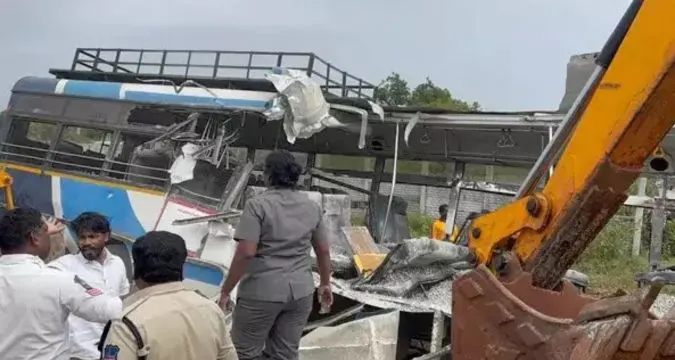
Scene of Horror at Mirjaguda
One of the eyewitnesses termed the crash as a deafening metal blast and thereafter I heard screams of people pleading to help me along the two-lane highway of Hyderabad-Bijapur. The crash took place approximately 50 km off the city limits of Hyderabad, on a stretch with much truck traffic, and sharp turns.
Management by police, rescue and locals was at the scene in minutes. A large number of the victims were caught under the shattered debris of the bus and spilled goods of the truck. Local volunteers and fire department officials spent the hours using cutters and cranes to retrieve the bodies.

By noon, the road was cleared, but the wreckage left a haunting reminder of the human cost of Telangana’s rising road fatalities.
An Impact That is in a Waiting Room
The Chevella police are preliminarily investigating that the tipper truck was moving at high velocity and that it was probably drifting into the opposite lane and most probably it was trying to pass another vehicle. The bus that was heading towards Tandur to Hyderabad carried about 40 passengers and it did not have time to respond.
The intensity of the crash immediately smashed the cabin of the two motor vehicles killing the tipper driver and some passengers aboard the bus instantly. Survivors who were at the rear side of the bus suffered serious injuries and some were thrown off their seats by the collision.
The investigators are also looking into the cause of the truck being overweight or whether the driver had gone beyond the acceptable working hours in the transport sector which is a common contravention that is known to cause fatigue related accidents.
Rescue and Emergency Response
An ambulance with Vikarabad and Chevella hospitals took part in the incident within 30 minutes and later a disaster response team of Hyderabad. The injured were transferred to Osmania general hospital and Apollo DRDO Hospital in order to obtain quick medical care.

The reported gravel load itself was also found to be a fatal element, as it broke out into masses and killed many of the passengers in the collision. Other victims could not be identified because of the injuries. Forensic teams have been instituted to establish identities.
Telangana Chief Minister Revanth Reddy expressed his thorough sympathy to the families that lost their loved ones and ordered immediate medical support to survivors. The remuneration should be announced as soon as the whole report is tabled by district authorities.
The Troubling Road Record in Telangana
This accident has revived the topic concerning the condition of road safety in Telangana – a state that, even in the context of the rapid development of infrastructure, shows the shocking rate of accidents every year.
Read Here: Bengaluru Road Rage

As per the annual statistics published by the Transport Department, Telangana indicated more than 25,000 road accidents in 2024 that claimed over 7,200 lives and caused more than 15,000 injuries. Most of these accidents were caused by over speeding, reckless overtaking, and lack of discipline on lanes.
The Hyderabad-Bijapur highway, especially, has become the area of concern of the region’s safety check-ups because of the mixed people traffic- a mixture of heavy trucks, personal vehicles and state passenger buses in the narrow lanes which are frequently uneven.
Reasons why the Hyderabad-Bijapur Stretch is High-Risk
- Traffic of Heavy Trucks – The road is an important route of construction materials supplying quarries in Vikarabad and Tandur. An array of dozens of tippers and cement carriers scour this line on a daily basis and mostly disregard lane regulations.
- Poor Road Geometry – Angular curves, inconsistent road widths, and poor dividers are involved which increase the risk of head on collisions, particularly during low-light situations.
- Absence of Rest Stops – Long-haul truck drivers lack sufficient rest facilities and may travel up to many hours with growing fatigability and loss of reaction time.
- Lack of Surveillance– There is a low number of police checkpoints and minimal speed cameras and where there are speed cameras, police services are not always enforced in areas that are not in the city.
Lives Lost in an Instant
Journalists interviewed locals of Mirjaguda who rushed to the scenes of the crash. They recalled a horrible scene: smashed-up glass, the aroma of diesel, and the image of passengers that were stampeded beneath the rubble.
One of the local farmers, named Ramesh, stated that they could hear the noise of trucks all night long. Most motorists drive recklessly in a bid to meet delivery time. A number of accidents have taken place on this road, but never did I witness one as bad as this one was.
The police affirmed that some of the deceased were ordinary day to day commuters like students, government employees and the minuscule traders who drive around Chevella and Hyderabad, with the RTC bus.
A Fashion That Cannot Be Overlooked
The Chevella tragedy is not a one-off case. Highways in the state of Telangana have turned into a threat of death over the last few years:
- In A Highway, there are almost 70% road fatalities in Telangana.
- Almost 85% of fatal accidents are due to overspeeding.
- Most of the accidents happen between 6 p.m. and 9 a.m. when the person can hardly see and hardly anybody is enforcing anything.
According to experts, the development of construction trucks, as well as the high rate of urbanization surrounding Hyderabad, has become the site of accidents in the surrounding districts.
The Human Toll
The statistics are the background of broken families. There were parents heading to Hyderabad to see their children studying in the city and daily wage earners heading to work among the dead. In the case of survivors, the trauma will be haunting over a number of years.
Severe consequences have been shared by one of the hospital officials: several victims presented with fractures and internal injuries. It was chaos. The initial hours were acute and many could not be rescued even though they could be treated immediately.
Ex-gratia compensation has been offered but families argue that money will not replace what they have lost.
Responsibility and Investigation
The committee has been constituted to determine the cause of the accident and determine whether it was as a result of negligence, failure of the machinery or the design of the road. The initial evidence indicates that the tipper driver was over-speeding and could have violated a lane.
To recreate the chronology of events, police have gathered CCTV shots at local petrol stations and even at toll cameras. The two vehicles are under mechanical conformity and load checks.
Should the probe prove negligence criminal charges will be instigated on the transport operator as outlined in the Motor Vehicles Act and IPC provisions dealing with culpable homicide.
Read More: Jaisalmer Bus Fire
Infrastructure vs. Safety: Telangana Dilemma
Over the last ten years Telangana has been heavily investing in the development of its road system with the introduction of new roads connecting industrial belts and rural markets to Hyderabad. Nevertheless, infrastructure development has way surpassed enforcement and education of drivers.
According to experts, the 3E approach of road safety which involves engineering, education and enforcement (3E Formula) is weakly enforced. Some roads can be new, yet there is still a lack of proper signs, effective policing, and driver exhaustion that leads to deaths.
Contrary to highways in multiple lanes, where traffic is separated by a central line, most regional roads such as the one between Hyderabad and Bijapur have discontinuous medians and random lighting, and are thus unsafe to use at high speed.
Preventing the Next Tragedy
The Chevella incident ought to act as a wake-up point of the transport policy in Telangana. It has been proposed by experts as a multi-tiered strategy:
- Distribution of Special Freight Lanes: Extravagant trucks such as tippers should work in their own lanes and the time limitation must be strict when transporting quarries.
- Speed Monitoring: Have the cameras installed to check speeds automatically.
- Driver Fatigue Management: Require rest shifts and install electronic logging in heavy vehicles.
- Cargo Regulation: Certify safe loading and inspection of gravel and construction material prior to shipment.
- Infrastructure: Develop trauma care units, which are 50 kilometers apart in the major state highways to ensure quick medical care.
Public Transportation on the Menu
TSRTC, which was previously regarded as one of the most disciplined state bus services in India, has been suffering over the past few years due to the financial losses and the lengthy working schedules. Aging fleets, inadequate rest cycle of drivers and minimal safety retrofit such as seatbelts or impact bars have been highlighted by safety audits.
Transport unions have been pressing the state to increase the safety standards of their fleets, enhance the route planning during the night after the accident and have state buses installed with state of the art collision warning equipment.
Voices from the Ground
Family members of the patient waiting outside Osmania General Hospital were starting to show anguish and frustration. There was also a lot of grumbling on the part of many that the authorities took too long to communicate and provide the right passenger lists which hampered the whole identification exercise.
One of the victims was related to the other and told journalists:
We had been calling into the bus depot all day long, and nobody had a list but it was vague. We were forced to rush from one hospital to another. The system must change.
These responses reaffirm the necessity of real-time passenger databases on public transport, which would contribute to emergency response in the case of any disaster.
A Call to Sustainability in Safety
In India, more than 1.6 lakh people are killed on the road every year- one of the highest in the world- and the proportion of Telangana is only increasing. The Mirjaguda tragedy is a miniature of such a country crisis: a tale of haste, weariness, and control coming right up against the lives of common people.
And assuming that there is some lesson to be learnt out of this loss, it is that road safety cannot be reactive. It needs to be integrated into all kilometers of road, in all the logbooks of the trucks, in all the timetables of the transport.
More Read

The Heart of the Matter: Turning the problem of pain into policy
It took mere seconds to claim the lives of sixteen people on a road that is traversed by millions a month. The photos by Mirjaguda of distorted steel, broken glass, and end users attempting to extend assistance are not to be erased like another article head. They should compel action.
How the Telangana government reacts in the days ahead will help identify whether this will be another statistic or the start of the actual change.
The commuter on the Hyderabad-Bijapur highway will have to travel on with a lot of maneuvering and muted prayers until that time when the next trip is not cut like this.