
Introduction
Startup India Impact is not to be described using success stories or unicorn stories, but in the structural change it has brought to the incentives of founders within the Indian startup ecosystem. The policy framework, which was introduced in 2016, was not focused on the promotion of startups only, but the way that founders perceive risk, capital, compliance, and the creation of long-term value.
Prior to Startup India they used to work in a disjointed environment of high regulatory friction, lack of early stage capital and bad policy awareness. The system brought formality, tax breaks and relaxation of compliance, post-implementation, not only the number of startups changed, but the economic behavior of starting a business in India changed.
This article examines these shifts on a structural level, i.e. in terms of incentive design, economic rationality and operational implications as opposed to narrative.
Startup Context
The Pre-Policy Ecosystem Issue.
The Indian startup ecosystem has four major structural problems that existed before Startup India:

Regulatory Ambiguity
Founders did not have a clear definition of startups and they received unequal treatment in terms of tax, labor and compliance regimes.
Capital Concentration
The initial financing was usually limited to a select number of metro cities and elite networks.
High Entry Friction

Registration and compliance filing and approvals posed a lot of time and cost barriers to the company.
Risk-Return Imbalance
The risk of downside (penalties on failure, compliance cost) was higher than the potential upside in the case of first-time founders.

Structural Outcome
The system disincentivized:
- First-time entrepreneurs
- Small-scale experimentation
- Formalization of initial projects.
Instead, it favored:
- Capital-backed founders
- Informal or semi structured business.
- Low-risk career choices
Structural Breakdown
2.1 Funding Structure
Startup India had no direct impact in injecting capital into startups at scale, but it altered the nature of capital flows.
Key Mechanisms:
- Fund of Funds (FoF): Invested through venture capital firms rather than government investment.
- Tax exemptions: Dashed capital gains and income tax obligations on the qualified startups.
- Angel tax break: Friction in stage 1 fundraising.
Structural Shift:
| Aspect | Pre-Startup India | Post-Startup India |
| Early-stage funding | Network-driven | Policy-enabled access |
| Government role | Minimal | Indirect capital allocator |
| Investor confidence | Moderate | Increased via recognition |
| Founder dependency | High on private capital | Diversified funding pathways |
Insight:
The state took the role of a facilitator of the market and not a competitor in it, that is, incentives were aligned to the private capital instead of substituting it.

2.2 Business Model Logic
The Startup India favored some kind of business model as compared to others.
Encouraged Models:
- Tech-based startups that are scalable.
- IP-driven businesses
- Platform-based models
Discouraged (Indirectly):
- Conventional service enterprises.
- Unscalable, low-margin businesses.
Why?
Since policy benefits (tax holidays, DPIIT recognition) were given with respect to:
- Innovation
- Scalability
- Employment generation
Structural Effect:
Design Founders started shaping businesses to get policy benefits, and not the demand of the market.
2.3 Regulatory Environment
Key Changes:
Quick registration of start-ups through DPIIT.
- Labor and environmental legislation self-certification.
- Faster patent processing
Before vs After:
| Factor | Before | After |
| Registration time | Weeks/months | Days |
| Compliance burden | High | Moderately reduced |
| Legal clarity | Low | Structured definitions |
| Cost of compliance | Significant | Reduced for eligible startups |
Insight:
One of the largest hidden costs in entrepreneurship is uncertainty which was minimized through regulatory clarity.
Economic Logic
Why Did This Model Work?
Startup India is successful since it can solve the problem of incentive asymmetry.
3.1 Risk Reduction
By offering:
- Tax holidays
- Compliance relaxations
- It minimizes the risk of downside and entrepreneurship will make more sense.
3.2 Signaling Effect
DPIIT recognition acts as:
- A good indicator to investors.
- A filtering mechanism in the decision making in funding.
- This lowers the information asymmetry in the market.
3.3 Capital Efficiency
Instead of direct subsidies:
- Funds are routed through VCs
- Discipline in the market is maintained.
This prevents inefficiencies which are common with state-funding models.
Where It Fails
Although the model has advantages, it has drawbacks:
Eligibility Bias
- A good number of startups are not eligible to receive DPIIT benefits.
- Conventional businesses are left out.
Urban Concentration
- Metro ecosystems have more advantages in policy.
Compliance Still Exists
- Reduction elimination
- Operational complexity still exists among founders.
Operational Challenges
4.1 Compliance Reality
Even in case of self-certification:
- GST filings
- Corporate governance
- Legal documentation
- remain complex.
Result:
The founders have to continue using time and capital on the non-core tasks.
4.2 Capital Access Gap
While funding improved:
- At an early stage, funding is still disproportionate.
- There are barriers to Tier-2 and Tier-3 founders.
4.3 Market Constraints
Policy cannot solve:
- Customer acquisition cost (CAC)
- Product-market fit
- Competitive differentiation
Insight:
Startup India minimizes the barrier to entry, rather than the market challenge.
4.4 Scalability Issues
Many startups:
- Optimize for funding
- Not for sustainable revenue
This creates:
- Valuation inflation
- Weak unit economics
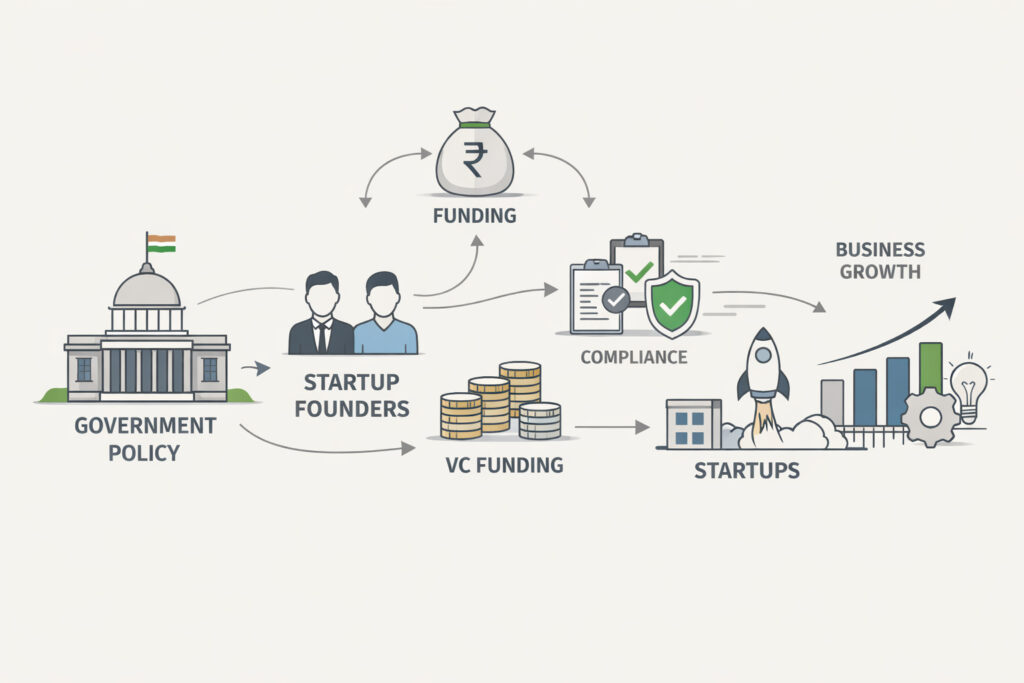
Policy Interaction
The way Startup Policy India Influences Behavior.
Startup policy India framework is an incentive engineered system but not controlled.
Key Policy Levers:
Tax Incentives
- Encourage formalization
- Reward compliance
Recognition Systems
- Create legitimacy
- Improve investor access
Regulatory Relaxation
- Reduce friction
- Enable faster execution
Policy vs Market Dynamics
| Dimension | Policy Influence | Market Reality |
| Entry barriers | Reduced | Still skill-dependent |
| Funding access | Improved | Still competitive |
| Growth | Encouraged | Market-driven |
| Survival | Not guaranteed | High failure rate |
Insight:
Entry conditions are influenced by policy although the markets are the ones that dictate whether an individual survives or not.
Founder Implications
6.1 Shift in Decision-Making
Startup India transformed the decision-making process of founders in three aspects:
Formalization First
Earlier:
- Start informal – scale later
Now:
- First come first served – early settlement perks.
Funding-Oriented Thinking
Founders increasingly:
- Design business-ready designs.
- Align with VC expectations
Incentive Optimization
Founders now consider:
- Tax benefits
- Compliance advantages
- Eligibility criteria
as part of business strategy.
6.2 Behavioral Changes
| Behavior | Pre-Startup India | Post-Startup India |
| Risk appetite | Low | Increased |
| Experimentation | Limited | Higher |
| Formal structure | Delayed | Early adoption |
| Policy awareness | Minimal | Strategic |
6.3 Hidden Trade-offs
While incentives improved:
- Valuation may be pursued by founders instead of value.
- Design driven by policy can pervert product orientation.
Future Outlook
7.1 Likely Trends
Decentralization of Startups.
- Growth beyond metro cities
Sector Diversification
- Deep tech, climate tech and health tech.
Policy Refinement
- More targeted incentives
- Reduced eligibility gaps

7.2 Structural Risks
Overdependence on Policy
- Founders who are over dependent on incentives.
Funding Cycles
- Exposure to international capital risks.
Execution Gap
Policymaking vs policymaking.
7.3 What Needs Improvement
- Streamlined compliance at later stages.
- Improved coverage in non metro areas.
- Invitations of non-technical startups.
Conclusion
The Startup India Impact is not the number of startups that have been established, but rather how it has fundamentally changed the incentives of founders in India. It lowered barriers to entry, deepened access to capital and established more framework in the policy frontier making the practice of entrepreneurship less risky and unstructured and more of a rational economic decision.

Nevertheless, there are limitations of the system. Although policy is important in bettering the initiation conditions, it does not ensure sustainability, scalability, and success. Founders are still required to work with market reality, operational complexity, and capital efficiency issues.
The Startup India Impact is in its final form the alignment of incentives between founders, investors, and the state – establishing a more consistent, yet still developing startup ecosystem.
Frequently Asked Questions (FAQs).
What is the Startup India Impact?
Startup India Impact is the effect the Startup India initiative had on the organization of entrepreneurship in India, decreasing regulatory friction, enhancing access to funds and developing formal recognition systems. Rather than merely adding more startups, it transformed the risks, capital, and business model evaluation by the founders.
What was the effect of Startup India on the incentives of the founders?
Startup India changed incentives to the founders by:
- Minimizing downside risk, tax benefits and compliance relaxations.
- Expanding upward growth potential through more convenient financing.
- Promoting early formalization by DPIIT recognition.
This turned the business into a more economically sensible choice and not a high-risk gamble.
What are the major advantages provided on the framework of startup policy India?
The major advantages of startup policy India model are:
- Tax holidays on eligible start ups.
- Capital gain exemptions (under certain circumstances).
- Self-certification to improve compliance.
- Quick patent and trademark registration.
- Fund of Funds supported by the government.
Does Startup India do direct funding of startups?
No, Startup India mostly operates under an indirect financing system. Venture capital funds are funds by the government to venture capital, which invest in startups. This is in a manner that there is market-based investment decision making and not centralized allocation.
Who is eligible to get Startup India benefits?
To qualify:
- This company has to be incorporated in India.
- It is to be under the age of 10 years.
- An annual turnover is not supposed to exceed the specified amount (usually 100 crore).
- It has to have an orientation on innovation, scalability or improvement of products/services.
- Qualification is done by DPIIT recognition.
Has startup india made funds more accessible to founders?
Yes, but unevenly. Although the general access to funds has been enhanced owing to the enhancement in signaling and investor confidence, the founders in the Tier-2 and Tier-3 cities continue to have an uphill task relative to startups in the metro areas.
What are the weaknesses of Startup India Impact?
Key limitations include:
- Limitations to eligibility that lock out a lot of traditional businesses.
- Still complex compliance even with improvement.
- Inequalities in funding distribution.
- Overfocus on scalable technology startups.
Does Startup India contribute to the success of business?
Startup India enhances the state of entry, but not success performance. It assists founders to begin quicker, and gain access to resources, however, variables such as product-market fit, execution, and competition dictate success.
What does DPIIT recognition do to a startup?
DPIIT recognition acts as:
- An investor confidence indicator.
- An entrance to tax and compliance advantages.
- Organized identity in the start-up world.
Nevertheless, it does not ensure investments or expansion.
Is Startup India relevant to tech startups alone?
Mostly, yes. The incentive system is biased towards:
- Scalable models
- Technology-driven businesses
- IP-based startups
The policy is not as beneficial to traditional or small service businesses.