
Introduction
In an era where information moves faster than ever, the concept of government narrative influence has become a central topic of public debate. From policy announcements to crisis communication, governments today do far more than govern—they shape how citizens perceive reality itself. This influence is not always overt. It often operates subtly through messaging strategies, media alignment, and digital amplification.
The question is no longer whether governments influence narratives, but how much control they exert—and whether that influence strengthens democracy or undermines it. In countries like India, the media control debate India has intensified as citizens, journalists, and policymakers grapple with competing claims about press freedom, misinformation, and political messaging.
Understanding this issue matters because narratives shape public opinion, electoral outcomes, and even policy acceptance. Whether it’s economic reforms, national security, or social issues, the story surrounding an event can be as impactful as the event itself. This article explores the full landscape of government narrative influence, offering a balanced, deeply analytical perspective on one of the most important issues in modern governance.
Background and Context
The idea of governments shaping public narratives is not new. Historically, rulers have always relied on messaging to legitimize power. From royal proclamations to wartime propaganda, controlling the flow of information has been a strategic necessity.
In the 20th century, the rise of mass media—newspapers, radio, and television—transformed narrative control into a structured system. Governments began working closely with media institutions to disseminate official viewpoints. During global conflicts like World War II, propaganda machinery became a formalized tool for influencing public perception.
With the advent of the internet and social media, the dynamics shifted dramatically. Information became decentralized, allowing individuals and independent platforms to challenge official narratives. However, this also created new challenges: misinformation, fake news, and algorithm-driven echo chambers.
In India, the evolution of media—from state-controlled broadcasting in earlier decades to a highly competitive private media ecosystem—has added layers of complexity to the media control debate India. Today, the interplay between government messaging and media independence sits at the heart of democratic discourse.
What Is Happening Right Now
Currently, the discussion around government narrative influence is being shaped by several global and domestic developments. Governments worldwide are increasingly investing in digital communication strategies, including social media outreach, influencer collaborations, and data-driven messaging.
In India, the debate has intensified due to:
- The rapid growth of digital news platforms
- Increased scrutiny of traditional media houses
- Allegations of bias or alignment with political interests
- The rise of independent journalism and fact-checking organizations
Additionally, regulatory frameworks around online content, data privacy, and misinformation are evolving. Governments argue that such measures are necessary to maintain order and prevent harm. Critics, however, view them as potential tools for controlling narratives.
This tension has made the topic highly relevant and widely discussed across political, academic, and public spheres.
Why This Topic Is Controversial
The controversy around government narrative influence stems from a fundamental conflict: the balance between governance and freedom of expression.
On one hand, governments have a responsibility to communicate policies, ensure public safety, and counter misinformation. On the other hand, excessive control over narratives can limit dissent, reduce transparency, and weaken democratic institutions.
Key triggers of controversy include:
- Perceived bias in media coverage
- Government interventions in digital platforms
- Laws regulating content and speech
- The role of state-owned versus private media
In India, the media control debate India often revolves around whether the media acts as an independent watchdog or as a channel for official narratives.
Different Perspectives
Supporters’ View
Supporters of government narrative influence argue that it is essential for stability and effective governance.
They believe:
- Governments must counter misinformation to prevent panic and confusion
- Unified messaging helps during crises like pandemics or natural disasters
- Strategic communication strengthens national unity
- Regulations ensure accountability in digital spaces
From this perspective, narrative influence is not control but coordination. It is seen as a necessary tool to maintain order in an increasingly complex information environment.
Critics’ View
Critics take a more cautious stance, emphasizing the risks associated with concentrated narrative power.
Their concerns include:
- Suppression of dissenting voices
- Reduced independence of media institutions
- Potential misuse of laws to silence criticism
- Creation of one-sided public discourse
Critics argue that a healthy democracy requires diverse perspectives. When governments dominate narratives, it can lead to a narrowing of public debate and reduced accountability.
Facts vs Claims
Understanding the difference between verified facts and public claims is crucial in this discussion.
Verified Facts
- Governments globally invest in communication strategies
- Digital platforms have transformed information dissemination
- Media ecosystems vary widely in independence and structure
- Regulations on content exist in many democratic countries
Public Claims
- Governments fully control media narratives
- All media houses are biased or influenced
- Regulations are solely tools for suppression
- Independent journalism is entirely free from influence
The reality lies somewhere in between. While governments do influence narratives, the extent and impact vary based on institutional strength, media diversity, and public awareness.
What People Might Be Missing
One overlooked aspect of government narrative influence is the role of technology. Algorithms, data analytics, and targeted messaging have significantly enhanced the ability to shape narratives.
Another missing layer is the role of audience behavior. People tend to consume information that aligns with their beliefs, creating echo chambers. This means that narrative influence is not just top-down but also shaped by user preferences.
Additionally, economic factors play a role. Media organizations rely on advertising revenue, which can indirectly influence editorial decisions. This adds complexity to the media control debate India, where financial sustainability intersects with editorial independence.

Impact on Society / Economy / Users
The impact of narrative influence extends beyond politics.
Society
- Shapes public opinion and social attitudes
- Influences cultural and ideological trends
- Affects trust in institutions
Economy
- Impacts investor confidence
- Influences policy acceptance
- Affects market behavior
Users
- Determines access to information
- Shapes perceptions of reality
- Influences decision-making
For individuals, the challenge lies in navigating an information landscape where narratives can be both informative and persuasive.
Role of Media and Narrative
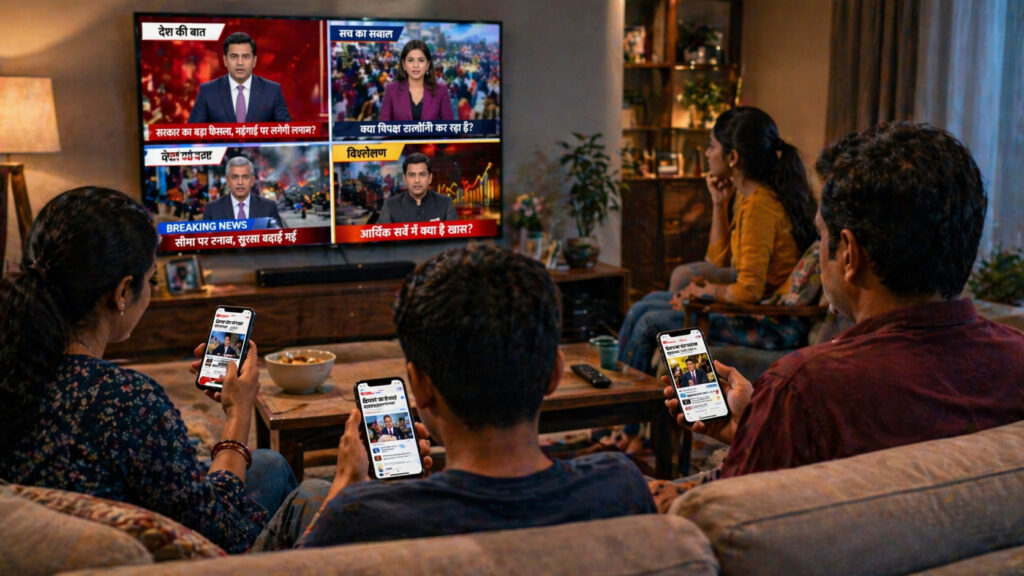
Media plays a defining role in shaping how government narrative influence reaches the public. It is not just a passive channel that delivers information; it actively interprets, frames, and prioritizes what people see and how they understand it. In many ways, media acts as both a bridge and a gatekeeper between governments and citizens.
Traditional media—television, newspapers, and radio—continues to hold strong influence, especially in regions where digital access is uneven. These platforms often set the agenda for public discussion. Prime-time debates, editorial choices, and headline framing can significantly affect how a policy or event is perceived. Even today, a single news cycle on television can shape national discourse within hours.
However, the rise of digital platforms has fundamentally altered this landscape. Social media allows governments to communicate directly with citizens without relying entirely on traditional media filters. Official handles, live broadcasts, and instant updates enable real-time messaging. This direct communication reduces dependency on intermediaries but also raises questions about accountability and verification.
At the same time, independent journalists, content creators, and digital-first media platforms have emerged as powerful counterbalances. They provide alternative perspectives, fact-check official claims, and highlight stories that may not receive mainstream coverage. This diversity has strengthened public discourse but has also contributed to information overload and fragmented audiences.
Another crucial factor is the role of algorithms. Digital platforms prioritize content based on engagement, relevance, and user behavior. This means that visibility is not always determined by importance but by what generates clicks, shares, and reactions. As a result, certain narratives can gain disproportionate traction, while others remain underrepresented. This algorithmic influence adds a new layer to the media control debate India, where concerns extend beyond ownership and editorial independence to include platform dynamics.
Narratives themselves are rarely neutral. They are shaped through repetition, framing, and selective emphasis. The same event can be presented in multiple ways depending on the angle chosen. Media organizations, consciously or unconsciously, influence this framing. Over time, repeated exposure to a particular narrative can normalize certain viewpoints and marginalize others.
In India, the scrutiny of media’s role has intensified. Questions about alignment, independence, and credibility are frequently raised. Some argue that parts of the media ecosystem reflect government perspectives too closely, while others believe that criticism of the government is still widely visible across platforms. The reality is complex, involving a mix of editorial choices, market pressures, audience preferences, and political context.
Ultimately, media is not just a transmitter of narratives but a powerful participant in shaping them. Its influence depends on credibility, diversity, and the ability to balance speed with accuracy.
Bigger Picture / Future Outlook
Looking ahead, the landscape of government narrative influence is expected to become even more sophisticated and multifaceted. Technology will continue to play a central role in how narratives are created, distributed, and consumed.
One of the most significant developments is the increasing use of artificial intelligence in communication. Governments can now analyze vast amounts of data to understand public sentiment, predict reactions, and tailor messages accordingly. AI-driven tools enable highly targeted communication, allowing different messages to be delivered to different audience segments. While this enhances efficiency, it also raises concerns about transparency and ethical use.
Regulation of digital platforms is another area that will shape the future. Governments around the world, including India, are exploring ways to address misinformation, harmful content, and platform accountability. These regulations aim to create a safer information environment but are often debated for their potential impact on free expression. The media control debate India is likely to evolve further as these policies take shape.
Data privacy is becoming increasingly important as well. With more communication happening online, the collection and use of user data have come under scrutiny. Citizens are becoming more aware of how their data influences the content they see. This awareness could lead to greater demand for transparency in both government communication and platform operations.
Another emerging trend is the growing expectation for accountability. Audiences today are more informed and more critical. They question sources, verify claims, and engage in discussions across multiple platforms. This shift places pressure on both governments and media organizations to maintain credibility and accuracy.
The challenge in the coming years will be to balance effective communication with democratic values. Governments need to inform and guide, especially during crises, but they must also respect the diversity of voices that define a healthy society. Similarly, media platforms must navigate the tension between engagement-driven models and responsible journalism.
As technology continues to blur the lines between information, influence, and control, the need for media literacy will become even more critical. Citizens will need the skills to evaluate sources, understand biases, and interpret narratives critically.
Conclusion
The concept of government narrative influence reflects the evolving relationship between power, information, and public perception. It is shaped by a combination of traditional media structures, digital innovation, and audience behavior. Rather than being inherently positive or negative, it represents a dynamic process that can either strengthen or challenge democratic systems.
More Read

Governments have a legitimate role in communicating policies and maintaining stability, but the potential for overreach remains a concern. The ongoing media control debate India underscores the importance of maintaining a balance between influence and independence. A media ecosystem that supports diverse viewpoints is essential for accountability and informed decision-making.
In the end, the future of narrative influence will depend not only on institutions but also on individuals. An informed and engaged public is the strongest safeguard against imbalance. By questioning, verifying, and exploring multiple perspectives, citizens play an active role in shaping the narratives that define society.
As the information landscape continues to evolve, one question remains central: not just who controls the narrative, but how responsibly that influence is exercised.