

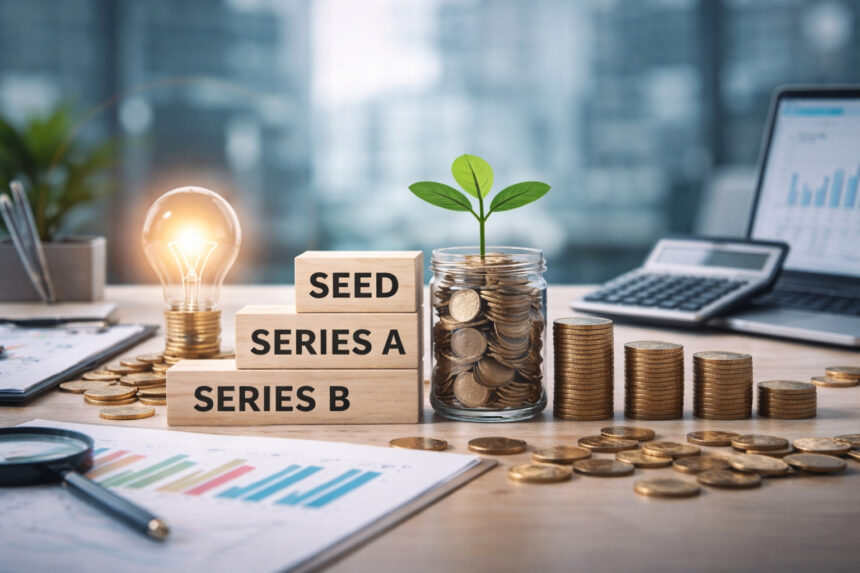
The conversation around Startup Funding Stages is often dominated by headline funding rounds and valuation announcements. However, funding stages are not merely milestones in a founder’s journey; they represent structural checkpoints in the financial architecture of startups. Each stage—from seed to Series A and B—exists to validate a specific business hypothesis: product feasibility, market fit, and scalable growth.
In India’s rapidly expanding startup ecosystem, capital flows through a layered funding system shaped by venture capital structures, institutional risk models, and regulatory frameworks. Understanding Startup Funding Stages is therefore less about celebrating fundraising and more about understanding how capital allocation mechanisms interact with startup business models.
For founders, this understanding determines not only when to raise capital but also whether external capital is strategically necessary. Misalignment between startup maturity and funding stage expectations often leads to premature scaling, dilution challenges, or operational instability.
This analysis examines the structural mechanics of startup funding stages, the economic logic behind them, operational constraints founders face, and the broader policy environment influencing capital flow within India’s startup ecosystem.
1. Startup Context
The modern startup ecosystem is fundamentally a capital allocation system. Venture capital firms, angel investors, and institutional funds collectively allocate risk capital to companies expected to generate disproportionate economic returns.
Unlike traditional small businesses, startups are typically built around scalable models designed to grow rapidly through technology, network effects, or platform economics. Because profitability often arrives late in the lifecycle, startups depend on staged capital injections to sustain development and expansion.
This staged financing structure developed in global venture ecosystems such as Silicon Valley but has been adapted within India’s economic context. Government initiatives supporting entrepreneurship, digital infrastructure growth, and expanding venture capital participation have created an environment where startups can access multiple rounds of funding.
However, capital is not evenly distributed across all stages. Early-stage founders often struggle to secure initial funding, while later-stage companies face pressure to demonstrate growth metrics aligned with venture expectations.
The funding lifecycle is therefore not simply a sequence of rounds. It represents a structured system of risk evaluation and capital deployment designed to filter viable companies from unsustainable ones.

2. Structural Breakdown of Startup Funding Stages
What Are Startup Funding Stages?
Startup Funding Stages refer to the structured phases through which startups raise capital during their lifecycle. Each stage corresponds to a different level of business maturity and investor risk tolerance.
These stages generally include:
- Pre-seed funding
- Seed funding
- Series A funding
- Series B funding
- Later-stage growth rounds
While terminology can vary across ecosystems, the structural logic remains consistent: early rounds finance experimentation, while later rounds finance scale.
Pre-Seed Stage
The pre-seed stage occurs before a startup has a fully developed product or validated market demand.
Funding sources typically include:
- Personal savings
- Friends and family
- Angel investors
- Early incubators
Capital in this stage primarily supports:
- Idea validation
- Early product development
- Initial team formation
- Market research
Investors at this stage accept extremely high risk because the startup has limited evidence of viability. Consequently, funding amounts are usually modest.
Seed Stage
The seed stage marks the first structured external investment round.
Seed funding supports the transition from idea to early product-market fit. Startups typically use seed capital to:
- Build a functional product
- Acquire early users
- Develop operational capabilities
- Establish initial revenue streams
Angel investors and early-stage venture capital funds often dominate this stage. The key evaluation metric is not profitability but the potential for scalable growth.
Founders frequently misunderstand seed funding as a validation of long-term success. In reality, seed capital primarily finances experimentation.
Series A Funding
Series A funding represents the first major institutional investment round.
By the time startups reach Series A, investors expect clear evidence of:
- Product-market fit
- Consistent user growth
- Repeatable revenue models
- Defined target market segments
Series A capital typically finances operational expansion, including:
- Hiring specialized teams
- Strengthening product infrastructure
- Scaling marketing efforts
The structural shift here is important. Seed investors fund possibilities; Series A investors fund evidence.
Series B Funding
Series B funding supports large-scale expansion.
At this stage, startups have already demonstrated:
- Market demand
- Revenue generation
- Operational stability
Series B capital enables companies to:
- Expand geographically
- Invest in advanced technology infrastructure
- Strengthen brand positioning
- Acquire market share aggressively
Investors in Series B rounds expect measurable growth trajectories rather than speculative potential.
Comparison Table: Major Startup Funding Stages
| Stage | Startup Maturity | Typical Investors | Primary Objective | Risk Level |
| Pre-seed | Idea or prototype | Founders, angels | Product development | Very high |
| Seed | Early product | Angels, seed VCs | Market validation | High |
| Series A | Product-market fit | Venture capital | Scaling operations | Medium |
| Series B | Growth phase | VC firms, growth funds | Market expansion | Lower |
This structured funding progression reflects a gradual reduction in investment risk as the startup matures.
3. Economic Logic Behind Startup Funding
The venture capital funding model is based on portfolio economics rather than individual startup success.
VC firms invest in multiple startups with the expectation that only a small percentage will generate large returns. These successful companies compensate for losses incurred from failed investments.
This model works because scalable technology companies can generate exponential growth once product-market fit is achieved.
Key economic drivers include:
Network Effects
Digital platforms become more valuable as more users join. Investors fund early losses to build market dominance.
Economies of Scale
Technology companies often experience declining marginal costs as user numbers increase.
Market Consolidation
Many venture-backed industries eventually consolidate around a few dominant players. Early funding enables startups to compete for leadership positions.
However, this economic logic also introduces systemic risks.
Startups may prioritize rapid growth over sustainable revenue models, leading to capital-intensive business strategies. When funding environments tighten, companies dependent on continuous funding may struggle to survive.
This dynamic has been observed across several Indian startup sectors, including food delivery, e-commerce, and mobility platforms.
4. Operational Challenges in Startup Funding
Although funding stages appear structured, founders face significant operational challenges while navigating them.
Capital Access Inequality
Access to venture funding remains uneven across geographic regions and sectors. Technology startups in metropolitan ecosystems often attract more capital compared to startups operating in manufacturing or rural sectors.
Valuation Pressure
Funding rounds often involve valuation negotiations that can affect long-term equity distribution.
Excessively high valuations may appear advantageous initially but can create challenges in subsequent rounds if growth expectations are not met.
Compliance Requirements
Startups raising institutional funding must comply with legal frameworks related to:
- Corporate governance
- Investor rights agreements
- Financial reporting
- Shareholder structures
These regulatory requirements can introduce administrative complexity, particularly for early-stage founders.
Growth Expectations
Investors expect startups to demonstrate rapid growth between funding rounds. This pressure can lead to aggressive spending strategies, sometimes prioritizing short-term metrics over sustainable operations.
Talent Acquisition
Scaling companies require specialized leadership teams. Recruiting experienced professionals during early growth stages can be difficult due to limited operational resources.
5. Policy Interaction in the Indian Ecosystem
Government policy has played an increasingly important role in shaping India’s startup funding environment.
Several initiatives have attempted to improve capital accessibility and encourage entrepreneurship.
Startup India Initiative
The Startup India program provides benefits such as:
- Simplified regulatory compliance
- Tax exemptions
- Intellectual property support
- Government recognition programs
These measures aim to reduce structural barriers for early-stage startups.
Fund of Funds for Startups (FFS)
The government-backed Fund of Funds program invests in venture capital funds rather than directly funding startups. This approach allows capital to reach startups indirectly through professional fund managers.
Regulatory Oversight
Startups raising capital must comply with regulations overseen by financial authorities such as the Securities and Exchange Board of India.
These regulations govern venture funds, investment structures, and investor protections.
Tax Policy Impact
Taxation policies affecting capital gains and startup investments influence investor behavior.
Changes in tax treatment can significantly affect venture capital participation, particularly in early-stage investments.
6. Founder Implications
Understanding funding stages is critical for founders making strategic decisions.
Timing Capital Raises
Raising capital too early can lead to unnecessary dilution, while raising it too late may limit growth opportunities.
Aligning Metrics with Funding Stages
Each funding stage requires different performance indicators.
Seed investors prioritize experimentation and market validation, whereas Series A investors focus on revenue traction and scalability.
Maintaining Capital Efficiency
Startups that maintain disciplined spending practices often retain strategic flexibility during market downturns.
Investor Alignment
Not all investors share identical expectations. Founders must evaluate whether investors’ growth timelines align with the startup’s operational capabilities.
Misalignment can create governance conflicts during later stages.
7. Future Outlook for Startup Funding
The startup funding ecosystem continues to evolve as global capital flows shift and economic conditions change.
Several trends are shaping the future of venture funding:
Increased Investor Selectivity
Recent market corrections have encouraged investors to prioritize sustainable business models rather than purely growth-driven strategies.
Rise of Alternative Funding
Revenue-based financing, venture debt, and crowdfunding platforms are emerging as complementary funding sources.
These alternatives may reduce dependency on traditional venture capital structures.
Sector Diversification
Investors are expanding beyond consumer internet startups into sectors such as:
- Climate technology
- Deep technology
- Financial infrastructure
- Healthcare innovation
Global Capital Integration
Indian startups increasingly attract international venture funds, integrating the ecosystem with global capital markets.
8. Conclusion
Understanding Startup Funding Stages is essential for founders navigating the financial architecture of modern startups. These stages—from seed through Series A and B—are not symbolic achievements but structured mechanisms through which investors evaluate risk, allocate capital, and guide company growth.
More Read

For founders, recognizing the structural purpose of each funding stage allows more informed decision-making about capital strategy, operational scaling, and investor partnerships.
As India’s startup ecosystem continues evolving, the ability to navigate Startup Funding Stages effectively will remain a critical determinant of long-term sustainability. Founders who understand the economic and regulatory forces shaping venture capital will be better positioned to align their business models with the realities of the funding landscape.