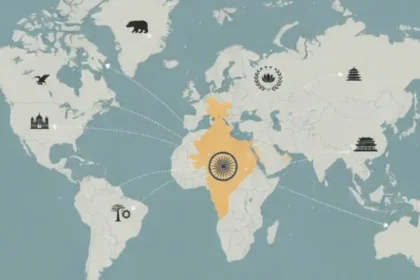
The Service vs Product Startup Model discussion in India has frequently been built emotionally or even aspirational– build global products vs cash-flowing services. However, the actual difference is in structure. It is located in capital formation, regulatory friction, revenue predictability, talent economics and market depth. The decision between services and products is not an ideological one; it is an architectural one as far as founders making a startup decision in India are concerned.
The startup ecosystem in India has gone through multiple stages: domination by the IT services industry, the growth of the consumer internet, the advent of SaaS and deep-tech experimentation. However, even with greater product exposure, services still hire more founders, take in more mid-level talent and provide more reliable early-stage cash flows. In the meantime, product startups are valued at greater multiples of capital but contain greater capital risk and longer gestation times.
This article considers the Service vs Product Startup Model in structural terms which include funding mechanisms, economic rationality, regulatory fact and ramifications and operational consequences but not founder stories.
Startup Context: The Structural Ecosystem Question.
The historic entrepreneurial ecosystem of India has been service-based. Some companies like Infosys, Tata Consultancy Services, and Wipro developed an export-oriented IT services company that took advantage of the labor arbitrage and global outsourcing requirements.

Conversely, more recent changes to a more scalable intellectual property are exemplified by product-led technology companies like Freshworks, Zoho, and Razorpay.
Whether one of the models is better is not an issue of the ecosystem. The question is:
- What are the structural conditions that are conducive to service startups?
- Under what circumstances can product startups be scaled?
- What are the recommendations that a founder will make depending on capital, skills and time horizon in India start up?
This decision is highly influenced by the economic fundamentals of India such as high labor force, price-sensitive domestic market, and the changing digital infrastructure.
Structural Breakdown
2.1 Funding Structure
Service Startups:
- Often bootstrap-friendly.
- The revenue can start in a few months.
- Reduced start up capital.
- Debt of banks might sometimes become viable as soon as the receivables stabilize.
- Unless the services are tech-enabled or niche services, the angel financing is less common.
Product Startups:

- High upfront R&D costs.
- Revenue is often delayed.
- Reliance on equity capital.
- Close congruence with the venture capital growth model.
- Burn rate is eminent during early years.
As a venture capital firm in India, venture capital firms like Sequoia capital India and Accel India generally have scalable product business because it is likely to give high returns. Non-platformized and non-margin-optimized services are considered linear-growth businesses.
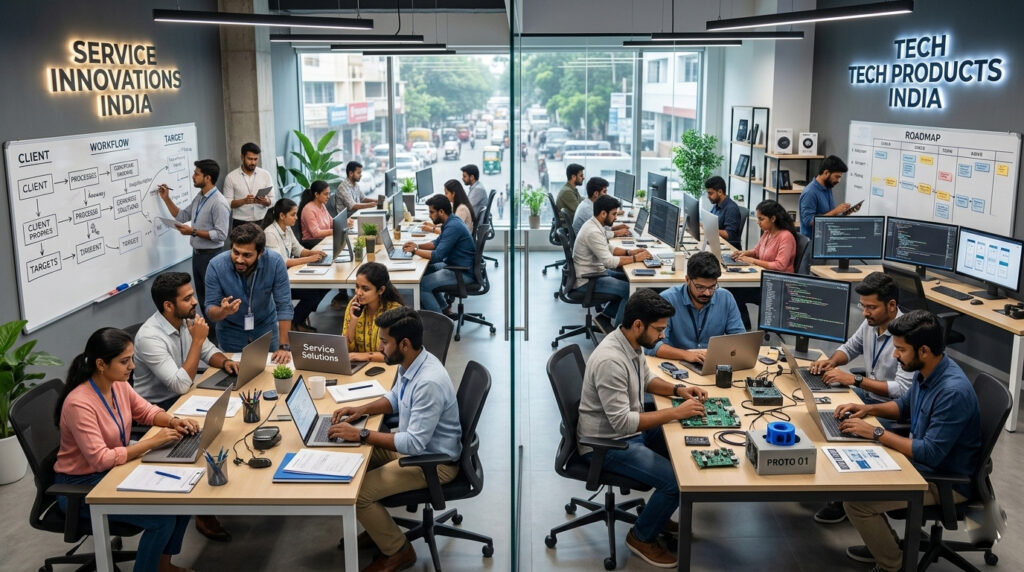
Structural Implication:
Premises Capital capital markets provide structural rewards to product businesses in the sense that the valuation framework is designed to be based on scalability multiples (ARR, gross margins, network effects). The service companies are rated based on the stability of EBITDA and predictability of revenues.

2.2 Business Model Logic
| Dimension | Service Startup | Product Startup |
| Revenue Model | Client contracts | License/subscription |
| Scalability | Linear (people-based) | Non-linear (tech-based) |
| Margins | Moderate | High (if scale achieved) |
| Risk Profile | Lower | Higher |
| Capital Intensity | Low–Medium | Medium–High |
| Customer Acquisition | Relationship-driven | Marketing + distribution-led |
| Time to Revenue | Short | Long |
Service businesses monetize effort. Product businesses monetize intellectual property.
In India, labor cost advantage makes services economically viable even with moderate pricing. However, product startups require deeper product-market fit validation and longer runway.
2.3 Regulatory Environment
The regulatory model of India has an impact on both models:
- Billings cycles of services are affected by GST compliance.
- Cross-border exports of SaaS have to be followed by FEMA and RBI standards.
- The compliance of data in changing frameworks has a tremendous impact on product startups.
- Service firms that have bigger teams are affected by labor compliance.
Startups of products are particularly subject to regulation within a sector, particularly in fintech, edtech, or healthtech. Companies in the service sector can easily be caught up in employment jurisdiction and tax structuring issues.
Economic Logic: What Makes this Model Work or Fail.
Service Model Economics
Why it works in India:
- Huge stock of technical graduates.
- Global outsourcing demand.
- Reduced pay foundation relative to the developed markets.
- Accelerated access to profitability.
Why it fails structurally:
- The income increases as the number of heads grows.
- Competitive margin pressure.
- Low valuation ratios.
- Exposed to the swings of the world market.
- Product Model Economics
Why it works in India:
- International SaaS markets.
- Recurring revenue models.
- High gross margins at scale.
- Venture capital alignment.
Why it fails structurally:
- High early burn.
- The volatility of customer acquisition cost.
- Profitability takes long before it takes effect.
- Reliance on the funding cycles.
The divergence of the economies is in the scaling elasticity. Service models change at the same rate; product models change exponentially–but only when product-market fit is attained.
Operational Challenges
4.1 Compliance Complexity
Service startups:
- Payroll compliance.
- Contract management.
- GST filing complexity.
Product startups:
- Data security frameworks.
- IP protection.
- Global multi-jurisdiction compliance.
4.2 Capital Management
- Slow payment raises pressure on working capital of service startups.
- Burn rate causes product startups to experience runway pressure.
The type of capital stress is different and is present in either.
4.3 Market Penetration
- The domestic market of India is price-elastic.
- Startups in the service sphere are able to tailor products.
- The enterprises that start products should justify subscription costs.
Export-led SaaS models minimize this limitation however amplify competition.

4.4 Scalability Constraints
Services:
- Talent dependency.
- Quality consistency issues.
- Scaling operational oversight.
Products:
- Scaling of infrastructure is expensive.
- Customer support at scale.
- Technical debt.
Policy Interaction
The Indian policy on the startup models does not look at all startup models as equal even in cases where frameworks seem to be neutral on paper. The regulatory and incentive environment modulates the capital flow, the compliance level, the viability of the exports and the classification of innovations. Policy interaction is silent but firm in the context of the Service vs Product Startup Model.
Formal recognition, facilitated easy entry into regulations, and better access to tax breaks, as well as funding facilitation, were aimed by government programs like Startup India. The tax holidays (on conditions), the simplification of the public procurement norms, intellectual property assistance are the benefits of DPIIT recognition under this program. The structural utility of these advantages however varies between service and product start ups.
Type of Biases in Innovation Classification Bias
The frameworks of DPIIT recognition are very much inclined to make an emphasis on innovation, scalability, and the development of technology. This orientation is much more visible, and, in fact, corresponds to product-led startups, particularly to SaaS, deep tech, biotech and fintech companies that can show intellectual property or technology differentiation.
Startups in the service industry, especially consulting firms, digital agencies, outsourcing companies, or operational services, have found it difficult to fit into the innovation-focused definitions, unless automating a specific tool or processing. Although they may still be registered as startups, product business is perceived to be more aligned to the policy.
This organizational prejudice affects the access to:
- Funds of funds supported by the government.
- Incubation support
- Innovation-linked grants
- IP reimbursement schemes
R&D Incorporations and IP Models.
Intellectual property schemes are more beneficial to product startups. Rebates on the filing of patents, expedited examination and facilitation through the law help in lowering the cost of safeguarding innovation. In the case of SaaS or deep-tech businesses, IP defensibility facilitates investor confidence.
Patentable innovation is seldom important to service startups. They are defensible in terms of relationships, quality of execution and expertise. This leads to the policy regimes which favour the creation of IP to generate structural benefits to the product firms indirectly.
This has an implication on taxation and the GST.
Taxation wise, the two types of startups that are service and product based operate under GST. However:
In service startups, there are frequent input-output credit cycles as well as client billing-related issues.
Software subscriptions sold on a subscription basis by product start ups within the country should use GST on digital services.
The export business of services and SaaS exports has zero-rated supply structures, which must be strictly adhered to in accordance with the FEMA and RBI requirements.
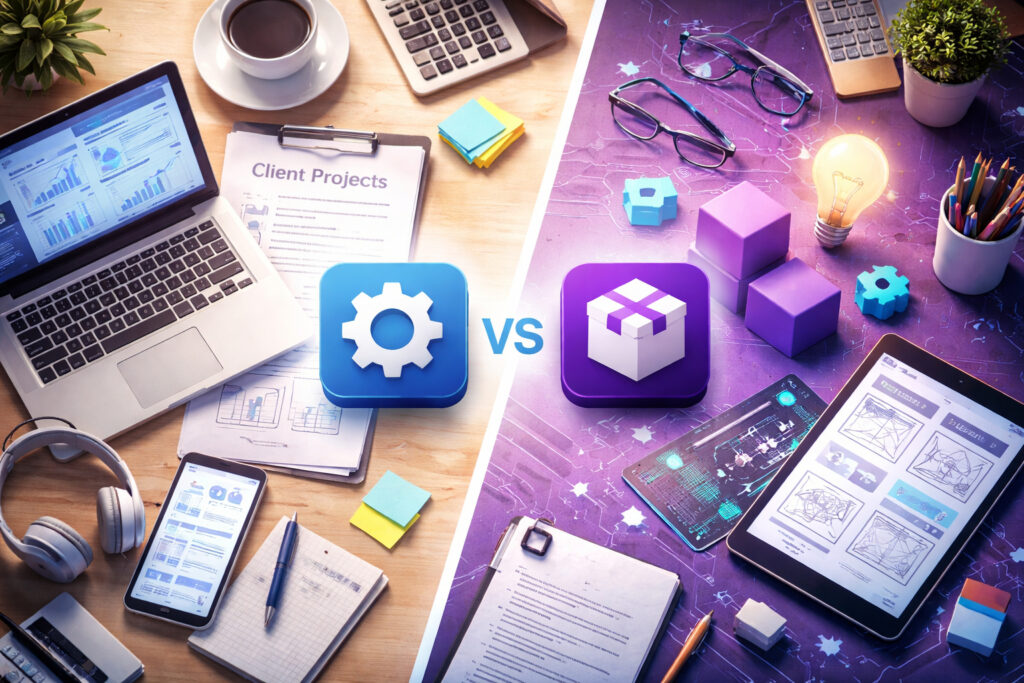
Traditionally, export incentives offered the IT service firms preference to the outsourcing boom. Big companies like Infosys and Tata Consultancy Services worked under Special Economic Zone (SEZ) and export-oriented units that lessened the painful taxation.
Modern-day SaaS exporters are subject to the same export provisions, though compliance documentation is still comprehensive to early-stage product firms that are not conversant with cross-border structuring.
Reforms in Ease of Doing Business.
The global ease-of-doing-business indicators have improved in India over the last decade due to the digitalization of the company incorporation procedure, quicker insolvency solutions, and easier compliance report submissions. These reforms ease entry barriers to service and product start up.
Nevertheless, structural differences are still present:
- The complexity of labor laws applies to large teams used by service startups.
- Sectoral compliance layers are experienced in product startups in regulated industries (fintech, healthtech, edtech).
- The development of data governance is shifting, making digital products firms more expensive to comply.
Therefore, when compared to friction, reforms have a minimum impact, whereas there is no complete neutralization of structural differences between models by the policy environment.
In a brief, the social policy is more likely to enhance the benefits of innovation induction product projects and provide a service exporter with operational security. To make a startup decision in India, it is important to have insight on how regulatory incentives can be incentivized in accordance with business architecture.
Founder Implications
The Service vs Product Startup Model is not about choice, but structural compatibility, in the case of founders. The decision of startup India needs to consider several axes at the same time.
Capital Access
Capital structure defines sustainability.
Service startups can be more viable to founders who have small savings and have no access to venture. Client-based revenue enables it to operate sustainably, without dilution of external equity.
The product startups may be structurally supported through risk capital by founders embedded within the venture networks, accelerator ecosystems or technology hubs.
It takes 18-36 months of runway to get stable revenue on product startups. Service startups become cash-flow positive in months in case client acquisition is successful.
Risk Appetite
There is a material difference between risk profiles.
Service startups face:
- Revenue volatility
- Client concentration risk
- Margin compression
Product startups face:
- Market rejection risk
- Burn-rate risk
- Fundraising dependency
Moderate risk appetite is associated with the service models, failure is likely to be slow and controllable. Product ventures are associated with high risk tolerance since binary outcomes are more prevalent.
Skill Orientation
Founder skillsets are resolute.
Service founders require:
- Client acquisition strength.
- Relationship management
- Operational oversight
- Delivery excellence
Product founders require:
- Product design thinking
- Technical architecture ability.
- Optimization of the user experience.
- Data-driven iteration
There is a disparity between the founder expertise and the model selected, which adds to the execution friction. Strategic alignment minimizes strategic drift.
Time Horizon
The model choice is affected by the time expectations.
Service startups typically:
- Achieve revenue earlier
- Provide income stability
- Scale incrementally
Product startups typically:
- Delay founder income
- Require reinvestment
- Objective should be valuation-driven exits.
In case a founder is focused on the short-term profitability and consistent growth, the services are organized structurally. Product models are more leverageable in cases where the goal is long-term equity upside and scaled valuation.
Strategic Optionality
More and more hybrid pathways are coming along. There are those service startups that develop internal tools that become their own products. Layering services is used by some product firms to enhance their retention and onboarding.
The implication of the founder is obvious: ambition has to be supported by the structure awareness. The decision India startup is a constructive decision, rather than an inspirational statement.
Future Outlook
The startup ecosystem of India is in a transitionary stage.
There are three structural trends to be observed:
Productization of Services
Consulting firms and agencies are developing their own SaaS solutions to enhance margins, and avoid headcount scaled/based services.
Products Firm Service Layers.
SaaS businesses are becoming more likely to offer onboarding services, managed care, and consulting services in order to boost retention and customer lifetime value.
International Strategy Day One.
A growing trend in product startups is to venture into international markets at an early stage so as not to be limited by price sensitivity in the domestic market.
Nevertheless, there are structural head winds.
Traditional service margins can be squeezed through artificial intelligence and automation reducing the need to provide manual effort. This can drive service firms to increasing specialization or augmentation of technology.
Funding cycles become normal and product startups are put under pressure of capital discipline. Multiples are being pegged on sustainable revenue rather than narratives of growth.
The line between service and product models can be operationally lost over the course of time, although the economic rationale is different:
- People are the scale of services.
- Systems increase the scale of goods.
There will be a further distinction in the use of linear and exponential growth architecture in capital markets.
Conclusion
The Indian version of the Service vs Product Startup Model is not dualistic with the focus on ambition vs. safety. It is a structural decision which is influenced by capital architecture, interaction of regulation, scalability mechanism and economic elasticity.
Startups in service businesses offer quicker monetization, less exposure to capital and increased ability to control operations. Their weakness is linear scalability and moderate valuation multiples.
The product startups have scalable intellectual property, repeatable income possibility, and better fit with the venture capital structure. Their weakness is in late monetization and increased structural risk.
In the case of founders going through an India start up decision, the final factors are:
- Capital depth
- Skill orientation
- Risk tolerance
- Time horizon
Both of the above models will exist side by side and gradually overlap as India develops its startup ecosystem. Usually, the friction can be decreased by policy changes gradually, yet structural economic realities will still create a disparity in results.
The debate on Service vs Product Startup Model will continue. However the right decision is not ideological. It is structural. Adhering to the economic reasoning, rather than ecosystem feeling, in matching resources, capabilities, and expectations, is more likely to help founders create enduring enterprises.