


Government exam papers that include an ethics component—particularly in descriptive examinations—test a candidate’s ability to apply ethical reasoning in administrative situations. Many aspirants prepare theory extensively but struggle to translate that knowledge into structured answers. This is where a clear Ethics Paper Strategy becomes essential.
Unlike other subjects, ethics papers reward clarity of thought, structured reasoning, and balanced judgment. Candidates who write concise, logically structured answers often outperform those who attempt lengthy theoretical explanations.
This guide explains a practical Ethics Paper Strategy that aspirants can apply during preparation and in the exam hall. It focuses on case study writing, structured responses, and answer evaluation methods that directly impact scoring.
Problem Statement: Why Students Struggle in Ethics Papers
Many aspirants approach the ethics paper incorrectly. The challenge is not lack of knowledge but lack of answer application.
The most common issues include:
1. Overemphasis on theory
Students memorize definitions of values like integrity, accountability, transparency, or empathy. However, ethics papers rarely reward definition-heavy answers.
2. Poor case study writing
Case studies require problem identification, stakeholder analysis, and practical solutions. Candidates often skip these steps and jump directly to generic conclusions.
3. Lack of structured answers
Answers without headings or logical flow are difficult for examiners to evaluate quickly.
4. Extreme viewpoints
Some candidates write moralistic or unrealistic solutions rather than practical administrative responses.
5. Time mismanagement
Case studies require deeper analysis. Candidates who spend excessive time on earlier questions struggle to complete them properly.
These mistakes reduce marks even when candidates know the concepts. A clear Ethics Paper Strategy helps avoid these errors.
Concept Clarity: Understanding Ethics Paper Strategy
Ethics papers generally assess three competencies:
-
Conceptual understanding of ethical values
-
Application of ethics in governance
-
Decision-making in administrative situations
Therefore, a strong Ethics Paper Strategy must combine theory with structured application.
A good ethics answer should demonstrate:
-
Ethical awareness
-
Administrative practicality
-
Balanced reasoning
-
Stakeholder sensitivity
Key Components of Ethics Answers
1. Definition or context
Start with a brief explanation of the concept involved.
2. Ethical dimension
Identify the moral issue involved in the question.
3. Administrative perspective
Explain the issue from a governance standpoint.
4. Practical solution
Provide implementable steps.
5. Balanced conclusion
End with an ethical principle or governance value.
Ethics answers should remain analytical rather than philosophical.
Internal Linking Opportunities
[Answer Writing Strategy for Government Exams]
[Self-Evaluation Method for Government Exams Preparation]
[Using Current Affairs in Government Exam Answers]
Practical Framework for Ethics Answers
A structured framework significantly improves clarity and marks.
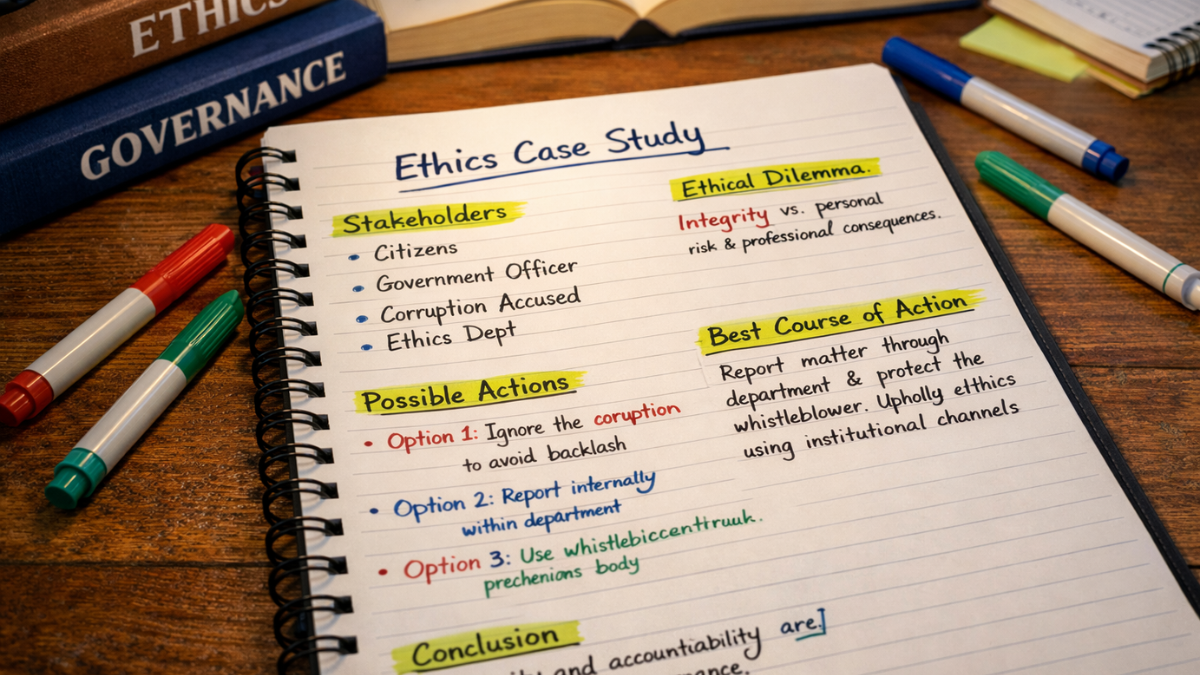
Below is a practical Ethics Paper Strategy framework that works for both theory questions and case studies.
Step-by-Step ApproachStep 1: Identify the Core Ethical Issue
Determine what ethical principle is being tested.
Examples include:
-
Conflict of interest
-
Integrity
-
Public accountability
-
Compassion vs rule enforcement
This step prevents generic answers.
Step 2: Identify Stakeholders
In ethics case studies, stakeholders must be listed clearly.
Common stakeholders include:
-
Citizens
-
Government officials
-
Institutions
-
Vulnerable groups
-
Law enforcement agencies
Stakeholder identification shows analytical thinking.
Step 3: List Possible Options
Most case studies expect the candidate to consider multiple courses of action.
Typical format:
-
Option 1: Strict rule enforcement
-
Option 2: Balanced administrative solution
-
Option 3: Ethical reform approach
Each option should include advantages and risks.
Step 4: Choose the Best Ethical Action
The final step is selecting the most balanced option.
The decision must satisfy three principles:
-
Legality
-
Ethical responsibility
-
Public interest
Example Answer Structure (Short Format)
This format works effectively in most descriptive ethics questions.
Introduction
Briefly explain the ethical concept in one or two lines.
Ethical Dimensions
Explain the moral conflict present in the question.
Stakeholders Involved
-
Citizens
-
Public institution
-
Government authority
-
Vulnerable groups
Possible Courses of Action
Option A – Strict administrative action
Option B – Balanced ethical response
Option C – Reform-oriented approach
Best Course of Action
Explain which option aligns with ethical governance.
Conclusion
Reinforce values like transparency, accountability, or empathy.
Model Answer Snippet (Example)
Question:
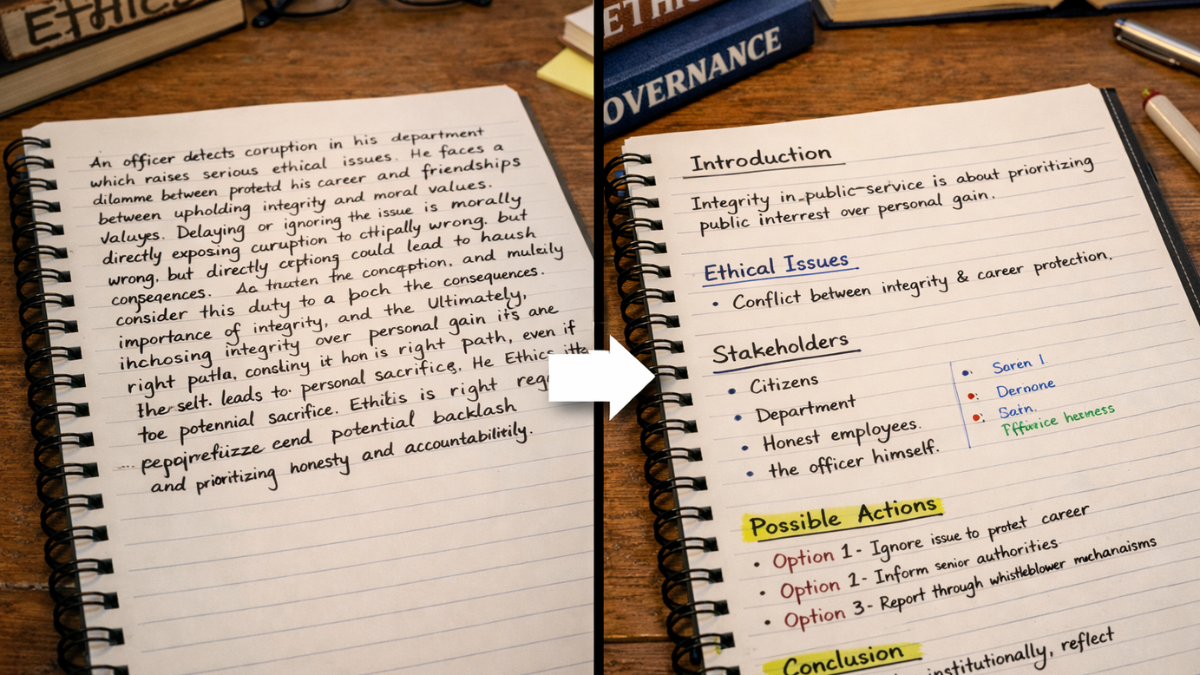
A public officer discovers corruption within his department. Reporting it may affect his career and relationships. What should he do?
Model Answer (Short Format)
Introduction:
Integrity in public service requires prioritizing public interest over personal considerations.
Ethical Issues:
The situation involves conflict between professional integrity and personal risk.
Stakeholders:
Citizens, government department, honest employees, and the officer himself.
Possible Actions:
Option 1 – Ignore the issue to protect career stability.
Option 2 – Inform senior authorities through official channels.
Option 3 – Report through whistleblower protection mechanisms.
Best Course of Action:
The officer should report the corruption through institutional mechanisms. This ensures accountability while maintaining procedural integrity.
Conclusion:
Ethical governance depends on institutional transparency and individual integrity.
Mistake vs Correct Approach
| Mistake | Correct Approach |
|---|---|
| Writing long moral lectures | Provide structured analysis |
| Ignoring stakeholders | Clearly list affected groups |
| Jumping to conclusions | Evaluate multiple options |
| Overuse of theory | Focus on practical solutions |
| Emotional language | Maintain administrative reasoning |
Common Errors in Ethics Paper Answers
Even well-prepared candidates lose marks due to recurring mistakes.
Writing philosophical essays
Ethics answers should not resemble academic philosophy discussions.
Incorrect approach:
Long discussions about moral theories.
Correct approach:
Focus on governance applications.
Ignoring administrative practicality
Some answers propose unrealistic solutions such as immediately exposing corruption publicly.
Examiners expect institutional processes, not dramatic actions.
Lack of structure in case study writing
Unstructured answers reduce readability.
Examiners prefer:
-
Headings
-
Bullet points
-
Logical flow
Overly lengthy introductions
Ethics answers should begin quickly with the ethical issue.
Ideal introduction length: 2–3 lines.
No final ethical principle
Many answers end abruptly.
A strong conclusion should reference values like:
-
Accountability
-
Compassion
-
Public service
Not connecting theory to governance
Concepts like empathy or integrity should always be linked to administrative situations.
For example:
Empathy → fair treatment of vulnerable citizens.
Tactical Application: How Ethics Strategy Improves Marks
A practical Ethics Paper Strategy improves marks in several measurable ways.
Improves answer clarity
Structured answers allow examiners to evaluate responses quickly.
Clear structure increases scoring consistency.
Demonstrates analytical thinking
Listing stakeholders and options shows problem-solving ability.
This is a key scoring parameter in ethics papers.
Shows administrative maturity
Balanced decisions demonstrate suitability for governance roles.
Examiners value practical judgment.
Reduces irrelevant content
Structured answers eliminate unnecessary explanations.
This saves time during the exam.
Improves case study writing
Case studies often carry higher marks.
Candidates who follow a structured framework consistently score better.
Improvement Plan: Weekly Ethics Preparation Strategy
A systematic preparation plan helps implement the Ethics Paper Strategy effectively.
Daily Practice (30–40 Minutes)
Task 1: Concept Review
Study one ethics concept per day.
Examples:
-
Integrity
-
Transparency
-
Accountability
-
Compassion
Write a 3-line explanation and one governance example.
Task 2: Mini Case Study
Practice one small case study daily.
Focus on:
-
Stakeholder identification
-
Two possible actions
-
One balanced decision
Weekly Practice Plan
Day 1–2
Concept-based questions.
Write short answers using the introduction–body–conclusion format.
Day 3–4
Case study writing practice.
Use the stakeholder–options–decision framework.
Day 5
Evaluate answers.
Check:
-
Logical structure
-
Ethical reasoning
-
Practical solutions
Day 6
Rewrite one previous answer with improved structure.
Day 7
Full-length ethics practice.
Attempt one timed mock section.
Self-Evaluation Checklist
Before finalizing answers, ask:
-
Did I identify the ethical issue clearly?
-
Did I list stakeholders?
-
Did I provide multiple options?
-
Is the final decision practical?
-
Did I include an ethical principle in conclusion?
If all answers are yes, the response follows a strong Ethics Paper Strategy.

Conclusion
The ethics paper in government examinations is not about memorizing philosophical definitions. It evaluates decision-making ability in real administrative situations. Candidates who rely only on theoretical preparation often struggle with case study writing and structured answers.
A well-defined Ethics Paper Strategy focuses on identifying ethical issues, analyzing stakeholders, evaluating possible actions, and selecting the most balanced administrative response. This structured approach ensures clarity, practicality, and strong scoring potential.
By consistently practicing structured answers, analyzing case studies, and evaluating responses, aspirants can significantly improve their performance in ethics papers. A disciplined preparation plan combined with a clear Ethics Paper Strategy transforms ethics from a difficult subject into a scoring opportunity.