

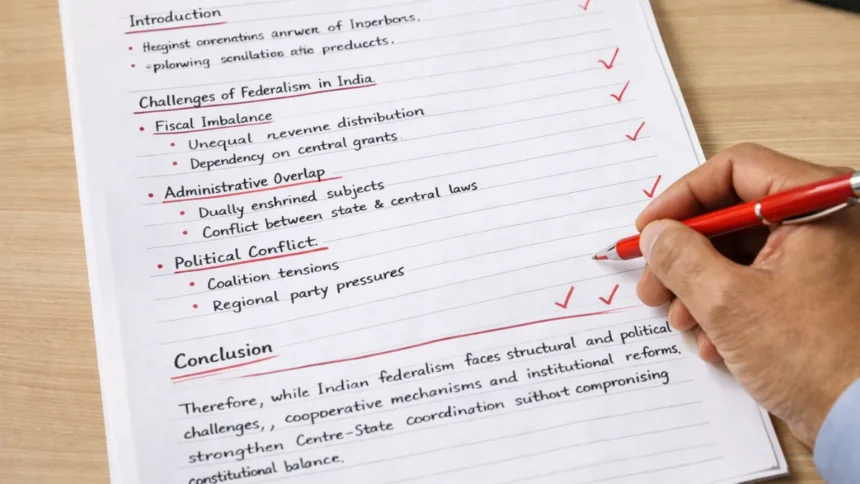
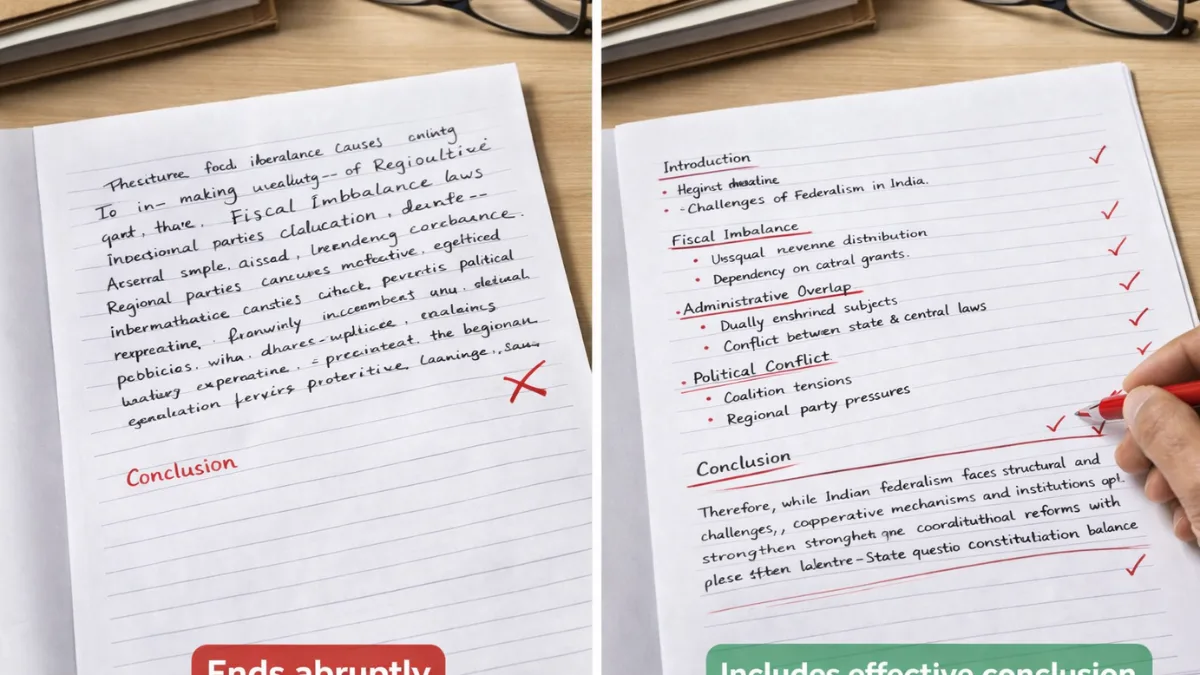
In descriptive government examinations, students often focus heavily on introductions and body content while neglecting the final 3–5 lines of their answer. However, Conclusion writing in government exams plays a direct role in how examiners perceive completeness, clarity, and maturity of thought. A strong answer that ends abruptly loses structural coherence. A moderate answer with a precise, structured ending often scores higher because it signals control.
The mistake is not a lack of knowledge. It is a lack of finishing discipline.
This article provides a practical, exam-focused system to build an effective answer-finish strategy that improves scoring reliability for 10-, 15-, and 20-mark questions.

Problem Statement
The Core Issue
Most aspirants:
- Run out of time and skip conclusion
- Write a generic summary sentence
- Repeat introduction in different words
- End abruptly after last body point
- Add irrelevant optimistic statements
Examiners checking hundreds of copies look for structural closure. When an answer lacks a defined conclusion:
- It appears incomplete
- It lacks conceptual wrapping
- It reduces examiner satisfaction
- It may lose 1–3 marks in mid-to-high range questions
In competitive exams like the Union Public Service Commission Civil Services Examination, margins of 2–3 marks per question determine final rank differences.
Conclusion writing is not decoration. It is structural reinforcement.
Concept Clarity
What Is a Conclusion in Government Exam Answers?
A conclusion is:
- A structured closing segment (3–5 lines)
- A synthesis of the core argument
- A forward-looking or solution-oriented closure
- A conceptual rounding-off
It is NOT:
- A repetition of introduction
- A motivational statement
- A moral speech
- A random future prediction
Types of Effective Conclusions
Depending on question demand, use one of these:
Summary-Based Conclusion
- Rephrase central argument briefly.
- Suitable for “Discuss” questions.
Way Forward Conclusion
- Provide 2–3 policy-oriented future steps.
- Suitable for governance questions.
-
Linkage Conclusion
- Connect answer to constitutional value, SDGs, or national goals.
- Suitable for polity, ethics, society.
-
-
Balanced Judgement Conclusion
- Provide final analytical stance.
- Suitable for “Critically examine” questions.
-
-
Your conclusion must match directive word.
This alignment is core to a strong answer finishing strategy.
Practical Framework
Step-by-Step Approach for Writing Conclusions
Identify Directive Word
- Discuss → Balanced wrap-up
- Analyse → Analytical closure
- Critically examine → Conditional judgement
- Evaluate → Final assessment
Extract Core Argument
Before writing conclusion, mentally ask:
- What is my central line?
- Did I argue benefit, limitation, or balance?
Choose Closure Type
Select from:
- Summary
- Way forward
- Institutional reference
- Value-based
Keep It Structured
Use:
- 3–4 lines maximum
- 1 short paragraph
- No bullet points unless question demands structure
Avoid New Information
Never introduce new data in conclusion.
Model Answer Snippet (Short Format)
Question: Discuss the challenges of federalism in India.
Body Points Discussed: Fiscal imbalance, administrative overlap, political friction.
Effective Conclusion Example:
Therefore, while Indian federalism faces structural and political challenges, cooperative mechanisms and institutional reforms can strengthen Centre-State coordination without compromising constitutional balance.
This conclusion:
- Synthesizes argument
- Avoids repetition
- Adds forward direction
- Signals maturity
Mistake vs Correct Approach Comparison
| Mistake | Why It Fails | Correct Approach |
| “In conclusion, federalism is important.” | Too generic | “Balanced institutional reforms can reinforce cooperative federalism.” |
| Repeating introduction | Redundant | Condense core argument |
| Writing 8–10 lines | Wastes time | Keep it precise |
| Adding new statistics | Breaks flow | Only synthesize existing points |
| Emotional ending | Not analytical | Stay policy-focused |
Common Errors in Conclusion Writing Government Exams
1. Time Collapse
Students write detailed body and leave 30 seconds for ending.
Result:
- Abrupt stop
- Incomplete thought
- Reduced structural clarity
2. Decorative Optimism
Example:
“With collective efforts, India will become a superpower.”
This adds no analytical value.
3. Mechanical Template Use
Some aspirants end every answer with:
“Thus, holistic reforms are needed.”
Examiners recognize repetition patterns across copies.
4. Introducing New Argument
If you didn’t discuss decentralization in body, don’t add it in conclusion.
5. Writing Too Long
A long conclusion reduces time for next answer.
Tactical Application: How It Improves Marks
Examiners typically assess:
- Relevance
- Structure
- Clarity
- Analytical depth
- Completeness
Conclusion directly affects:
1. Perceived Completeness
An answer with defined closure appears organized.
2. Conceptual Control
Shows you can synthesize argument.
3. Examiner Satisfaction
Examiners prefer answers that feel “finished.”
4. Differentiation
When 70% of copies end abruptly, structured endings stand out.
In exams conducted by bodies like Staff Selection Commission or state public service commissions, structured answers consistently receive mid-to-high band marks due to presentation clarity.
Conclusion writing helps convert:
- 5/10 → 6/10
- 9/15 → 11/15
- 11/20 → 13/20
That cumulative improvement shifts final ranking significantly.
Practical Templates for Different Question Types
A. For Governance Questions
A balanced implementation of institutional reforms and accountability mechanisms can address these challenges effectively.
B. For Economy Questions
Sustainable growth will depend on policy coordination, fiscal discipline, and inclusive development strategies.
C. For Polity Questions
Strengthening constitutional mechanisms while preserving democratic values remains central to resolving these concerns.
D. For Ethics Questions
Ethical leadership combined with institutional transparency can ensure long-term public trust.
These are adaptable formats — not fixed line
Integration with Overall Answer Structure
Your answer must follow:
- Introduction (10–15%)
- Body (70–75%)
- Conclusion (10–15%)
Conclusion should reflect body structure.
If body is:
- Cause → Impact → Solution
Then conclusion should emphasize solution.
If body is:
- Pros → Cons
Then conclusion should provide balanced judgement.
For full structure guide, see:
[How to Structure 10 and 20 Mark Answers]
[Directive Words in Government Exams Explained]
[Why Students Lose Marks in Mains Examination]
Improvement Plan: Execution Strategy
Daily Practice (30 Minutes)
- Write 3 conclusions for previous year questions.
- Limit to 4 lines each.
- Focus only on closure, not full answer.
Weekly Drill
- Take 10 random questions.
- Write only introduction and conclusion.
- Check alignment between both.
Evaluation Checklist
After writing conclusion, verify:
- Does it summarize core argument?
- Does it avoid repetition?
- Is it within 4 lines?
- Does it match directive word?
- Does it avoid new content?
Peer Review Method
Exchange answer sheets with serious aspirants.
Only evaluate:
- Strength of conclusion
- Clarity
- Analytical maturity
This targeted training builds finishing discipline.
Advanced Refinement Strategy
Once basic structure is mastered, refine by:
1. Value Linking
Connect to:
- Constitutional values
- Sustainable Development Goals
- Governance principles
But only if relevant.
2. Institutional Referencing
Mention institutions carefully if discussed in body.
Example:
Strengthening intergovernmental forums can enhance cooperative federalism.
3. Precision Language
Replace vague words:
- “Very important” → “Institutionally significant”
- “Needs improvement” → “Requires structural reform”
Precision improves scoring band.
Time Management for Conclusion Writing Government Exams
Allocate:
- 1 minute for 10-mark answer
- 1.5 minutes for 15-mark answer
- 2 minutes for 20-mark answer
Practice writing conclusion within time limit.
Never compromise next question for perfect ending.
Efficiency over decoration.
More Read

Conclusion
Conclusion Writing Government Exams is a structural skill, not a literary exercise. It converts knowledge into a complete answer. A disciplined answer finishing strategy ensures that your response does not collapse in the final lines. When aligned with directive words, synthesized properly, and limited to 3–4 precise lines, the conclusion improves perceived completeness, analytical maturity, and examiner satisfaction.
In competitive descriptive examinations, controlled endings are often the difference between average and high scoring copies. Mastering Conclusion Writing Government Exams ensures that every answer you write ends with clarity, balance, and structural strength.