Why Modi’s Japan Visit Matters Now
The two-day official visit of Prime Minister Narendra Modi to Japan (2930 August 2025) is perceived at a time when international geopolitics are becoming more volatile. The previous robust relations between India and the United States cannot be sustained anymore following the imposition of exorbitant tariffs on Indian imports by President Donald Trump. This has compelled New Delhi to orient to the east, a partner who has again and again demonstrated trust, reliability and long term commitment: Japan.
India is not new with Japan. The India-Japan relationship is more than trade and defense. It rests on centuries of cultural links, mutual interests in democracy, and an awareness of the significance of every country within the greater Indo-Pacific region. The historicity of this visit is, however, in the magnitude of the economic and technological partnership on the table.
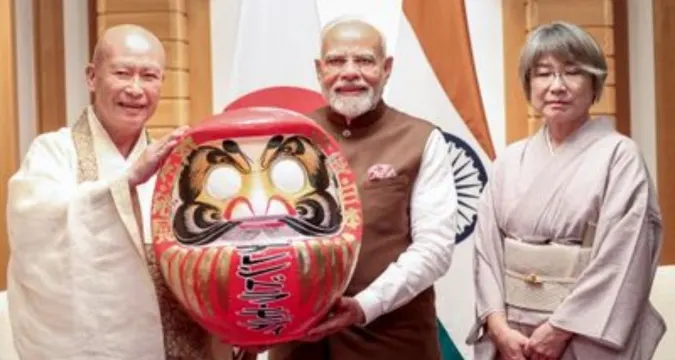
The center of the negotiations is an enormous investment package of $68 billion. Japan is ready to increase its investment in India, it brings back the Mumbai-Ahmedabad bullet-train project and it is concentrating on high-technology collaborations- semiconductors to robotics. The 15th Annual India-Japan Summit, the so-called Modi-Ishiba summit is not merely a diplomatic ceremony. It is an indication that India and Japan are prepared to influence the future of Asia jointly.
The $68 Billion Investment Plan: A Historic Step
Among the largest announcements that are likely to be made during this visit is the commitment of Japan to increase its investment target in India, to an aggregate of an estimated 68 billion dollars during a period of five years. This isn’t just a symbolic gesture. To Japan, India is the fastest-growing large economy in the world, 1.4-billion-person market, and insurance against China ruling Asia. In the case of India, Japanese capital is not only money; it also has technology, efficiency, and trust.

Key Sectors for Investment
Infrastructure: Japan will invest a lot of money in the urban development projects of India such as metro rails, highways, and smart cities. Japan International Cooperation Agency (JICA) has already funded Delhi Metro; such prototypes are underway in Chennai, Bangalore and Ahmedabad.
Green Energy Transition: The Indian, carbon-neutral commitment to 2070 appeals to Tokyo, where renewable technology and hydrogen-based power are actively being advanced. In its investment, Japan will concentrate on hydrogen fuel ecosystems, electric vehicles, solar, and offshore wind projects, which will assist India achieve its high green goals.
High‑Tech Collaboration: The most important areas are semiconductors, AI, robotics, and 6G research. India seeks to eliminate its reliance on Taiwan and South Korea to supply semiconductors and the Japanese experience would be revolutionary. The Semiconductor Mission of the Modi government is in tandem with the efforts of the Japanese in reviving its chip industry.
Defense Manufacturing: As China becomes more assertive in the Indo-Pacific, Tokyo is more open than ever to the prospect of sharing defence technologies. There is ongoing talk about collaborative work on submarines, unmanned aerial systems, and surveillance platforms. This is a historic change of which Japan has until recently had stringent rules as to export of arms.

The very size and dimensions of the $68billion package are indicators that India and Japan are not simply thinking in short-term benefits but are trying to make a multi-decade alliance legal and institutional.
Bullet Train Project: Symbol of the Partnership
The Mumbai-Ahmedabad bullet train was launched in 2017. It is regarded as the focus of the India-Japan collaboration. The train has its foundation on Japan Shinkansen technology. Nevertheless, the project has been delayed. The pandemic, increased prices, and land acquisition have decreased the pace.
The recent visit by Prime Minister Modi has given new impetus. Both parties have promised to accelerate construction. The initial stage will entail about 350 kilometers. It is scheduled to be finished in 2028.

The project has a symbolic component in addition to speed and connectivity. It demonstrates that Japan is ready to give India its most technologically advanced technology- something Tokyo has only given to a limited number of its trusted partners. The bullet train does not only symbolize transportation, but it also symbolizes belief, growth, and unity.
Modi–Ishiba Summit: A Meeting of Strategic Minds
The ModiIshiba meeting is the inaugural summit of the two leaders in a year since Shigeru Ishiba assumed the role of the Japanese Prime Minister early in 2025. With a reputation of being a firm believer in security and defense, Ishiba introduces a new dimension to the Indo-Pacific strategy.
The agenda of the talks occupies a broad canvas:
- Expansion of trade and investment, and new structures should be provided to assist Japanese SMEs in India.
- Defense and maritime cooperation, especially in the East China Sea and the Indian Ocean.
- Technology collaboration, with upcoming agreements in semiconductors, 6G, and space research.
- Cultural diplomacy, including future plans to encourage educational exchanges, training language and Buddhist heritage tourism.
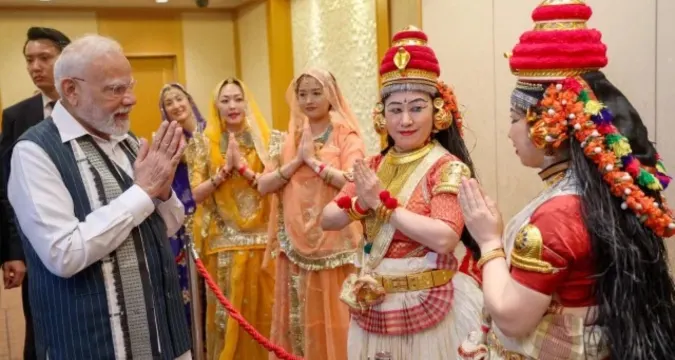
It is not only a meeting regarding the signing of agreements; it is a strategic alignment. It is clear to both Modi and Ishiba that the future of Asian security lies in the establishment of a rules-based Indo-Pacific order with India and Japan as close allies.
Semiconductors and Tech Diplomacy: Sendai Visit
One of the most important scenes of the visit is the trip of Modi and Ishiba to Sendai during which they will ride a high-speed train in Japan as well as visit one of the largest semiconductor factories. The visit has symbolic meanings in a number of ways.
It brings out the ambition of India to emerge as a worldwide semiconductor center by 2030.
It is also an indication of how Japan was determined to revive its once-dominant chip industry by involving its trusted allies.
In addition, it conveys a strong geopolitical message that India and Japan are willing to cooperate to reduce their dependence on China and Taiwan on essential technologies.
Artificial intelligence, robotics, quantum computing, and clean-tech innovation will also be discussed in the talks. To India, which is also trying to be a center of digital creativity and manufacturing, such a collaboration can be a game-changer.
Japan’s Role in India’s Strategic Balancing
Japan comes in as a stabilizer when the relations between India and Washington are not healthy. Indo-Pacific has ceased to be a mere geographical zone; it is now a strategic venue in which India and Japan are major players.
- India Diversification of partnerships: Japan investments reduce the reliance of India on the United States and Europe.
- Quad framework: Japan and India are the main part of the Quad along with the United States and Australia. The coalition is to secure freedom of the sea and fight Chinese aggressiveness.
- Defence cooperation: The willingness of Japan to exchange defense technologies cannot be compared. It shows the decades of trust.
- Energy security: Japan funds LNG terminals and green hydrogen plants in India, reducing the dependence of New Delhi on unreliable suppliers.
It is Tokyo that needs India and the other way round. To Japan, India provides size, human resource, and a democratic ally to the Indo-Pacific chess board.
India-US Trade Strains and Japan’s Opportunity
The backdrop of this trip is that there has been a tremendous drop in IndiaUS relations because of the move by President Trump to impose high tariffs on Indian imports. The tariffs have hit textile, pharmaceuticals, and IT services wherein the Indian exporters have been left wondering.
The deepening of involvement in Japan comes at an opportune time. Contrary to Washington, Tokyo regards India as not only a market but also as a strategic ally to transform the economic structure of Asia. In host countries, Japan concentrates on long-term investments that create sustainable ecosystems, but not on short-term transactions.
Is the US replaceable by Japan as the most reliable partner of India? Probably not relative to that, since the US continues to be a prime Indian IT and services export destination. In trust, predictability and technology transfer, however, Japan leads the pack.
Second Leg: Modi at SCO in Tianjin
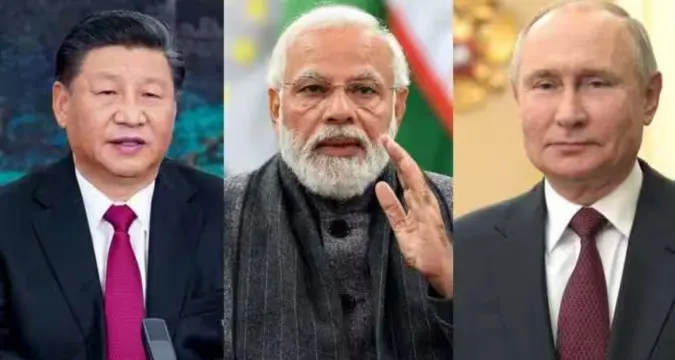
After his visit to Japan, Modi will visit Tianjin, China to the Shanghai Cooperation Organization (SCO) Summit on August 31-September 1. The difference is brought out by the timing. In three days, Modi will be hosting leaders of both Japan and China- two nations that are in a very intense strategic rivalry.
The SCO negotiations will address regional security, terrorism, infrastructure developments and energy collaboration in Central Asia.
The issue of India is to juggle its desire towards Japan and its involvement in China-led groups, such as SCO and BRICS+. This is an Indian diplomatic art: how to deal with rivalries and at the same time keep both parties happy.
Historical Context: India–Japan Relations Since 2000s
The Modi-Ishiba summit is the latest development in the long-time relationship of India and Japan.
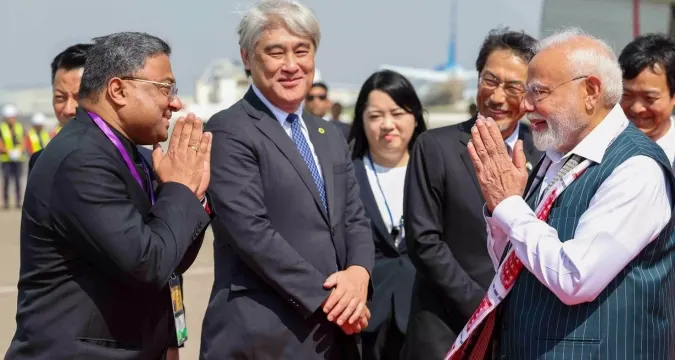
- The first time when a global partnership with Japan was conceived was by Atal Bihari Vajpayee in the early 2000s.
- Manmohan Singh enhanced the relationship by signing a 2006 civil nuclear agreement yet Japan was sensitive in nuclear policy.
- Since 2014 Narendra Modi and Shinzo Abe have made the partnership a special strategic and global alliance, with annual summits and close friendship.
India Japan relationship today is not only more cultural affinity but also strong economic and security partnership making them one of the most stable bilateral relationships in Asia.
Challenges Ahead
Even in the wake of optimism, there are still obstacles.
- In both countries, there has been criticism of bullet train delays.
- Repeatedly the Japanese companies cite the bureaucratic obstacles confronting India, land-acquisition issues, and uncertain regulations.
- The Indian semiconductor and military defense collaboration with Japan is perceived by Beijing as a containment policy.
- Washington might consider the fact that Tokyo is increasing its relationship with India as a threat to its primacy.
In the case of India and Japan, it would be to handle these forces without derailing their partnership.
A Defining Moment in India’s Asia Policy
The visit of PM Modi to Japan in August 2025 might prove to be a turning point in the India policy towards Asia. That occurred at a time when the India US relations were unsure, China tension was building and the global economy was evolving fast.
Japan had offered 68 billion, wanted a bullet train and wanted technological cooperation. These gestures indicate that the partnership is concerned with action and not words. The visit enhances the status of India as an important Indo-Pacific power. In the case of Japan, it has cemented the fact that India is the partner it requires to balance China and establish a stable Asian order.
Provided that Tokyo makes good its promises, the India-Japan alliance could be the defining 21st-century alliance in Asia. It would be constructed on common-ground, common-values, common vision of progress.