Laws shape almost every aspect of our daily lives , the taxes we pay, the rights we enjoy, the protections we receive, and the responsibilities we carry as citizens. Yet, for many people, the process through which these laws are created remains distant and complex. Terms like Bill, Parliament, Lok Sabha, Rajya Sabha, and President’s assent are often heard, but rarely understood in sequence.
This article explains how a Bill becomes a law in India, step by step, in easy explanation and relatable examples so that our audience from all backgrounds can follow the process with confidence. The goal is not just to explain the procedure of Bill becoming A Law, but to help readers understand why each step exists and how it protects democratic decision-making.
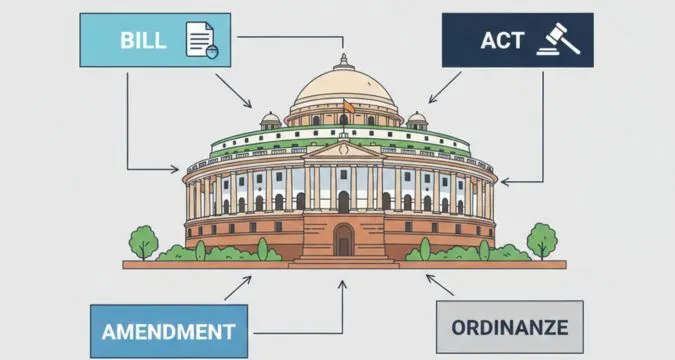
What Does “Law-Making” Really Mean in India?
India follows a constitutional and parliamentary system. This means laws are not made by one person or one institution alone. Instead, they are created through:
- Discussion
- Debate
- Expert review
- Democratic approval
This layered process ensures that laws are not rushed, arbitrary, or disconnected from public interest.

At the center of this system is Parliament, which consists of:
- Lok Sabha (House of the People)
- Rajya Sabha (Council of States)
Every law must pass through this system before it can affect citizens.
First Things First: What Is a Bill?
A Bill is simply a proposed law. It is an idea written in legal form, suggesting:
- A new rule, or
- A change to an existing rule
At this stage, a Bill does not apply to anyone. It has no legal power.
Take A Example
Imagine a housing society planning new rules for parking.
The draft rules written and circulated among residents are like a Bill.
Only after residents discuss, approve, and formally adopt them do they become binding rules.

When Does a Bill Become a Law?
A Bill becomes a law (Act) only after:
- Approval by Parliament
- Assent by the President of India
- Official notification
Only then does it become enforceable.
Who Can Introduce a Bill in India?
Government Bills
Most Bills are introduced by:

- Ministers
- On behalf of the government
These are called Government Bills and usually relate to national policies.
Private Member Bills
Any Member of Parliament who is not a minister can also introduce a Bill. These are called Private Member Bills.
While private member Bills rarely become law, they often:
- Raise important issues
- Influence public debate
- Shape future government policy
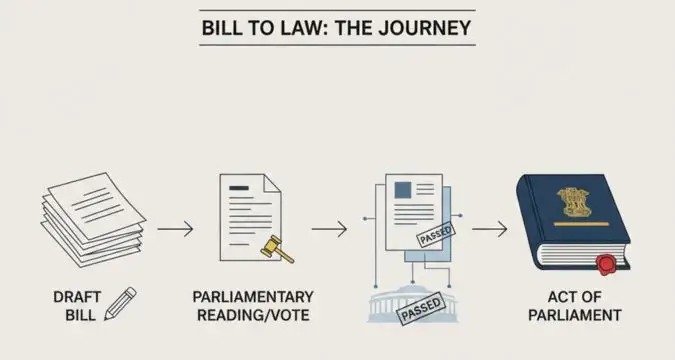
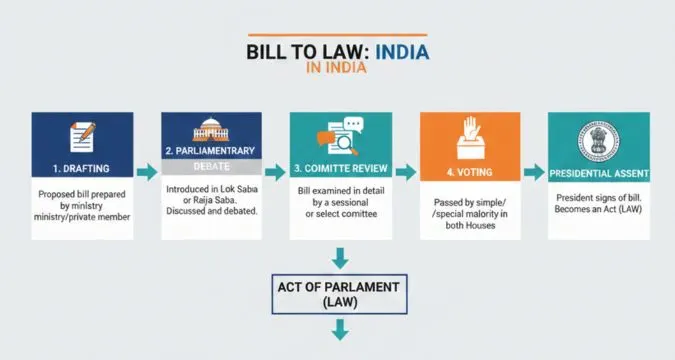
Step 1: Drafting the Bill – Where Ideas Take Legal Shape
Before a Bill reaches Parliament, it goes through careful drafting.
What Happens During Drafting?
- Ministries consult experts
- Legal language is finalized
- Constitutional compatibility is checked
- Objectives are clearly defined
The drafting stage ensures the Bill:
- Does not violate fundamental rights
- Is practically enforceable
- Uses precise legal terms
Real-Life Example
Suppose the government wants to regulate online platforms to protect user data.
Before introducing a Bill:
- IT experts advise on technology
- Legal experts draft definitions
- Policy makers assess impact on businesses
Only after this groundwork does the Bill move forward.
Step 2: Introduction of the Bill in Parliament (First Reading)
The Bill is formally introduced in either:
- Lok Sabha, or
- Rajya Sabha
(depending on its nature)
This stage is called the First Reading.
What Happens Here?
- The title of the Bill is read
- Its purpose is briefly explained
- No detailed discussion takes place
At this stage, Parliament only decides whether the Bill should be considered further.
Simple Analogy
Think of this like presenting a proposal in a meeting agenda.
Members agree to discuss it later, not approve it immediately.
Step 3: Making the Bill Public
After introduction:
- The Bill is published in the Official Gazette
- Media reports on it
- Experts and citizens begin discussions
This step ensures transparency and allows:
- Public debate
- Expert criticism
- Civil society feedback
Many changes to laws have occurred because of public reactions at this stage.
Step 4: Second Reading – The Heart of the Law-Making Process
The Second Reading is where real scrutiny begins. It is the most important stage.
This stage has three sub-parts, each serving a distinct purpose.
Stage 4.1: General Discussion on the Bill
Members of Parliament discuss:
- Why the Bill is needed
- Whether the problem is real
- If the solution proposed is appropriate
Supporters and critics present their views.
Example
If a Bill proposes stricter traffic penalties:
- Some MPs may argue it improves road safety
- Others may worry about harassment or enforcement misuse
This debate ensures multiple perspectives are heard.
Stage 4.2: Committee Examination – Deep Dive into Details
Most important Bills are sent to a Parliamentary Committee.
Why Committees Are Crucial
Committees:
- Examine each clause carefully
- Invite experts, officials, and stakeholders
- Compare international practices
- Suggest improvements
They work away from political pressure and focus on substance.
Real-Life Parallel
Think of this as a technical review before launching a product.
You test it, fix flaws, and improve usability before release.
Committee reports often lead to:
- Removal of vague clauses
- Clarification of definitions
- Better enforcement mechanisms
Stage 4.3: Clause-by-Clause Discussion in Parliament
After committee review:
- The Bill returns to Parliament
- Each clause is debated
- Amendments are proposed and voted upon
Only approved clauses remain part of the Bill.
This ensures the final version is refined and balanced.
Step 5: Voting in the First House
Once discussion ends:
- The Bill is put to vote
- A simple majority is required in most cases
If passed, the Bill moves to the other House of Parliament.
Step 6: The Bill in the Second House
The second House repeats:
- Discussion
- Scrutiny
- Voting
It may:
- Pass the Bill
- Suggest amendments
- Reject the Bill
- Delay consideration
This dual-House system ensures:
- States’ interests are represented
- Hasty decisions are avoided
Step 7: What If Both Houses Disagree?
Ordinary Bills
If disagreement arises:
- A Joint Sitting may be called
- Members of both Houses vote together
- Majority decision prevails
Money Bills
Money Bills are special:
- Introduced only in Lok Sabha
- Rajya Sabha can only make recommendations
- Lok Sabha has final authority
This reflects the principle that financial control lies with the directly elected House.
Step 8: The Role of the President of India
After Parliament passes the Bill, it goes to the President.
The President may:
- Give assent
- Return the Bill for reconsideration
- Withhold assent (rare)
If Parliament passes the Bill again, the President must approve it.
Why This Step Exists
This provides a constitutional safeguard and ensures:
- Serious reconsideration
- Protection against procedural lapses
Step 9: From Bill to Law – Final Notification
Once the President gives assent:
- The Bill becomes an Act
- It is published in the Official Gazette
- An enforcement date is announced
Only now does it become legally binding.
Also Read: Role of Regional Parties In Strengthening India’s Democracy
Special Case: Constitutional Amendment Bills
Changing the Constitution requires:
- Special majority
- State ratification (in some cases)
- Mandatory Presidential assent
This ensures constitutional stability and prevents misuse of power.
Why This Process Matters to Ordinary Citizens
This process:
- Protects citizens from arbitrary laws
- Ensures expert input
- Encourages accountability
- Strengthens democracy
Every step exists to balance power with responsibility.
Frequently Asked Questions (FAQs)
Can laws be challenged after they are passed?
Yes. Courts can review laws for constitutional validity.
Why do some Bills take years to pass?
Due to debate, political consensus, and committee scrutiny.
Do citizens have any influence?
Yes, through public opinion, media, and expert consultations.
Are all Bills debated thoroughly?
Major Bills usually are; urgent Bills may move faster.

Conclusion
The journey of a Bill becoming a law in India is deliberate, layered, and democratic. It reflects a system that values discussion over speed, scrutiny over simplicity, and accountability over authority.
Understanding this process helps readers see laws not as distant commands, but as outcomes of debate, compromise, and constitutional design. It reminds us that democracy is not only about voting, it is about how decisions are made after the votes are cast.