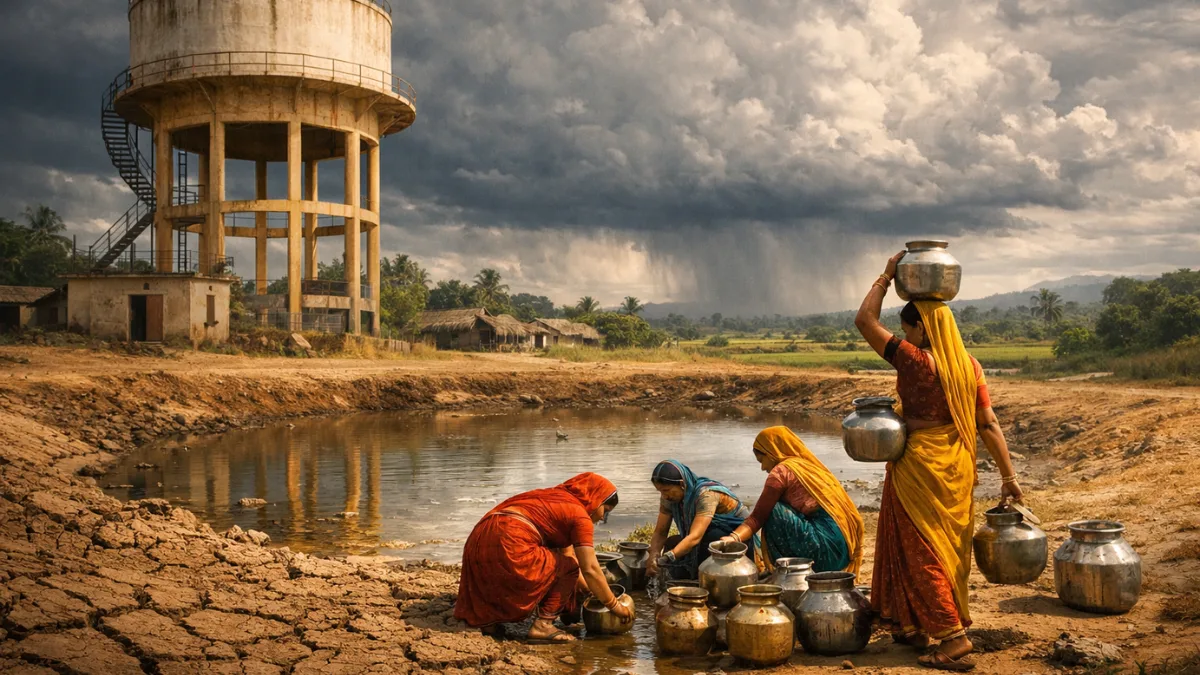
A village pond shrinks, a city tanker arrives late, a farmer watches a borewell go deeper than it did five years ago, and somewhere in a ministry office the language is still about allocation, efficiency, and integrated management. India’s water story is often told in statistics, but it is lived in queues, crop decisions, urban anxiety, and political bargaining. Water is one of those subjects that becomes visible only when it fails.
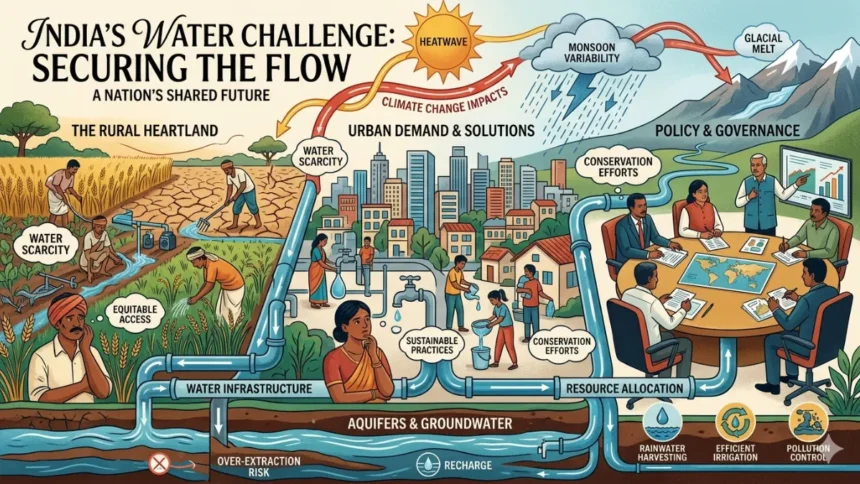
That is why National Water Policy and India’s Water Security Challenge is not just a bureaucratic theme. It is one of the central development questions facing the country. India has a formal policy framework, major flagship schemes, and no shortage of mission statements. Yet the gap between policy ambition and hydrological reality remains unsettlingly wide. The country is dealing with groundwater stress, uneven monsoons, deteriorating water quality, rising urban demand, and a governance structure that still struggles to treat water as one connected system rather than a series of departmental files.
The official framework in force is still the National Water Policy, 2012, adopted by the National Water Resources Council on December 28, 2012. The Ministry of Jal Shakti states that this policy emphasizes water conservation, rainwater harvesting, scientific planning, and community participation. But a policy can only do so much when implementation is fragmented and the pressures on water are becoming more severe with climate variability and demand growth.
National Water Policy and India’s Water Security Challenge in Plain Terms
Put simply, India’s water security challenge is this: there is not enough reliable, well-managed, clean water available at the right place and time to meet the needs of households, farms, industry, and ecosystems without intensifying conflict or depletion.

That sounds neat on paper. On the ground, it means a country trying to serve multiple water futures at once. Rural households want dependable tap connections. Farmers need irrigation that does not collapse with erratic rainfall. Cities need supply systems that do not depend so heavily on extraction and emergency trucking. Rivers and wetlands need enough flow to remain alive, which policy documents often acknowledge but governance systems rarely prioritize consistently.
The policy language has long moved in the right direction. The harder part is turning principles into institutions that can actually manage scarcity, quality, and competing claims together. India’s water problem is not a single shortage. It is a management crisis layered over a physical resource crisis.
Why This Debate Still Feels Urgent
The urgency is not theoretical. NITI Aayog’s Composite Water Management Index famously warned that 600 million Indians face high to extreme water stress. The same report said 75% of households did not have drinking water on premises at the time, with the burden especially heavy in rural India. Those figures became widely quoted for a reason: they captured how large the water challenge already was before climate volatility made it even harder.
Since then, there has been visible progress in household tap-water coverage through the Jal Jeevan Mission. The official dashboard shows the scale of rural household coverage and tracks the growth from the low baseline at mission launch in August 2019. That matters. Expanding basic access is not a small achievement.
Still, access is not the same thing as security. A pipe connection means less if the source is seasonal, groundwater tables are falling, or water quality is compromised. India’s water debate often gets trapped in infrastructure metrics when the deeper issue is source sustainability. Getting water to households is vital. Ensuring the source can keep serving them is the harder, more neglected half of the story.

The Shadow Beneath the Ground
Any serious discussion of National Water Policy and India’s Water Security Challenge eventually ends up underground.
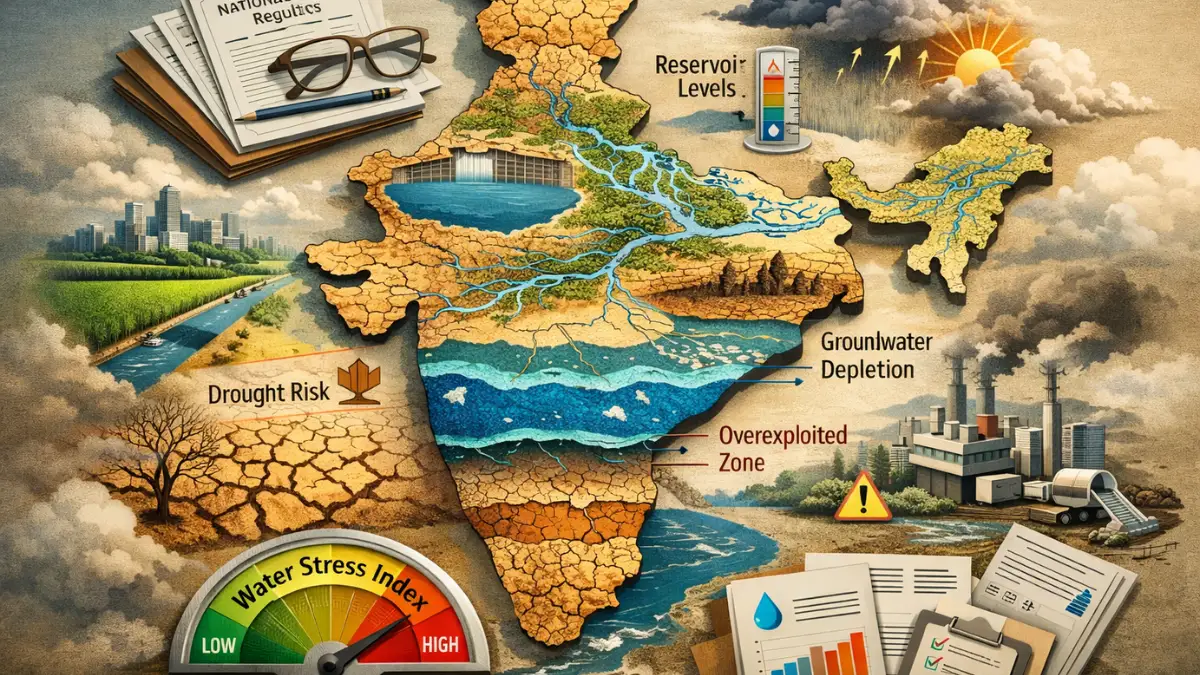
India relies heavily on groundwater, especially for irrigation. That dependence made agricultural expansion and rural livelihoods possible across large parts of the country. It also created a quiet structural vulnerability. The latest Dynamic Ground Water Resources assessment for 2024 notes that groundwater remains a vital component of India’s water supply, and official summaries place the average stage of groundwater extraction for the country at about 60.47%. National averages, however, are soothing in a misleading way. They hide the local severity of depletion in many blocks where extraction is far more intense.
This is one of the weaknesses in public water conversations. The crisis is not uniform, so it is easy for decision-makers to cite a national average while communities live a regional emergency. Some places are coping with chronic over-extraction; others are dealing with contamination; still others face the old problem of too much water during a flood season and too little six months later.

The policy system knows this. The trouble is that incentives often still reward extraction more than conservation. Cheap or poorly priced power, crop choices tied to procurement systems, and fragmented regulation create a perverse logic: everyone knows the aquifer is stressed, but individual actors are pushed to keep pumping anyway.
Water Policy Is Really About Governance
The most revealing thing about India’s water crisis is that it is not only hydrological. It is administrative.
Water is shaped by central schemes, state laws, local bodies, irrigation departments, urban utilities, pollution regulators, groundwater authorities, and political compulsions that change by region. The result is a system in which everyone is responsible and no one is fully in charge. Policy documents regularly speak of integrated water resources management. The lived reality is closer to institutional compartmentalization.
The National Water Policy, 2012 was not blind to this. It called for better planning, conservation, efficiency, and legal changes, while parliamentary material later noted ideas such as a National Bureau of Water Use Efficiency and broader reform measures. Yet reform in water governance is notoriously difficult because water is politically sensitive, economically vital, and constitutionally layered. States guard authority. Local realities vary sharply. Pricing is contentious. Enforcement is weak where it is needed most.
That means water policy often sounds more modern than water governance actually is.
Climate Change Has Made the Old Model Obsolete
For years, India’s water management was built around a certain expectation of seasonality: monsoon patterns may fluctuate, but they remain broadly legible. That assumption is weakening.
Recent policy discussions from NITI Aayog highlight rising heat stress, rainfall variability, and growing pressure on land and water resources in agriculture. This matters because the entire water system depends on a climatic rhythm that is becoming less predictable. When rainfall arrives in shorter, more intense bursts, storage, recharge, and flood management all become harder. The old model of waiting for monsoon water and treating it as dependable annual replenishment starts to break down.
This is where the phrase India’s water security challenge takes on its full meaning. Security is not simply about having water. It is about resilience under uncertainty. Can reservoirs, aquifers, urban systems, cropping patterns, and local institutions absorb shocks without collapsing into scarcity or conflict? That is the question climate change is now forcing into the center of water policy.
The Politics of Who Gets Water, and When
Water policy is never just about hydrology. It is about distribution, power, and legitimacy.
Urban India often secures water by reaching farther outward, drawing from distant rivers, reservoirs, or peri-urban aquifers. Agriculture consumes the largest share of freshwater, but not always with incentives aligned to efficiency. Rural households have historically borne the burden of unreliable access, especially women. Industries need predictability and tend to frame the debate in terms of competitiveness and risk. Ecosystems, meanwhile, have almost no lobby strong enough to match their importance.
That mix creates a familiar political temptation: solve today’s visible shortage and postpone the structural correction. It is easier to sanction a pipeline than to reform groundwater use. Easier to announce a scheme than to confront the economics of crops, pricing, and extraction. Easier to talk about new supply than to discipline waste and leakage.
The deeper problem is psychological as much as institutional. Water is treated as locally urgent but nationally abstract. Every crisis feels immediate when a city runs short or a region floods, yet sustained reform often lacks electoral glamour. Pipes photograph better than aquifer governance.
What a More Serious Water Policy Would Look Like
A more credible water future for India would not begin with slogans. It would begin with harder choices.
First, source sustainability would have to matter as much as service delivery. Household tap coverage is important, but the system should be judged equally on whether its rivers, reservoirs, and aquifers remain viable. Second, groundwater governance would need teeth, not just reports. Third, cropping incentives and irrigation policy would need a more honest conversation, especially in water-stressed regions where current patterns are economically and hydrologically misaligned.
There is also a strong case for better water accounting, better local data, and more transparent river-basin-level planning. One of the persistent weaknesses in Indian water governance is that decisions are often made with incomplete visibility, especially across state lines and institutional silos. You cannot manage what you do not measure properly, and you cannot secure what you treat as somebody else’s department.
Future Direction: From Water Supply to Water Security
That may be the real shift India now needs. For too long, the focus has been on water provision in the narrow sense: build assets, extend reach, solve immediate deficits. Necessary, yes. Sufficient, no.
The future will demand a broader water-security lens that treats quality, reliability, ecological health, recharge, urban resilience, and climate adaptation as one connected problem. The policy vocabulary already gestures in this direction. The challenge is execution. India does not lack missions. It lacks enough institutional alignment to make those missions durable.
And yet this is not a hopeless picture. The fact that water is now discussed in relation to climate resilience, urban vulnerability, rural livelihoods, and national development is itself a sign of progress. The policy debate is maturing. The question is whether implementation can catch up before hydrology becomes even less forgiving.
Final Insight for The Vue Times
At The Vue Times, the real test of water policy is not how elegantly it is written but whether it changes what people experience at the tap, on the farm, and in the aquifer below.
India does not need a more decorative conversation about water. It needs a more honest one—one that treats water security as a foundation of economic stability, public health, and climate resilience, not as a seasonal emergency to be revisited when reservoirs run low.
More Read

Conclusion
National Water Policy and India’s Water Security Challenge is ultimately about whether the country can move from reactive water management to long-term stewardship. The warning signs are already visible: stressed groundwater, uneven access, climate volatility, and a governance system that still struggles to act as one coherent whole.
India’s future will not be secured by pipelines alone. It will depend on whether policy can finally align incentives, institutions, and ecological limits with the reality that water is not an endless resource. The countries that manage water well do not wait for crisis to teach them discipline. India is large, complex, and hydrologically diverse, but that is exactly why the discipline now matters more than ever.
Frequently Asked Questions
What is the National Water Policy in India?
The National Water Policy is India’s broad framework for water planning and management. The policy currently in force is the 2012 version, which emphasizes conservation, efficiency, rainwater harvesting, and integrated planning.
Why is water security a challenge in India?
India faces water stress because of groundwater depletion, uneven rainfall, water pollution, rising demand, and fragmented governance. Climate variability is making this harder by increasing uncertainty around both droughts and intense rainfall.
What is India’s biggest water problem?
There is no single problem, but groundwater stress is one of the biggest. Many regions depend heavily on groundwater for irrigation and household use, which creates long-term vulnerability when extraction outpaces recharge.
How does Jal Jeevan Mission relate to water security?
Jal Jeevan Mission focuses on providing rural households with tap-water connections. It improves access, but long-term water security depends on whether local water sources remain sustainable and water quality remains reliable.
How can India improve water security?
India can improve water security through stronger groundwater regulation, better water-use efficiency, more scientific local planning, sustainable crop and irrigation choices, and governance that treats water as one connected system rather than separate sectors.