Supreme Court Bans Feeding of Stray Dogs in Streets and Other Public Spaces: Only Special Places are to be Used
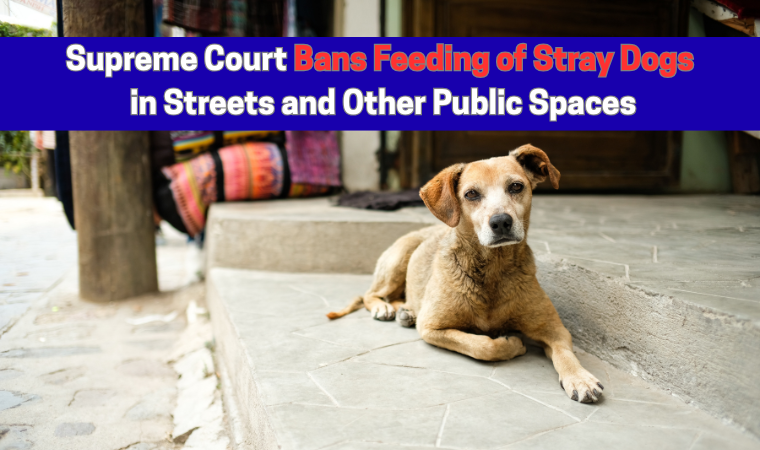
In a landmark decision that will alter the manner in which India treats animal welfare in urban areas, the Supreme Court of India has ordered that stray dogs cannot be fed in public places, on the streets, and in open areas. Rather, the Court has mandated all Municipalities to allow designated feeding areas in every ward to ensure the well-being of stray dogs and also ensure that the people are not attacked.
The judgment, which was ruled on 22 August 2025 by a three-judge bench consisting of Justice Vikram Nath, Justice Sandeep Mehta, and Justice NV Anjaria, alters a previous order dated 11 August that proposed moving stray dogs to shelters in the Delhi NCR. The new policy seeks a balance by making it clear that stray dogs should not leave the environment/habitat they were initially placed in once they have been vaccinated and sterilised, unless dogs tend to turn rabid after vaccination, are suspected to be rabid, or are aggressive.
This ruling does not just reflect the increasing alarm towards the number of dog-biting occurrences and city safety, but it also attempts to carve out some organization to a discussion which polarized citizens and policymakers for decades; the rights of animals and the safety of human beings.
Close Read of the Supreme Court Directive
The order of the Court clearly mentions that:

- No feeding dogs publicly: People must not feed any stray dogs in the roadways, pavements, residential colonies, markets, or other places.
- Establishment of feeding zones: The municipal authorities in India need to immediately come up with specific zones in each ward to start feeding stray dogs.
- Awareness and notices: Notice boards must be placed at these areas to inform the citizens that it is only in specific areas where they can feed.
- Legal implications of the lawbreakers: All those found guilty of feeding dogs as per defy this order risk legal action by being handled according to the standard municipal laws or criminal law.
- Sterilization and vaccination to proceed: Sterilization and vaccination drives are still to go on as before, and the stray dogs must be released back into their original localities, unless they are found to be rabid or aggressive.
- Preventive priority of public safety: The Court pointed out that such a measure is not concerned with animal treatments but possible “untoward incidents that may occur due to nonregulated stray dogs feeding”.
Why was it necessary to ship off by this judgment
Increasing Cases Of Dog Bites
Dog bite cases have intensified tremendously in India. Government health statistics show that there were about 18 million cases of dog bites in India between the years 2019 and 2024. Some of these concerned children and the reason they attract public indignation and calls for stronger legislation.
This public anxiety is seen in the case under discussion, City Hounded by Strays, Kids Pay Price, where the number of children who are mauled or attacked by street dogs has been brought out in the different reports.
Disagreement between Animal Rights Activists and Citizens
Whether or not to feed stray dogs has been a contentious topic for a very long time. On the one hand, animal rights movements and animal-welfare activists say that dogs are entitled to sustenance and survival, and that citizens have the freedom to give them food. On the other side, resident welfare associations and city dwellers claim that such feeding invites packs of dogs, results in a territorial nature of aggressive behavior, and poses challenges to human life at the street level.
The directive issued by the Court tries to find a compromise between these two goals, creating a safe middle road that will keep dogs out of danger of starving to death, whilst also keeping humans safe.

The Problem of Urban Governance
Local governments throughout India have frequently been unable to enact reasonable stray dog management policies. Sterilization campaigns have also been uneven, and free-feeding has not helped the situation. The Court has now provided clear guidelines to authorities on how to better handle the problem, as they require specific feeding areas.
Implications of the Order
For Citizens
- Feeding of stray dogs in residential colonies, footpaths, or at shops will become a punishable act now.
- Dog lovers will be required to go to designated feeding areas to feed the dogs.
- Citizens can also be included in providing information to authorities about the violations.
Municipal Corporations

- Urgent responsibility to find and impose feeding spaces in every ward.
- Installation of signage, control of timings, and possibly the use of personnel to control the process.
- Heightened responsibility in making sure sterilization, vaccination, and safe transportation of aggressive dogs occur.
To Animal Rights Activists
- The order can be viewed as limiting because it will be less open to the freedom to feed dogs in open vistas.
- Nevertheless, the civic rights activists may find potential in cooperation with the city administration to organize a humane position within feeding zones.
- This can also open up the collaboration of the NGOs in running these spaces successfully.
For Public Safety
- Citizens, particularly children and the elderly, can look forward to safer streets without risk of being knocked over by the sudden onset of a pack of stray dogs gathering to find food.
- A decrease in uncontrolled feeding may provide a drop in dog bites in the long term.
Managing Human Safety and Animal Welfare
The Supreme Court has struck a tentative decision after changing its previous order to set up dog shelters, which required that these stray dogs be relocated. Animal rights organizations had explained that relocation disrupts the territorial stability of stray dog populations, which often increases aggression and associated territorial aggression or fights.
The Court appears to be taking a cue from the Animal Birth Control (Dogs) Rules, 2023 ,which have given priority to sterilization and vaccination as the most effective methods of reducing stray dog populations.
This is a smart balance, one that does not leave dogs to starve but at the same time does not endanger citizens.

Voices of the Courtroom
The case involved the intervention of some of the most senior lawyers of the country, including Kapil Sibal, Dr Abhishek Manu Singhvi, Siddharth Luthra, Colin Gonsalves, and Aman Lekhi on behalf of different stakeholders.
There was a variety of arguments used, including constitutional rights under Article 21 (Right to Life of both humans and animals), municipal duties under section # under various state laws.
The Court, whilst echoing the interests of animal feeders, was emphatic that the interests of society should take precedence and that governance by a municipality could not be undermined by practices left without any regulation.
The Future Perspectives: Threats and Opportunities
Implementation Hurdles
- Finding land: In parks and open spaces are already limited, municipalities will find it challenging to provide adequate feeding grounds in densely populated urban wards.
- Maintenance: These areas are likely to require regular checking to ensure it does not become a health hazard.
- Enforcement: Fairly penalizing violators without creating harassment or corruption opportunities is going to be a significant challenge.
Potential Benefits
- Further to this, regular feeding can also enable authorities to track and monitor stray populations more efficiently.
- It may help open the door to the collaboration of population-private partnerships, with NGOs and animal lovers overseeing specific feeding areas.
- The society can benefit by having safer streets and fewer cases of rabies.

Cultural Dimension
India has had a special connection with animals, particularly dogs, cows, and monkeys, that happen to be sanctified in religious and cultural practices. The order by the Supreme Court is governed by the logic of the law, but there is a wider social dialogue present within the issues that are considered in such a decision, i.e., how does an increasingly urbanized India reconcile compassion and security?
Conclusion
The Supreme Court ban on feeding stray dogs in the streets is more than a legal decision; it is a shift in policy in the governance and handling of animals. By introducing feeding zones, the Court is striking a balance between compassionate treatment of stray animals with the safety of people who have increasingly suffered because of unregulated feeding habits.
The decision will lead to practical issues but also present fresh avenues to manage India’s stray dog population in a structured, humane, and sustainable manner. At the moment, it preconditions a certain new social contract between people and street animals that would not be established based on confrontation, but rather on the balance of forces.