Why the Doctrine of Basic Structure Matters?
The Indian Constitution is often described as a living document, capable of growth, adaptation, and reform. At the same time, it is expected to preserve the core ideals on which the Republic was founded. This balance between change and continuity is where the Doctrine of Basic Structure becomes critically important.
Simply put, the Doctrine of Basic Structure places limits on Parliament’s power to amend the Constitution. While Parliament can change many parts of the Constitution, it cannot destroy or alter its fundamental identity.
This doctrine has shaped India’s constitutional journey more than any other judicial principle. It has protected democracy during times of political dominance, preserved judicial independence, and ensured that constitutional amendments do not become tools of absolute power.
For students, competitive exam aspirants, legal learners, and informed citizens, understanding this doctrine is not optional, it is essential.

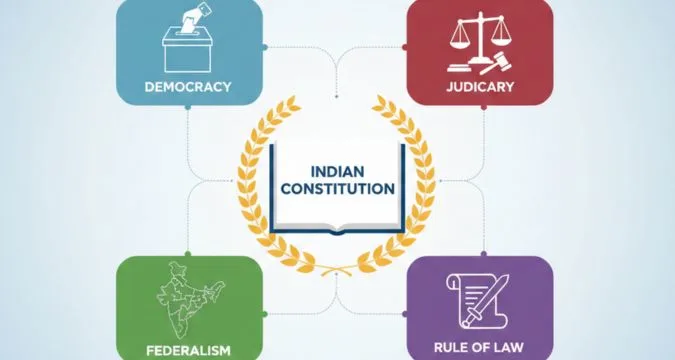
Also Read: What is Money Bill
What Is the Doctrine of Basic Structure?
The Doctrine of Basic Structure holds that:
Parliament has the power to amend the Constitution under Article 368, but it cannot alter or destroy the “basic structure” or essential features of the Constitution.
In simple terms:
- Parliament can amend
- Parliament cannot rewrite the Constitution’s soul
The Constitution does not explicitly mention the term “basic structure.” Instead, this doctrine was created by the Supreme Court of India through judicial interpretation.

Why Was This Doctrine Needed?
To understand the need for this doctrine, one must look at the conflict between Parliament and the Judiciary in the early decades after independence.
The Core Question:
Can Parliament amend any part of the Constitution, including Fundamental Rights?
This question arose because:

- The government wanted to implement land reforms and socio-economic policies.
- These reforms often conflicted with Fundamental Rights, especially the Right to Property (earlier a Fundamental Right).
- Parliament began passing constitutional amendments to override court judgments.
This led to a constitutional tug-of-war that ultimately gave birth to the Doctrine of Basic Structure.
Constitutional Provisions Involved
Before moving to landmark cases, it is important to understand two key constitutional provisions:
Article 13
- States that laws violating Fundamental Rights are void.
Article 368
- Grants Parliament the power to amend the Constitution.
The tension between these two articles formed the foundation of the doctrine.
Also Read: How Bill Become Law
Evolution of the Doctrine of Basic Structure: Landmark Cases
The doctrine did not emerge overnight. It evolved through a series of judicial decisions. Each case refined, challenged, or strengthened the idea.
1. Shankari Prasad Case (1951)
Case Name:
Shankari Prasad v. Union of India
Issue:
Can Parliament amend Fundamental Rights?
Supreme Court Verdict:
- Parliament can amend any part of the Constitution, including Fundamental Rights.
- Constitutional amendments are not considered “law” under Article 13.
Impact:
- Gave Parliament wide and unrestricted amending power
- Set the stage for future constitutional conflicts
2. Sajjan Singh Case (1965)
Case Name:
Sajjan Singh v. State of Rajasthan
Issue:
Validity of constitutional amendments affecting Fundamental Rights
Supreme Court Verdict:
- Reaffirmed the Shankari Prasad judgment
- Parliament has the power to amend Fundamental Rights
Important Observation:
For the first time, judges expressed concern that unlimited amending power could harm the Constitution.
This dissent planted the intellectual seed for the doctrine.
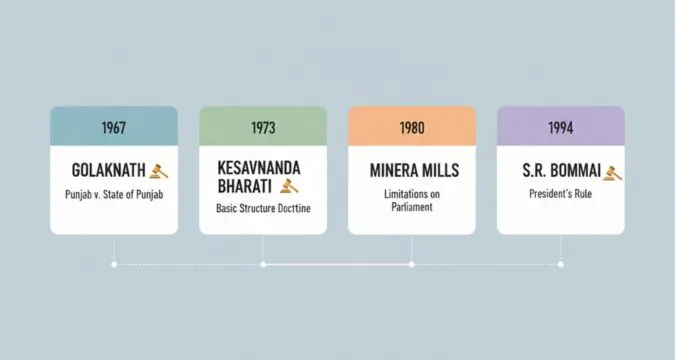
3. Golaknath Case (1967): The Turning Point
Case Name:
I.C. Golaknath v. State of Punjab
Issue:
Can Parliament amend Fundamental Rights?
Supreme Court Verdict:
- Parliament cannot amend Fundamental Rights
- Fundamental Rights are “transcendental” and immutable
Reasoning:
- Constitutional amendments are considered “law” under Article 13
- Any amendment violating Fundamental Rights is void
Impact:
- Restricted Parliament’s amending power significantly
- Triggered strong political backlash
Also Read: Difference Between Bill, Ordinance and Amendments
Parliament’s Response: 24th Constitutional Amendment
To nullify Golaknath:
- Parliament amended Article 368
- Explicitly stated that Parliament can amend any part of the Constitution, including Fundamental Rights
This amendment directly led to the most important constitutional case in Indian history.
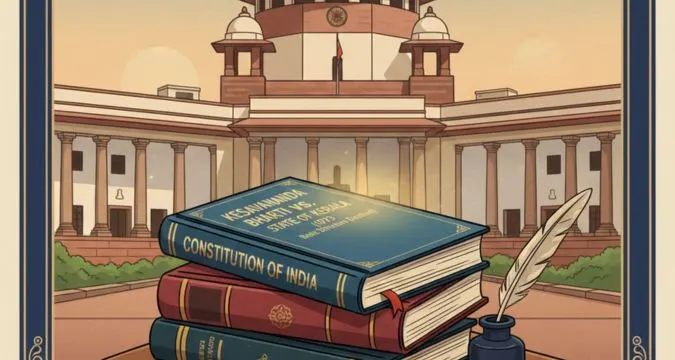
4. Kesavananda Bharati Case (1973): Birth of the Doctrine
Case Name:
Kesavananda Bharati v. State of Kerala
Bench Strength:
13 judges (largest ever)
Core Issue:
What is the extent of Parliament’s amending power?
Supreme Court Verdict:
- Parliament can amend any part of the Constitution
- But cannot alter its basic structure
This judgment introduced the Doctrine of Basic Structure.
What Did the Court Mean by “Basic Structure”?
The Court did not provide an exhaustive list. However, judges identified several core features.
Elements of the Basic Structure (As Identified Over Time)
Some of the commonly accepted components include:
- Supremacy of the Constitution
- Rule of Law
- Separation of Powers
- Judicial Review
- Federalism
- Secularism
- Sovereignty and Integrity of India
- Democratic and Republican form of government
- Free and fair elections
- Independence of the judiciary
- Fundamental Rights
- Limited power of Parliament
This list is not final. The Court decides case by case.
Why Kesavananda Bharati Case Is Historic
- Balanced Parliamentary sovereignty and constitutional supremacy
- Prevented constitutional authoritarianism
- Strengthened judicial review
- Protected democracy during politically volatile times
This single judgment has influenced every major constitutional case since 1973.
5. Indira Nehru Gandhi Case (1975)
Background:
The 39th Constitutional Amendment tried to:
- Place the Prime Minister’s election beyond judicial review
Supreme Court Verdict:
- Struck down the amendment
- Held that free and fair elections are part of the basic structure
Significance:
- Reinforced democracy
- Prevented misuse of constitutional amendments for political survival
6. Minerva Mills Case (1980
Issue:
Validity of provisions that gave Parliament unlimited amending power
Supreme Court Verdict:
- Limited amending power is itself part of the basic structure
- Judicial review cannot be taken away
Key Principle:
The Constitution is supreme, not Parliament.
7. Waman Rao Case (1981)
Issue:
Applicability of basic structure doctrine to laws placed in the Ninth Schedule
Verdict:
- Laws added after April 24, 1973, are subject to basic structure review
Importance:
- Prevented misuse of the Ninth Schedule as a legal shield
8. S.R. Bommai Case (1994)
Issue:
Misuse of Article 356 (President’s Rule)
Verdict:
- Federalism and secularism are part of the basic structure
- President’s Rule subject to judicial review
Impact:
- Strengthened Centre-State balance
- Protected secular governance
9. I.R. Coelho Case (2007)
Issue:
Can Ninth Schedule laws violate basic structure?
Verdict:
- Yes, if they damage basic structure
- Judicial review reaffirmed
Why the Doctrine Is Criticised
Despite its importance, the doctrine has faced criticism.
Common Criticisms:
- Not mentioned in the Constitution
- Gives excessive power to judiciary
- Judges decide what is “basic”
- Undermines parliamentary sovereignty
Why the Doctrine Is Still Necessary
Despite criticisms, the doctrine serves as a constitutional safety valve.
It:
- Prevents authoritarian amendments
- Protects minority rights
- Preserves democratic governance
- Ensures constitutional continuity
Without this doctrine, a government with brute majority could legally dismantle democracy.
Doctrine of Basic Structure Explained with an Example
Imagine the Constitution as a building:
- Parliament can renovate rooms
- Change paint
- Add floors
But it cannot remove the foundation.
That foundation is the basic structure
Also read: Role Of President In Indian Legislative
Doctrine of Basic Structure in Simple Words
- Parliament can amend the Constitution
- Parliament cannot destroy its core values
- Supreme Court protects those values
- Democracy, rule of law, and justice are safeguarded
Conclusion: A Living Shield for Indian Democracy
The Doctrine of Basic Structure is not just a legal theory. It is a constitutional guardian that stands between democratic governance and absolute power.
Over the decades, it has proven its relevance across political regimes, constitutional crises, and social transformations. It ensures that while India evolves, it never forgets the principles on which it was founded.
In a world where constitutional backsliding is a real threat, this doctrine remains one of India’s strongest democratic safeguards.
More Read

Read more in-depth constitutional explainers at The Vue Times , where law, governance, and clarity meet.
1. The Doctrine of Basic Structure was laid down by the Supreme Court in which case?
- Golaknath v. State of Punjab
B. Minerva Mills v. Union of India
C. Kesavananda Bharati v. State of Kerala
D. Shankari Prasad v. Union of India
Correct Answer: C
2. Which constitutional article grants Parliament the power to amend the Constitution?
- Article 12
B. Article 13
C. Article 32
D. Article 368
Correct Answer: D
3. Which of the following is NOT considered part of the Basic Structure of the Constitution?
- Supremacy of the Constitution
B. Judicial Review
C. Parliamentary Supremacy
D. Secularism
Correct Answer: C
4. The Golaknath case (1967) held that:
- Parliament has unlimited amending power
B. Fundamental Rights cannot be amended
C. Ninth Schedule laws are immune from review
D. Basic Structure doctrine applies
Correct Answer: B
5. Which case held that limited amending power of Parliament itself is part of the Basic Structure?
- Sajjan Singh Case
B. Minerva Mills Case
C. Waman Rao Case
D. I.R. Coelho Case
Correct Answer: B
6. The 39th Constitutional Amendment was struck down for violating which basic feature?
- Federalism
B. Judicial Review
C. Free and fair elections
D. Separation of powers
Correct Answer: C
7. Laws placed in the Ninth Schedule after 24 April 1973 are:
- Completely immune from judicial review
B. Valid only if approved by Parliament
C. Subject to the Basic Structure doctrine
D. Automatically unconstitutional
Correct Answer: C
8. Which case declared secularism as part of the Basic Structure of the Constitution?
- Kesavananda Bharati Case
B. S.R. Bommai Case
C. Golaknath Case
D. Minerva Mills Case
Correct Answer: B
9. The Doctrine of Basic Structure primarily limits the power of:
- President
B. Judiciary
C. Parliament
D. Election Commission
Correct Answer: C
10. Which of the following best explains the Doctrine of Basic Structure?
- Parliament cannot amend any part of the Constitution
B. Only Fundamental Rights form the basic structure
C. Parliament can amend the Constitution but not its core principles
D. Judiciary can amend the Constitution
Correct Answer: C