
The Cash Counter That Build India: Family Business Digital Transformation
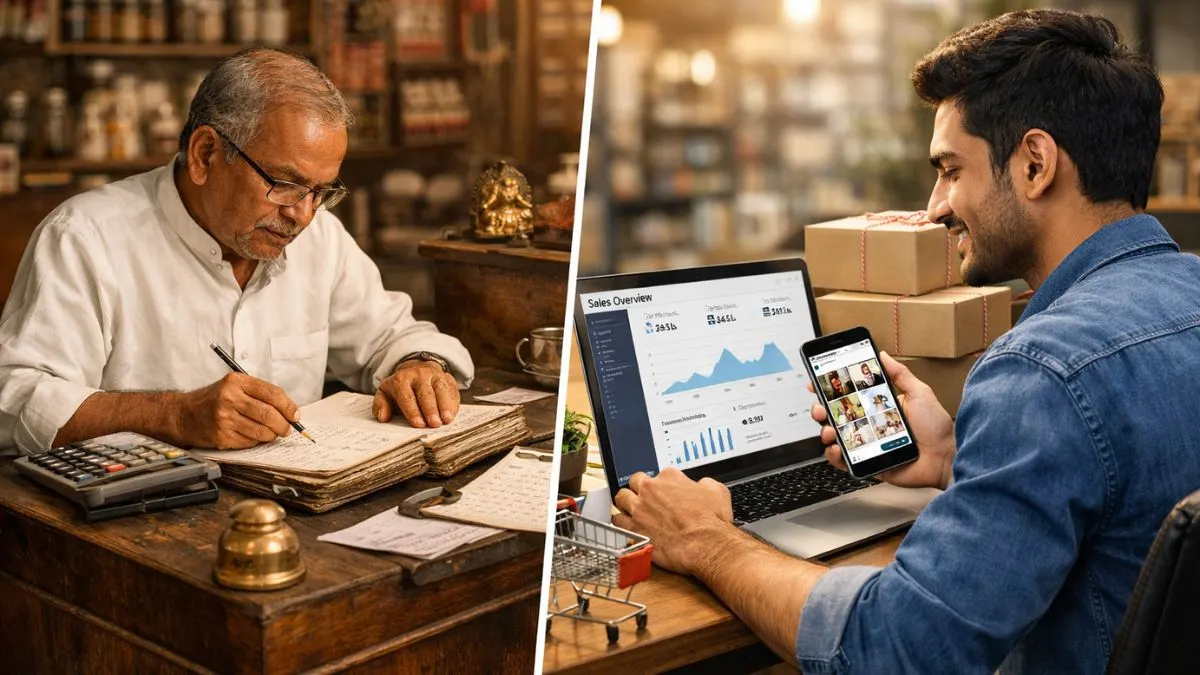
Before venture capital, before pitch decks, before announcements coming out on LinkedIn, the Indian family business was defined by the galla, the wooden cash counter in a small shop. The metal drawer was crammed with bills, all handwriting. The ledger wrapped in cloth. The customer who said, “likh dena” – put it down , and paid at the end of the month where trust was developed, relationship was maintained and the transactions were sealed with a handshake. A shop was not just a place to make a profit, it was a community institution. The grocer knew what brand of rice the family wanted to buy. Wedding seasons before the calendar existed was known by the jeweller. The textile trader was lending on the basis, not of algorithmic risk scoring, but social capital.
That was India’s original startup ecosystem.
For decades, family businesses drove the country’s economy. From textile traders in Surat to spice merchants in Kochi, from auto-part manufacturers in Ludhiana to jewellery houses in Jaipur, India’s growth story has been long feted by family-run enterprises.
Today India does have more than 63 million MSMEs. A large share are second- or third-generation businesses. They survived liberalization in the 1990s. They navigated GST. They suffered from demonetization. They adapted during COVID.
But the year 2026 is a different test.
The customer is now digital-first and move to family business digital transformation. Discovery occurs on Instagram. Payments are instant via UPI. Here is what they say about it:
“Seen-versus-Unseen Reviews Do Differentially Influence Decisions of Where to Buy Products”
“Reviews Have a Bigger Influence on Purchasing Decisions Than Does Neighborhood Familiarity”.
Supply chains are data driven. Competition is no longer the shop across the street , it has a D2C brand advertising nationally .
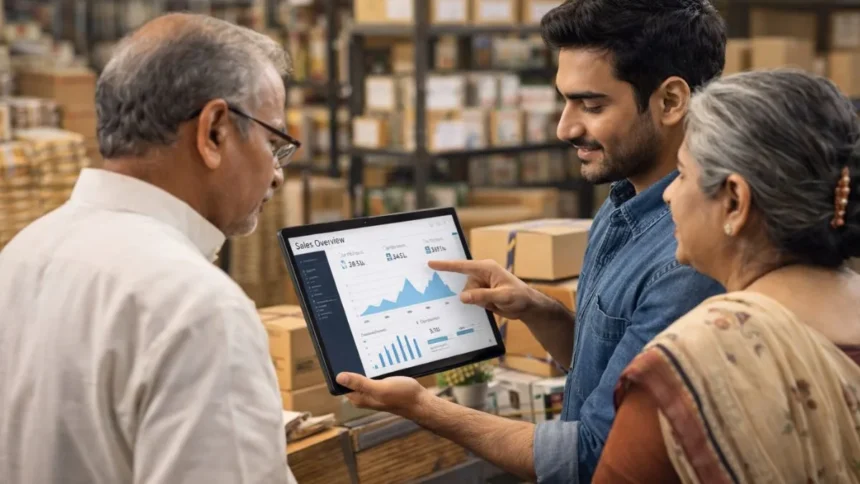
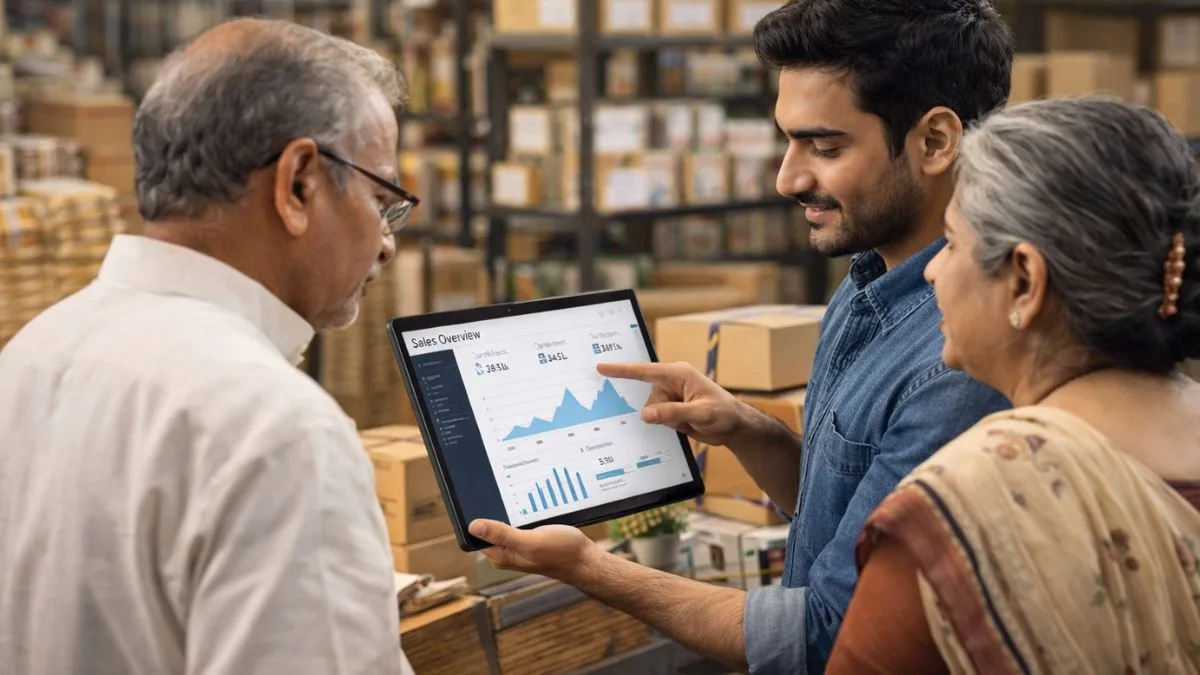
Inside thousands of Indian business families a silent change is occurring.
The older generation asks:
“Why change what changes what already works?”
The response of the younger generation:
says “If we don’t change, it won’t work long.”
This is not a conflict for the sake of drama. It is structural evolution.
India’s next wave of startup growth may not come out of garages in Bengaluru. It could be from the godowns of Rajkot.
The Balance Of The Core Tension: Stability vs Scalability
The Traditional Model of the Operating Model
First generation entrepreneurs constructed business through:
- Relationship capital
- Community-based trust
- Fiscal Conservative Financial Discipline
- Cash-flow management
- Deep supplier networks
The process of making decisions was intuitive. Risk was calculated on the basis of lived experience. Growth was incremental. Reputation was everything.
Physical presence was equal to credibility in this model.
The New-Gen Operating Model
Second and third generation founders think differently:
- Digital-first discovery
- Customer acquisition cost measures
- Analytics of Inventory Turnover
- SaaS-driven accounting
- Positioning frameworks for brands
- National/ global scale-ability
They know something important: the future market is not confined to a geographic location.
The reason for that friction is that while both models are correct , they are incomplete on their own.
The breakthrough occurs when businesses cease to choose between tradition and technology.
The true pivot is integration.
Why This Moment Is Different From Previous Transitions
Family businesses have experienced change before , from managing accounting on paper to Tally, from operating on a cash basis to digital payment, from local sourcing to global imports.
But today’s shift is deeper, however, for three reasons:
- Consumer Behavior Has Changed Forever
Customers have come to expect omnichannel access. Even if they purchase offline, they first research online. - Brand Matters More Than Ever
Earlier, as long as it was reliable, it was enough. Today storytelling, packaging and perception are the drivers of value. - Data Is the new Competitive Edge
The businesses that measure demand, customer retention and unit economics beat those that simply use instinct.
This is not cosmetic modernization. Is structural transformation, takes the form of.
The “Next-Gen” Friction, In Detail
Let us have a closer look at the emotional and operational realities.
Emotional Layer
For founding generations consist of:
- In terms of business the act of offering sacrifice is represented.
- Every single rupee was gained in light of dangers.
- Change feels like criticism.
For the second generation leaders:
- Growth feels constrained.
- Processes feel inefficient.
- Missing out on digital opportunities is dangerous.
Unless done carefully, digitization becomes personal, rather than strategic.
The solution?
- Prove results and not arguments.
- Pilot one product online.
- Track incremental revenue.
- Show data.
In the case of transforming to create measurable gains, resistance diminishes.
The 3 Layer Pivot Model
Modernization of a family business can be best achieved when done in structured layers.
Layer 1: The D2C Expansion Layer
The wholesale backbone in India is huge. But, wholesale margins are thin and are dependent upon distributors.
The D2C model that changes the equation.
As an alternative to selling to retailers who sell to customers, businesses sell directly through:
- Shopify / WooCommerce web sites
- Amazon / Flipkart / Pansofic Mall
- Instagram Shops
- WhatsApp Business
- Own mobile apps (Taptoexplore)
Why This Matters
If businesses are selling directly then:
- Margins increase
- Customer data is collected
- Repeat purchase strategies are made possible
- Brand loyalty strengthens
A spice trader in Kerala is now able to transport to the households in Mumbai. A Banarasi saree store can do live selling sessions on Instagram. A sweets manufacturer can provide its services on the national scale by cold chain logistics.
This is not a theory , it is already something that is happening.
The D2C model, as we discussed in our prior analysis of startup categories, enables traditional businesses to act like digital native brands without giving up their core operations.
Layer 2: The Technology Infrastructure
This is where profitability gets better on the sly.
Many family businesses are run with:
- Manual inventory counting
- Delayed stock audits
- Supplier dependency
- Unstructured pricing
Cloud ERP systems, low-cost SaaS solutions and AI-based demand prediction capabilities are now available even to midsized enterprises.
What Tech Integration Allows:
- System of tracking the real-time inventory
- Dead stock identification
- Demand forecasting
- Finding the optimal working capital
- Automated GST compliance
For manufacturing businesses, IoT integration can:
- Monitor machine uptime
- Reduce downtime
- Predict maintenance needs
The impact is measurable:
- Reduce inventory holding costs
- Higher turnover
- Improved margins
Technology here is not a branding thing. It is the business operational precision.
Layer 3: The Pepañía Brands Party
This layer decides whether a business is transactional in nature, or becomes aspirational.
Many legacy businesses create high-quality goods and suffer from:
- Outdated packaging
- Generic brand names
- Weak digital presence
- No storytelling
The new generation knows narrative capital.
Customers want:
- Origin stories
- Founder journeys
- Craftsmanship transparency
- Ethical sourcing
- Community connection
A conventional mithai store can rebrand itself as a premium artisanal products brand. A textile wholesaler can bring out handloom heritage and sustainability.
Rebranding does not mean giving up identity. It means articulating it strategically.
Emerging From the Case Studies
RK Jewellers – కిలోమీటర్ల Trust Make Digitally
Established in the 1990s, RK Jewellers made its name through referrals and wedding networks.
The second generation put into place:
- Digital catalogues
- Customization Consultations online
- Instagram storytelling
- NRI-focused campaigns
Revenue diversification was to follow. Online inquiries led to improved geographical reach. Customer trust transformed into a digital environment since the credibility of the brand was established already.
The main thing to learn from all this is that trust sends a very long message if you package it correctly.
Goldmedal Electricals – Innovate not Innovate but Innovate
Originally a traditional business in electrical goods, Goldmedal grew under second-generation leadership.
They introduced:
- Switches made of modern polycarbonate
- Contemporary design of products
- National distribution expansion
- Brand-centric marketing
Instead of competition on price alone, they came to establish themselves on design and durability.
Legacy operations met product innovation.
The end result: category leadership.
4: The Economics of The Pivot
Let us investigate family duty in terms of money.
Without Digital Pivot:
- Limited geography
- Distributor-dependent margins
- Low brand equity
- Static growth
With Digital Integration:
- Higher margins via D2C
- National demand access
- Customer lifetime value monitoring
- Brand premium pricing
Even a small 15-20% diversion of revenues to direct channels goes a long way in bettering the profit structure.
Over a period of 5 years this compounds.
5: The Analysis of Structure: The Structural Comparison
| Feature | Traditional Family Business | Startup Pivot |
| Revenue Model | Wholesale / Local Retail | D2C + Marketplace + Offline |
| Marketing | Word-of-Mouth | Performance Sponsored Advertising + Influencers |
| Data Usage | Minimal | Analytics-Driven |
| Branding | Functional | Identity-Led |
| Scalability | Regional | National / Global |
| Risk Profile | Conservative | Calculated Growth |
The pivot is not that conservatives will give up, it is about one in the face of great expansion.
The Cultural Benefit of Family Businesses
It’s common for startups to have this problem of:
- High burn rates
- Brand trust deficit
- Supply chain fragility
Family businesses possess:
- Consolidated supplier networks
- Stable cash flow
- Community credibility
- Operational discipline
When digitized, these become formidable competitive advantages.
The Silent Macro Impact
If 10% of India’s MSMEs incorporate structured digital pivots:
- Export volumes increase
- Employment scales
- Tax compliance improves
- Regional wealth rises
The next economic leap may not be unicorn driven. It may be MSME-driven.
The Vue Perspective
A family business has something a new startup doesn’t have: decades of trust.
The pivot is not to replace that trust.
It is about giving it a digital engine.
Trust without technology is stagnant.
Technology without trust is struggling.
Combined, they scale.
A 12-Month Pivot Roadmap
Quarter 1:
- Launch website
- Integrate digital payments
- Conduct brand audit
Quarter 2:
- normality-social media storytelling
- List on marketplaces
- Adopt cloud accounting
Quarter 3:
- Put performance marketing into practice.
- Track repeat customers
- Optimize pricing
Quarter 4:
- Launch new product line
- Expand logistics network
- Analyse profitability per channel
Transformation can become visible in a year’s time.
The Future: The Hybrids Enterprises
The most successful Indian businesses for the next decade will not be either purely digital or purely traditional.
They will be hybrid:
- Physical flagship stores
- Nationality of e-commerce presence
- AI-driven operations
- Strong brand identity
- Community-rooted credibility
The distinction between “family business” and “startup” will be blurred.
Only mindset will matter.
More Read

Conclusion: Starts of the Quiet Revolution
Entrepreneurial India, there is often glory in billion-dollar valuations.
But by far the greatest revolution is quieter.
It is happening in:
- Saree Stores giving a live on Instagram
- IoT Integrative auto-part manufacturers
- Sweet shops launching D2C brands
- Jewellery has international shipping
The shift from Dukan to digital (Cash Counter) is not cosmetic.
It is structural.
The next generation is not rebelling against legacy.
They are upgrading it.
And in doing so, they may recreate what an Indian startup really looks like.
The opportunity is vast.
The tools are available.
The trust already exists.
The only question is whether legacy businesses are ready to hit “upgrade.”
A Note from The Vue Times
If this story feels familiar, it’s because this shift is already happening around you.
India’s next growth story will not come only from new startups , it will come from family business digital transformation.
Stay with The Vue Times as we track the ideas, decisions, and quiet transformations shaping that future.