India’s Climate Policy Framework and Global Commitments
On a late autumn morning in New Delhi, the sun sliced through a hazy sky, the delicate orange glow barely overcoming the dust-laden air. It’s a city that feels the weight of India’s development aspirations and its environmental challenges at the same time. You see scooters whirring past construction sites, and in the distance, the gleam of solar panels on newly built rooftops. This juxtaposition—of relentless growth and environmental strain—is central to understanding India’s climate policy.
Over the last decade, India’s approach to climate action has matured considerably. More than just rhetoric, it now represents a complex blend of ambitious targets, institutional mechanisms, and diplomatic engagement. Still, the process reveals tensions between growth imperatives and sustainability commitments—and underscores why India’s climate policy is one of the most closely watched in the world.
A Policy Born from Dual Imperatives
India’s climate policy framework did not emerge overnight. It evolved from a history of balancing economic development with environmental protection. In the early years, climate concerns were peripheral. The focus was squarely on lifting millions out of poverty, building infrastructure, and gaining global economic competitiveness.

But as climate science sharpened its message—pointing to more frequent heatwaves, irregular monsoons, and rising sea levels—India faced a reckoning. Climate change was no longer a distant problem for future generations; it was affecting the present. Crop yields fluctuated unpredictably, water scarcity intensified in urban and rural areas alike, and coastal cities faced the encroaching threat of rising waters.
This realization shaped the way India framed its climate commitments. Rather than choosing between growth and sustainability, policymakers argued for a development pathway that integrated both. What emerged was a policy structure that emphasizes adaptation and resilience as much as mitigation.
India Climate Policy: The Architecture
At the heart of India’s climate strategy are several foundational elements:
Nationally Determined Contributions (NDCs): Under the Paris Agreement, India committed to lowering the emissions intensity of its GDP by 33–35% from 2005 levels by 2030. This includes enhancing renewable energy capacity to 450 GW by 2030 and striving to create an economy with net-zero emissions by 2070.
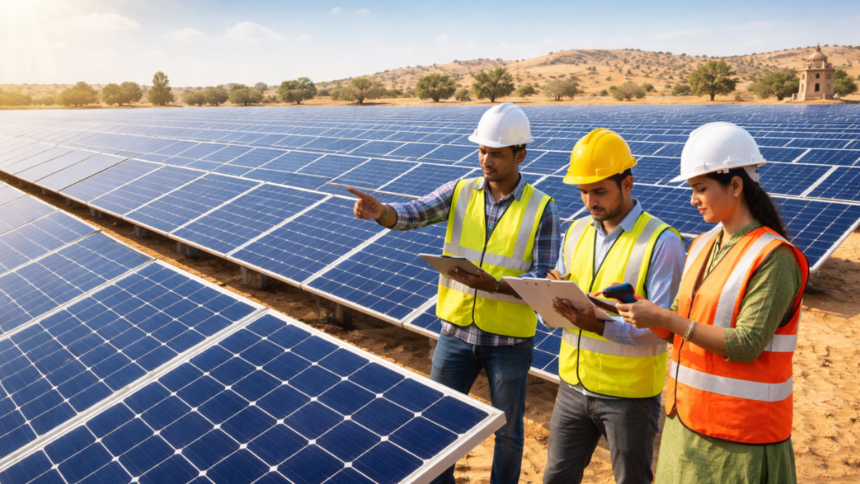
Renewable Energy Expansion: India has surged ahead with solar and wind power. Large-scale solar parks, wind farms in coastal areas, and investment in green hydrogen reflect not just policy targets, but real infrastructure change. Solar power auctions in states like Rajasthan and Tamil Nadu consistently achieve record-low tariffs, highlighting cost competitiveness.

Energy Efficiency and Sustainable Transport: Programs like the Perform, Achieve & Trade (PAT) scheme promote energy savings in energy-intensive industries. At the same time, electric mobility is gaining traction, supported by incentives and state-level policies.
Afforestation and Carbon Sinks: India’s commitment to creating additional carbon sinks aligns with its broader vision of maintaining ecological balance. Initiatives like the Green India Mission aim to enhance forest cover and biodiversity.
Together, these pillars give shape to the India climate policy. But what makes it unique is how it’s tied to socio-economic priorities. Poverty reduction, energy access, and job creation are not separate from climate goals—they are woven into the same narrative.


Why India’s Climate Commitments Matter Globally
India sits at a pivotal intersection of climate geopolitics. It is the world’s most populous country, a rapidly growing economy, and one of the largest energy consumers. Its climate choices have outsized implications—not just domestically, but globally.
When India pledged net-zero emissions by 2070 at the 2021 United Nations Climate Change Conference (COP26), the announcement drew both applause and critique. Environmental advocates celebrated the declaration; some analysts questioned the timeline and feasibility. But regardless of the debate, the pledge reaffirmed India’s role as a key player in climate diplomacy.
Moreover, India’s energy transition carries global economic weight. By scaling up renewable energy, India not only reduces its carbon footprint but also drives down costs for clean technologies worldwide. The competitive pricing of solar panels and energy storage units in international markets owes something to India’s aggressive domestic procurement and manufacturing strategies.
Bridging Ambition and Implementation
The talk of targets and commitments only tells part of the story. On the ground, implementation presents its own set of challenges.
Infrastructure and Finance: Expanding renewable energy at scale requires robust grid infrastructure, storage solutions, and financing. While India has mobilized significant investment, gaps remain—especially in rural electrification and energy access for marginalized communities.
Coal Dependence: Coal still accounts for a sizable proportion of India’s energy mix. Transitioning away from coal poses social and economic questions, particularly for regions dependent on mining and power generation for employment and revenue.
Urbanization and Transportation: Cities like Mumbai and Bengaluru grow faster than transport networks and waste management systems can keep up. Congestion, pollution, and inefficient urban planning complicate the shift to low-carbon mobility.
Despite these challenges, there have been noteworthy successes. States are experimenting with climate-smart agriculture. Renewable energy capacity has seen exponential growth. And there’s a palpable shift in corporate India, with several companies setting their own net-zero targets and investing in clean technology.
The Private Sector and Innovation
India’s climate trajectory is no longer the domain of governments alone. The private sector—notably in renewable energy, electric vehicles (EVs), and sustainable finance—is an active and often leading participant.
Startups focusing on energy storage, carbon capture, and climate analytics are securing funding. Legacy industries, from steel to cement, are exploring low-carbon solutions to stay competitive in international markets that increasingly penalize carbon-intensive imports.
Through initiatives like voluntary carbon markets and sustainability-linked loans, businesses are discovering that climate responsibility can also be a market advantage. India’s top asset management firms have launched green bonds and climate-focused funds, giving retail investors a vehicle to support sustainable growth.

Global Cooperation and Equity
India’s climate policy is also shaped by considerations of justice and equity. From its standpoint, historical emissions—and thus responsibility for climate change—are far higher in developed economies. This framing has led India to emphasize support mechanisms, technology transfer, and climate finance from wealthier nations.
At global forums, India often brings attention to adaptation needs: protecting farmers from climate variability, strengthening coastal defenses, and supporting water conservation in arid regions. These priorities reflect both domestic necessity and a call for a cooperative global framework that recognizes differing capacities and responsibilities.
The Road Ahead
Looking forward, several dynamics will shape the evolution of India’s climate policy:
Technology Leapfrogging: Advances in battery technology, green hydrogen, and carbon capture could change the calculus for decarbonization. India’s ability to harness these technologies—through investment and partnerships—will determine the pace of its transition.
Climate Risks and Resilience: As climate impacts become more pronounced—heatwaves intensify, monsoon patterns shift—resilience will become as central as mitigation. Water security, public health, and disaster preparedness will shape policy priorities.
Political Will and Public Engagement: Sustained climate action depends on governance continuity and civic participation. Public awareness, local leadership, and community-led initiatives will lend depth to national objectives.
Global Economic Shifts: Trade agreements, carbon border taxes, and global investment flows are increasingly tied to climate performance. India’s ability to align its industrial strategy with these emerging norms will influence its economic competitiveness.
A New Equilibrium
India’s climate journey reflects a broader search for equilibrium—between aspiration and constraint, between growth and stewardship, between national interest and global responsibility. The India climate policy is neither static nor simplistic; it is an evolving narrative shaped by negotiations, innovation, and real-world pressures.
What strikes an observer is not just the ambition of India’s vision, but the scale of the challenge. Turning policy commitments into measurable, equitable outcomes will require sustained effort, ingenuity, and cooperation—within India and beyond.
Ultimately, the success of India’s climate strategy will be measured not by declarations made at global conferences, but by the quality of life of its citizens and the resilience of its landscapes in a warming world.
More Read

Conclusion
India’s climate policy framework reflects the realities of a fast-growing nation trying to respond to a fast-worsening global crisis. It is ambitious in parts, cautious in others, and shaped by the constant need to balance development, energy security, and environmental responsibility. The real test now lies in execution—how effectively policy targets translate into cleaner industries, stronger resilience, and fairer growth. India’s next climate chapter will not be defined only by promises at global forums, but by what changes on the ground for its people, cities, and ecosystems.
Final Insight
India’s climate policy balances growth with sustainability, shaping both its future and global climate action. Stay informed on India’s journey toward a greener, resilient world.-The Vue Times
Frequently Asked Questions
What is India’s Climate Policy?
India’s climate policy refers to the set of national plans, regulatory frameworks, and international commitments designed to reduce greenhouse gas emissions, expand renewable energy, and strengthen resilience to climate impacts.
What are India’s global climate commitments?
Under the Paris Agreement, India committed to reducing emissions intensity, expanding renewable energy capacity, enhancing carbon sinks through afforestation, and achieving net-zero emissions by 2070.
How is India expanding renewable energy?
India’s expansion includes large-scale solar parks, wind farms, battery storage initiatives, and policy incentives that lower costs and attract investment from domestic and foreign firms.
Why is climate finance important for India?
Climate finance supports India’s transition by funding infrastructure, clean technology, adaptation measures, and community resilience programs that may otherwise be unaffordable at scale.
Does India still rely on coal?
Yes. Coal remains a significant part of India’s energy mix, especially for electricity generation. However, policy efforts aim to gradually reduce dependence through cleaner alternatives and efficiency gains.