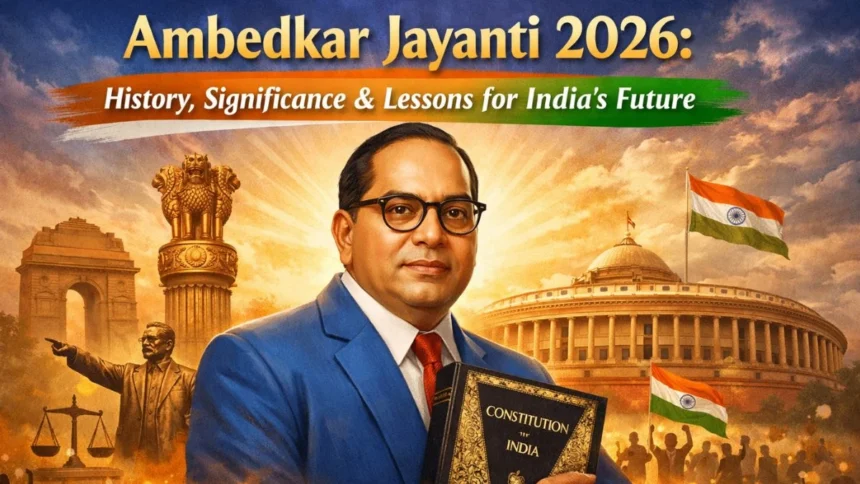
Ambedkar Jayanti 2026: History, Significance & Lessons from Dr. B.R. Ambedkar for India’s Future
On April 14, 2026, the 135th birth anniversary of Babasaheb, we revisit the extraordinary life, constitutional genius, and timeless vision of the man who gave India its moral backbone.
Every year on April 14, India pauses. Streets fill with blue flags and garlands of marigold. Statues of a bespectacled man in a blue suit receive offerings from millions of hands, from farmers in Maharashtra, scholars in Delhi, students in Tamil Nadu, and diaspora communities from London to Toronto. That man is Dr. Bhimrao Ramji Ambedkar, and the day is Ambedkar Jayanti, a celebration not merely of a birthday, but of a life that reshaped the idea of India itself.
In 2026, this observance carries extraordinary weight. Ambedkar Jayanti 2026 marks the 135th birth anniversary of Babasaheb, falling on Tuesday, April 14, a national gazetted holiday across the country. Schools hold debates, Parliament pays tribute, stock markets close, and hundreds of thousands gather at pilgrimage sites like Deekshabhoomi in Nagpur and Chaitya Bhoomi in Mumbai. But beyond ceremony lies a deeper question: What does Dr. Ambedkar mean for India in 2026?
This article traces the history, significance, and living lessons of India’s greatest social reformer, and why his ideas are more urgent today than ever before.

Who Was Dr. B.R. Ambedkar? A Life Against the Current
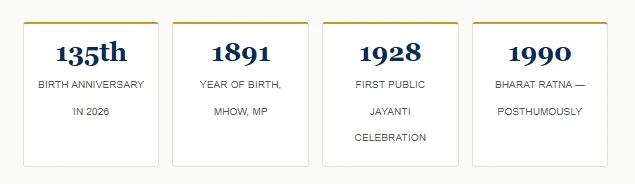
Born on April 14, 1891, in the small cantonment town of Mhow (now Dr. Ambedkar Nagar) in present-day Madhya Pradesh, Bhimrao Ramji Ambedkar entered a world that had already decided what he was worth. As the 14th child of an Indian Army officer from the Mahar caste, a group branded “untouchable” under the Hindu caste hierarchy, young Bhimrao was forbidden from drinking from shared water pots at school, barred from entering certain temples, and forced to sit on a gunny sack lest he “pollute” the classroom floor.
Yet from that same floor, he rose to become one of the most educated leaders in Indian history. Ambedkar earned a doctorate in Economics from Columbia University, New York and another from the London School of Economics. He studied at Gray’s Inn and was called to the Bar as a barrister. At a time when most of his caste peers were denied basic literacy, Ambedkar held multiple advanced degrees from two of the world’s greatest institutions.
“Cultivation of mind should be the ultimate aim of human existence.”
— Dr. B.R. Ambedkar
This was not merely academic achievement. It was a political act, a defiant refusal to accept the limits society had drawn for him. And he would spend the rest of his life refusing those limits on behalf of millions who had never been given the chance to refuse them for themselves.

The History of Ambedkar Jayanti: From Pune to the World Stage
The first public celebration of Ambedkar Jayanti was organised in 1928 in Pune by social activist Janardan Sadashiv Ranapisay, a modest gathering that marked the birth anniversary of an already-rising leader. Over the following decades, as Ambedkar’s influence grew through his political writing, legal advocacy, and mass mobilisation, so too did the scale of April 14 observances across India.
After India’s independence and Ambedkar’s death in 1956, the day took on the dimensions of a national day of mourning, memory, and renewal. Milestones since then have amplified its global reach:
1956

Dr. Ambedkar passes away
On December 6, now observed as Mahaparinirvan Diwas, Babasaheb breathes his last in Delhi, two months after converting to Buddhism alongside hundreds of thousands of followers.
1990
Bharat Ratna, posthumously awarded
The Government of India confers its highest civilian honour on Dr. Ambedkar. His life-size portrait is also unveiled in the Central Hall of Parliament.
2015
125th birth anniversary, national celebrations
The Government issues commemorative ₹10 and ₹125 coins. Google marks the occasion with a special Doodle visible in India and seven other countries.
2016–2018
United Nations observes Ambedkar Jayanti
For three consecutive years, the United Nations officially recognises April 14 as a day to honour Ambedkar’s contributions to global human rights.
2020–2021
Canada declares April 14 “Dr. B.R. Ambedkar Day of Equality”
The City of Burnaby (2020) and the province of British Columbia (2021) formally recognise April 14, cementing Ambedkar’s place in the global human rights canon.
2026
135th birth anniversary, Ambedkar Jayanti 2026
India observes a gazetted national holiday. Tributes pour in from Parliament, civic institutions, educational bodies, and Indian communities across the globe.
The Significance of Ambedkar Jayanti: Why April 14 Matters
Ambedkar Jayanti is not a religious festival, nor a purely political one. It is something rarer and more essential: a civic observance. It asks citizens, regardless of caste, faith, or political affiliation, to reflect on the ideals of equality, dignity, and constitutional rights that Dr. Ambedkar enshrined in India’s founding document.
For Dalit communities across India, the day carries deeply personal weight. It is a day of pride, identity, and collective memory, a moment to affirm that the battles Ambedkar fought were not fought in vain, and that the journey toward genuine equality continues. For the broader public, April 14 is a reminder that India’s democracy was never meant to be merely a transfer of colonial power from British hands to upper-caste ones. It was meant, at least in Ambedkar’s vision, to be a radical equalisation.
Why Ambedkar Jayanti 2026 matters especially
India in 2026 is a rising global power, its economy among the world’s largest, its democratic institutions globally respected. Yet questions of caste-based discrimination, access to quality education, and the rights of marginalised communities remain unresolved. Ambedkar Jayanti 2026 asks: are we building the India Babasaheb imagined?
Dr. Ambedkar’s Contributions: Far More Than the Constitution
When most Indians think of Ambedkar, they think of the Constitution, and rightly so. But reducing him to a single achievement is to miss the astonishing breadth of his life’s work.
Architect of the Indian Constitution
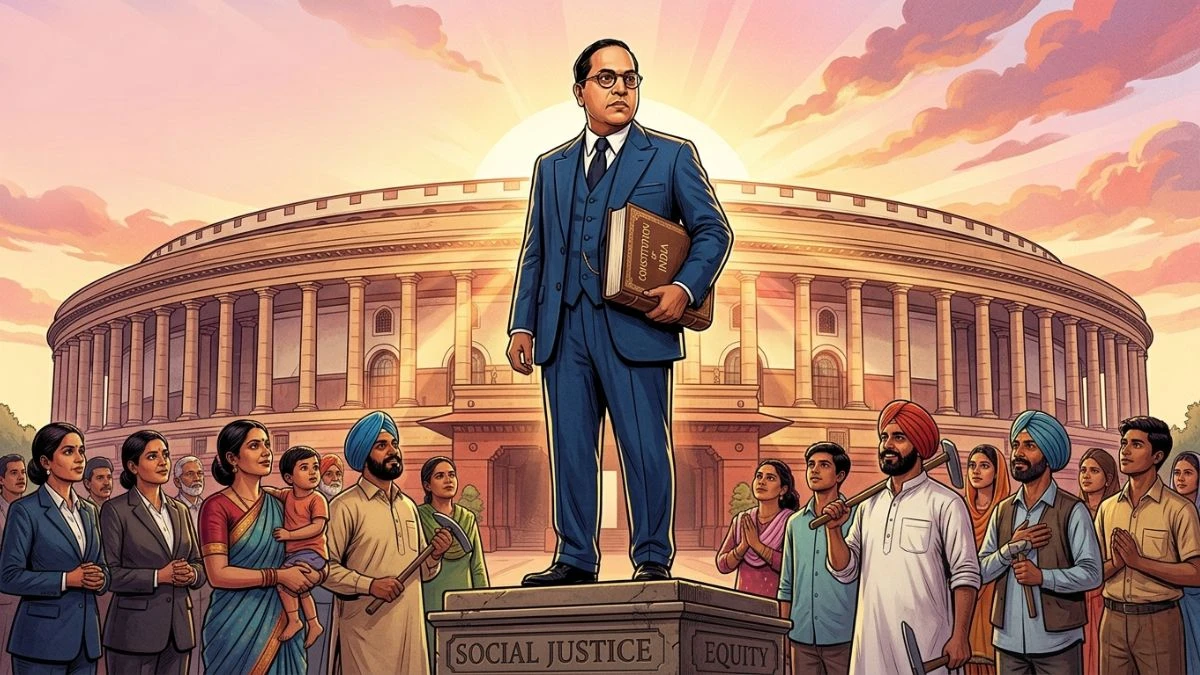
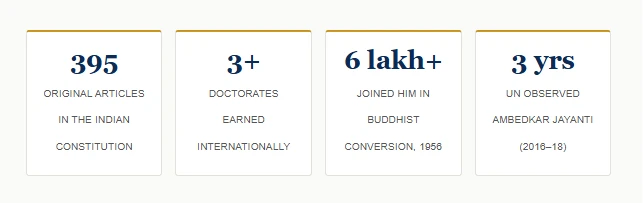
As Chairman of the Constitution Drafting Committee, Dr. Ambedkar led the writing of the Indian Constitution, which was adopted on November 26, 1949. The document, running to 395 articles and 8 schedules at the time of its adoption, guaranteed fundamental rights to every Indian citizen regardless of caste, religion, or gender. The abolition of untouchability under Article 17 was Ambedkar’s personal crusade translated into supreme law.
India’s first Law Minister
After independence, Prime Minister Nehru appointed Ambedkar as India’s first Law Minister. In this role, he championed the Hindu Code Bill, which sought to codify and reform Hindu personal law, granting women rights of inheritance, divorce, and adoption. When the bill was diluted beyond recognition by Parliament, Ambedkar resigned in protest. His resignation was a political act of principle that history has since vindicated.
Economist and financial architect
Long before he became known as a constitutionalist, Ambedkar was a trained economist whose doctoral thesis on the rupee is still studied in monetary policy circles. He played a significant role in advocating for what eventually became the Reserve Bank of India, and his 1923 work The Problem of the Rupee: Its Origin and Its Solution influenced the design of India’s central banking framework. He also argued strongly for agricultural and industrial development, and for improved working conditions for India’s labour class.
Social reformer and mass mobiliser
In 1923, Ambedkar founded the Bahishkrit Hitkarini Sabha to promote education and social uplift among marginalised communities. In 1930, he led the Temple Entry Movement at Kalaram Temple in Nashik, demanding the right of Dalits to enter Hindu places of worship. He organised the Mahad Satyagraha in 1927, a movement to assert the right of Dalits to draw water from a public tank. These were not symbolic protests. They were confrontations with the architecture of caste oppression, conducted with legal precision and moral clarity.
The conversion to Buddhism
On October 14, 1956, just weeks before his death, Ambedkar led one of the largest mass religious conversions in history, embracing Buddhism alongside an estimated 600,000 followers in Nagpur. He chose Buddhism, he said, because it offered a philosophy of equality, reason, and compassion, without the hierarchies embedded in Hindu orthodoxy. The site of this event, Deekshabhoomi in Nagpur, remains one of the most visited pilgrimage sites in India.
Celebrating Ambedkar Jayanti 2026: How India Observes the Day
Across India, Ambedkar Jayanti 2026 is being observed with a mix of solemnity and celebration. The day typically unfolds as follows:
Early morning tributes: Crowds gather at Ambedkar statues and portraits across the country, garlanding them with marigolds and blue flowers, his symbolic colour. Key sites include the Ambedkar Memorial in Lucknow, Dr. Ambedkar National Memorial in New Delhi, Chaitya Bhoomi in Dadar (Mumbai), and Deekshabhoomi in Nagpur.
Government functions: The President and Prime Minister of India traditionally pay floral tributes at the Parliament House portrait of Ambedkar. State governments organise official ceremonies, and many announce welfare schemes in his name.
Educational events: Schools and universities, including Kendriya Vidyalayas and Navodaya Vidyalayas nationwide, host essay competitions, speech contests, quiz events, and constitutional awareness seminars. Students read excerpts from Ambedkar’s speeches and debate the relevance of his ideas today.
Community gatherings: Langar-style community meals, rallies, and cultural programmes bring people of all backgrounds together in public spaces. Many participants wear blue or white, colours associated with Ambedkar and the Buddhist conversion movement.
Global observance: Indian communities in the United Kingdom, the United States, Canada, Australia, and across Europe mark the day with seminars, community dinners, and social media campaigns spreading Ambedkar’s message of “Educate, Agitate, Organise.”
Lessons from Dr. Ambedkar for India’s Future
What can a man born 135 years ago teach an India navigating artificial intelligence, geopolitical realignment, and democratic tensions? Quite a lot, it turns out. Ambedkar’s ideas were not merely reactive responses to the injustices of his era. They were forward-looking principles, a blueprint for a society that had not yet been built.
Education is liberation
Ambedkar believed that the mind, once educated, could never be truly enslaved. In a country where quality education remains unevenly distributed along lines of caste, class, and geography, his insistence that “Cultivation of mind should be the ultimate aim of human existence” remains a radical demand, not a platitude.
The Constitution must be lived, not merely cited
Ambedkar knew that parchment guarantees mean nothing without civic engagement. He warned that political democracy without social and economic democracy was a structure built on sand. India must ask itself, on every April 14, whether the Constitution’s promise of liberty, equality, and fraternity is a lived reality or merely a recited aspiration.
Fraternity is the hardest, and most necessary, goal
Of the three pillars of democracy, liberty, equality, and fraternity, Ambedkar said fraternity was the most difficult to achieve. It requires not just law, but a change in the human heart. In an era of polarised social media and deepening communal divides, this lesson deserves urgent attention.
Organise, or be marginalised
His famous rallying cry, “Educate, Agitate, Organise”, understood that knowledge without collective action is incomplete. For India’s farmers, workers, women, and minority communities, this remains the most practical political wisdom available.
Human rights are universal, not a domestic matter
Ambedkar sought to bring India’s treatment of Dalits before the United Nations, decades before “human rights” became standard international vocabulary. His global lens is a reminder that India’s internal social justice is not separate from its standing in the world.
“I measure the progress of a community by the degree of progress which women have achieved.”
— Dr. B.R. Ambedkar
More Read
Ambedkar’s Legacy in Numbers: A Snapshot
The scale of Dr. Ambedkar’s influence is difficult to convey in words alone. Consider the following dimensions of his enduring legacy:
Frequently Asked Questions: Ambedkar Jayanti 2026
When is Ambedkar Jayanti 2026?
Ambedkar Jayanti 2026 falls on Tuesday, April 14, 2026. It marks the 135th birth anniversary of Dr. B.R. Ambedkar, who was born on April 14, 1891.
Why is Ambedkar Jayanti celebrated on April 14?
Dr. Bhimrao Ramji Ambedkar was born on April 14, 1891, in Mhow, Madhya Pradesh. The day is observed every year on this date as his birth anniversary.
Is April 14, 2026 a public holiday in India?
Yes. April 14, 2026 is a gazetted public holiday across India. Banks, stock exchanges (NSE and BSE), government offices, and many educational institutions remain closed.
What is Dr. Ambedkar’s most significant contribution?
Dr. Ambedkar is best known as the chief architect of the Indian Constitution. As Chairman of the Constitution Drafting Committee, he guided the document that guaranteed fundamental rights to every Indian citizen. He also served as India’s first Law Minister and played a foundational role in conceptualising the Reserve Bank of India.
When did the public celebration of Ambedkar Jayanti begin?
The first public celebration of Ambedkar Jayanti was organised in 1928 in Pune by social activist Janardan Sadashiv Ranapisay. Since then, the observance has grown into a major national and international event.
What is Ambedkar’s famous slogan?
Dr. Ambedkar’s most famous rallying call is “Educate, Agitate, Organise”, urging marginalised communities to seek education, challenge injustice, and build collective power.
Is Ambedkar Jayanti observed internationally?
Yes. Ambedkar Jayanti is observed by Indian communities across the United Kingdom, the United States, Canada, and Australia. Notably, the United Nations recognised April 14 for three consecutive years (2016–2018), and the province of British Columbia, Canada, officially declared April 14 as “Dr. B.R. Ambedkar Equality Day” in 2021.
Babasaheb’s Unfinished Mission
Every April 14, India faces a mirror. The reflection it sees is not just of a man born 135 years ago in a small cantonment town in Madhya Pradesh. It sees the Constitution he wrote, the rights he demanded, the communities he uplifted, and the India he imagined, one where a person’s worth would never again be determined by the accident of their birth.
Dr. B.R. Ambedkar did not live to see that India. He died on December 6, 1956, knowing the work was incomplete. It remains incomplete today. Caste discrimination persists. Access to quality education remains deeply unequal. Constitutional guarantees are still being fought for in courts and on streets.
But the fact that millions gather every April 14, in Delhi and Dadar, in London and Los Angeles, is itself proof that Ambedkar’s mission did not die with him. It lives in the hands that garland his statues, in the students who read his speeches, in the lawyers who cite his Constitution, and in every Indian who dares to believe that the country they live in can be better than the one they inherited.
On Ambedkar Jayanti 2026, The Vue Times joins crores of Indians in paying tribute to Babasaheb, not with ceremony alone, but with a commitment to the only thing that truly honours his memory: continuing the work.
“Life should be great rather than long.”
— Dr. B.R. Ambedkar | April 14, 1891 – December 6, 1956