

Contempt of Court
In any constitutional democracy, the authority of courts is not derived from physical power but from public trust. Courts function effectively only when their decisions are respected, their processes are not obstructed, and their dignity is preserved. In India, the concept of contempt of court exists to protect this delicate balance between judicial authority and democratic freedom. It is not a tool for ego or prestige, but a constitutional mechanism designed to ensure that justice is delivered without fear, disruption, or deliberate erosion of credibility.
Contempt of court often becomes a topic of public debate when journalists, politicians, activists, or ordinary citizens face proceedings for statements or actions seen as undermining the judiciary. Supporters argue that contempt powers are essential for maintaining the rule of law, while critics worry about misuse and restrictions on free speech. Understanding what contempt of court truly means, how it evolved in India, and why it continues to matter is crucial for anyone engaging with public discourse in a constitutional system.
This article explains the idea of contempt of court in India in clear terms, explores its constitutional and legal foundations, examines its types and procedures, and analyses why it remains relevant in a rapidly changing democratic society.
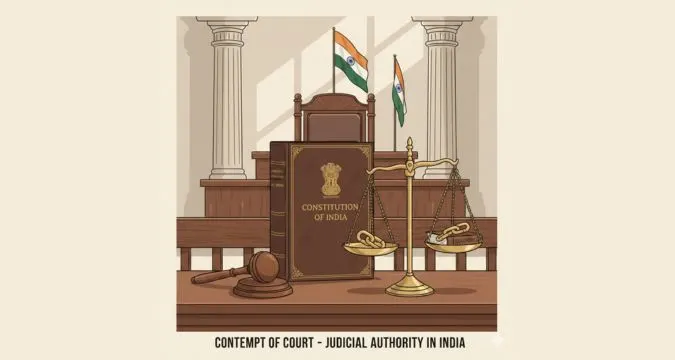
Meaning of Contempt of Court
Basic Definition
Contempt of court refers to any act, statement, or conduct that disobeys, disrespects, or undermines the authority of a court or interferes with the administration of justice. In simple terms, it is behavior that prevents courts from performing their functions fairly and independently.
The focus of contempt law is not to protect individual judges from criticism but to protect the judicial process itself. When courts are obstructed, intimidated, or deliberately scandalised, the entire justice delivery system is affected, and public confidence begins to erode.
Constitutional Recognition in India
The Indian Constitution explicitly recognises the power of courts to punish for contempt. Article 129 declares the Supreme Court as a court of record with the power to punish for contempt of itself. Similarly, Article 215 grants the same power to High Courts.
This constitutional recognition places contempt powers at a very high level, making them independent of ordinary legislation. Parliament can regulate contempt through law, but it cannot take away the inherent power of constitutional courts to act against contemptuous conduct.
Also Read: Constitutional Duties Key And Making of a Strong Democracy
Historical Evolution of Contempt Law in India
Colonial Origins
The law of contempt in India has its roots in British common law. During colonial rule, contempt powers were used primarily to protect the authority of British courts. The concept of scandalising the court emerged during this period, aimed at preventing public statements that could weaken judicial legitimacy in the eyes of the public.
After independence, India inherited this legal framework but adapted it to a democratic and constitutional context. The challenge was to balance inherited legal principles with constitutional values such as free speech and accountability.
Post Independence Development
In 1971, Parliament enacted the Contempt of Courts Act to define and limit the scope of contempt powers. The Act did not create contempt jurisdiction but clarified its application, procedures, and safeguards.
Over time, Indian courts have interpreted contempt law through constitutional principles, gradually narrowing its scope while reaffirming its necessity. Judicial pronouncements have repeatedly emphasised that contempt powers must be used sparingly and with restraint.
Types of Contempt of Court
Civil Contempt
Civil contempt refers to wilful disobedience of a court order, judgment, or direction. It also includes the breach of an undertaking given to a court.
The purpose of civil contempt is primarily remedial rather than punitive. It seeks to enforce compliance with court orders and ensure that judicial decisions are not rendered meaningless. For example, if a government authority deliberately ignores a court order, civil contempt proceedings may be initiated to compel obedience.
Criminal Contempt
Criminal contempt involves actions that interfere with the administration of justice or lower the authority of the court. It includes publishing statements that scandalise the judiciary, prejudicing ongoing proceedings, or obstructing court functioning.
Criminal contempt is more controversial because it often intersects with freedom of expression. Courts have clarified that fair criticism of judgments is not contempt, but malicious attacks aimed at undermining public confidence may attract action.
Also Read: Dr Ambedkar Constitutional
Contempt of Courts Act, 1971 Explained
Purpose of the Act
The Contempt of Courts Act, 1971 was enacted to define the limits of contempt jurisdiction and provide clarity on its application. It attempts to strike a balance between judicial authority and constitutional freedoms.
The Act defines civil and criminal contempt, prescribes punishment, and lays down procedural safeguards. Importantly, it recognises that not every criticism of the judiciary amounts to contempt.
Punishment Under the Act
Punishment for contempt may include simple imprisonment for up to six months, a fine, or both. Courts also have the power to discharge an accused if an apology is made to the satisfaction of the court.
The emphasis on apology reflects the corrective nature of contempt proceedings. The objective is not retribution but restoration of respect for the judicial process.
Freedom of Speech and Contempt of Court
Constitutional Tension
Article 19 of the Constitution guarantees freedom of speech and expression, subject to reasonable restrictions. Contempt of court is one such restriction expressly mentioned in Article 19(2).
This creates an inherent tension between the right to criticise institutions and the need to protect judicial authority. Indian courts have repeatedly held that democracy thrives on criticism, including criticism of the judiciary, but such criticism must be responsible and based on facts.
Fair Criticism Versus Contempt
The Supreme Court has clarified that fair, reasonable, and constructive criticism of judicial decisions does not amount to contempt. Academic analysis, journalistic scrutiny, and public debate are all essential components of an open society.
Contempt arises only when criticism crosses into the realm of malicious intent, personal attacks, or deliberate misinformation that threatens the credibility of the justice system.
Why Contempt of Court Matters in India
Protecting the Rule of Law
India is governed by the rule of law, which means that everyone, including the government, is subject to legal authority. Courts are the final interpreters of law, and their orders must be respected for the system to function.
If court orders can be openly defied or ridiculed without consequence, the rule of law collapses. Contempt powers act as a safeguard against such breakdown.
Ensuring Judicial Independence
Judicial independence is a cornerstone of the Indian Constitution. Judges must be able to decide cases without fear of retaliation, public intimidation, or political pressure.
Contempt law helps shield judges and courts from campaigns designed to influence or intimidate them. It ensures that decisions are based on law and conscience rather than public hostility.
Maintaining Public Confidence
The judiciary does not command armies or control finances. Its authority rests entirely on public confidence. When false narratives or deliberate attacks undermine that confidence, justice delivery suffers.
Contempt proceedings serve as a mechanism to protect institutional credibility while reminding society of the importance of responsible discourse.
Contempt of Court and Media in India
Role of Journalism
The media plays a vital role in reporting on court proceedings and holding institutions accountable. Indian courts have recognised the importance of press freedom in a democracy.
At the same time, sensationalism, half truths, or prejudicial reporting during ongoing trials can harm justice. Contempt law draws a line between responsible reporting and interference with judicial processes.
Trial by Media Concerns
One of the most significant modern challenges is trial by media, where public opinion is shaped aggressively before courts reach a verdict. Such coverage can influence witnesses, prejudice judges, and compromise fair trials.
Contempt powers allow courts to intervene when media conduct threatens the integrity of judicial proceedings.
Landmark Contempt Cases in India
Judicial Clarifications
Over the decades, several landmark cases have shaped India’s contempt jurisprudence. Courts have consistently reiterated that contempt jurisdiction is not meant to silence dissent but to preserve institutional functioning.
Judgments have narrowed the scope of scandalising the court and emphasised that judges, like all public officials, are subject to scrutiny and debate.
Apology and Judicial Restraint
Indian courts have often shown restraint by accepting apologies and closing proceedings. This reflects an understanding that contempt law should educate and correct rather than punish harshly.
Such restraint has strengthened the legitimacy of contempt jurisdiction rather than weakened it.
Criticism and Calls for Reform
Arguments Against Broad Contempt Powers
Critics argue that the concept of scandalising the court is vague and susceptible to misuse. They point out that mature democracies have either abolished or significantly restricted this ground of contempt.
Concerns are also raised about chilling effects on free speech, especially in the age of social media where public commentary is instant and widespread.
Need for Balance, Not Abolition
While criticism is valid, most legal scholars agree that complete abolition of contempt powers may weaken judicial authority in a country as large and diverse as India.
The focus, therefore, is on clearer standards, greater tolerance for criticism, and consistent judicial restraint rather than eliminating contempt jurisdiction altogether.
Also Read: How India’s Local Startup Are Building AI Tools
Contempt of Court in the Digital Age
Social Media Challenges
Social media has transformed public engagement with the judiciary. Judges, judgments, and court proceedings are now discussed widely and often emotionally.
This creates new challenges in distinguishing between genuine opinion and harmful misinformation. Contempt law is increasingly being tested in this fast moving digital environment.
Responsibility of Citizens
With greater access to information comes greater responsibility. Citizens must understand that freedom of expression does not include the freedom to obstruct justice or spread falsehoods about courts.
Awareness of contempt law encourages more informed and responsible civic participation.,
More Read

Conclusion
Contempt of court in India is not an outdated colonial relic nor a weapon to suppress democratic voices. It is a constitutional safeguard designed to protect the administration of justice, judicial independence, and public confidence in the rule of law.
In a vibrant democracy like India, criticism of institutions is both inevitable and necessary. The true challenge lies in ensuring that such criticism strengthens accountability without weakening the foundations of justice. Contempt law, when applied with restraint, transparency, and constitutional sensitivity, plays a vital role in maintaining this balance.
As India continues to evolve socially, politically, and digitally, the relevance of contempt of court will depend not on the frequency of its use but on the wisdom with which it is exercised. A mature democracy does not fear criticism, but it also does not allow the erosion of institutions that uphold justice for all.