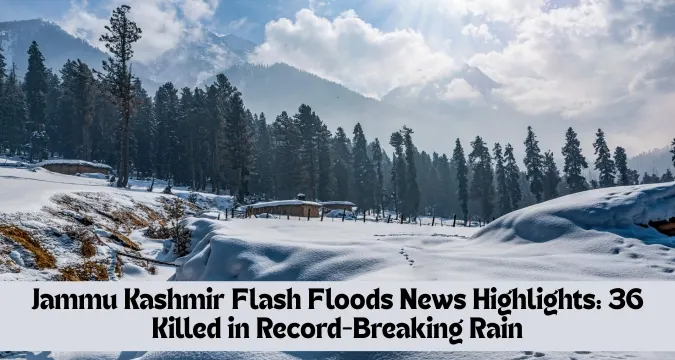
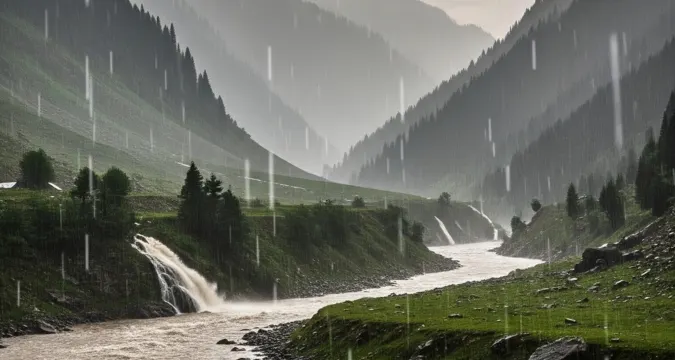
Jammu and Kashmir the Union Territory has experienced one of the most awful natural disasters in recent years. Massive rains generated flash floods and landslides in various districts killing at least 36 and injuring dozens eliciting the response of assessing them at almost 2000:00 HRS.
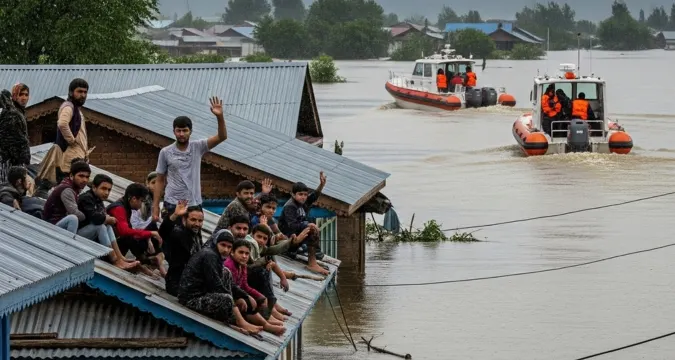
This disaster, predetermined by history-record rains over the last three days, has clearly shown how sensitive the mountain ecosystems in the Himalayan belt are once again. It highlights the dire situation in which disaster preparedness is required in an already climatically prone region.
The Scale of the Disaster
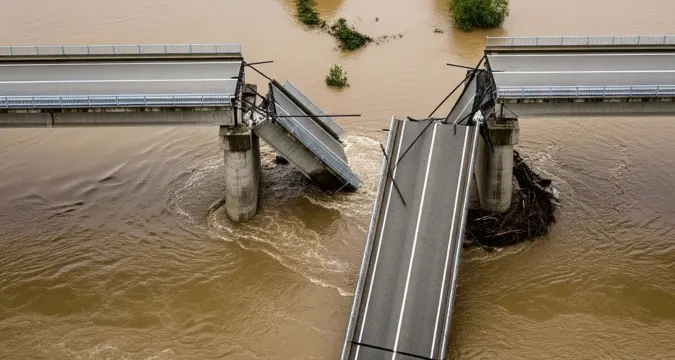
The India Meteorological Department (IMD) released and reported that Jammu and Kashmir received well over 220mm of rainfall within 48 hours. It is a record of the highest dose in the last twenty years. The flood overwhelmed low-lying regions, carried away bridges, washed away roads and left thousands of people vulnerable with no water or electricity.
The most affected districts are Anantnag, Kulgam, Poonch, Rajori, Baramulla and Kupwara. Overnoths and cloud bursts became floods of destruction, packing houses and families out of mixture in a single too brief night.

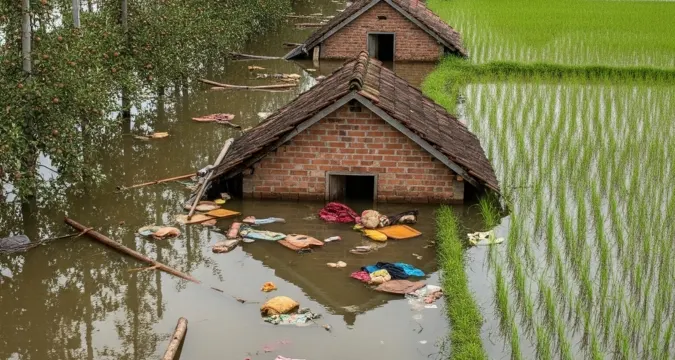
- State disaster response authorities affirmed 36 deaths to date, as of Wednesday morning. A large number of victims got trapped in houses that collapsed or were swept by the floods.
- More than 100 villages are still isolated as a result of road damages and landslides.
- Dozens of animals have died, further ravaging the economy of villages.
- There are preliminary estimates of property losses in hundreds of crores. There is a resounding failure on farming and horticulture, which are some of the main livelihoods in the Valley.
Human Tragedy on the Ground
A dark picture has been observed by eyewitnesses. Some families in South Kashmir district, Kulgam, claimed that entire orchards were submerged in flood water. Poonch villagers reported in villages that streams burst their banks to pour in at night, and the occupants had no time to pack their bags.
A local resident in Baramulla, speaking to reporters, said:
“The water level rose faster than anything we had seen before. Within minutes, our cattle, our fields, everything was gone. People ran towards higher ground, but many were trapped.”
The hospitals at Anantnag or Srinagar are swamped with patients with injuries, infections and trauma. The State Disaster Response Force, National Disaster Response Force and the Army rescue teams are working round the clock and are engaged in the evacuation of the stranded. The critically injured are commonly airlifted to healthier hospitals.
Government and Army Response
The Jammu and Kashmir government declared an emergency in the worst affected regions. Swift helicopters, boats and medical teams part of Operation Madad have been deployed by the army, targeting the rescue of civilians who live in remote villages. Schools, government buildings have opened relief camps where those in need are getting temporary shelter, food and water.
Lieutenant Governor Manoj Sinha also provided condolences to families who lost loved ones and promised to provide financial assistance through the State Disaster Relief Fund. Prime minister Narendra Modi also checked the situation and instructed central agencies to implement some immediate help and assistance in the restoration work.

Why Are Flash Floods Increasing in Jammu and Kashmir?
The man-made catastrophe offers very urgent questions: how frequent and how intense are extreme weather conditions in the Himalayas? Researchers pinpoint climate change, environmental degradation and unplanned urbanization as contributing factors.
Climate change: Himalayas are warming at a faster rate than the rest of the world. The monsoons are unpredictable and the cloudbursts are increasing making seasonal rains massive.
Deforestation and encroachment: Large scale logging, sand mining and building on banks and these are destroying natural systems by which rivers drain, exposing the area to flood risks.

Geographically, it is close to unstable Himalayan glaciers in Jammu and Kashmir. There is an additional source of uncertainty in sudden glacial lake outburst floods (GLOFs).
Poor infrastructure: Roads, bridges, and housing often lack climate‑resilient design. Their foundation is weak, and thus can be threatened by sudden rise of the water levels.
The Centre of Science and Environment (CSE) recently conducted a study that reported that extreme rain, in the Himalayan region, has increased 65 per cent in the last three decades.
Lessons from Past Disasters
This play is remarkably similar to the 2014 Kashmir floods, during which more than 250 individuals perished and Srinagar was submerged in water many feet deep. Despite lessons being learned, the evolution of climate has not been met by a change in flood-management infrastructure.
There have been some embankments and drainage implications but urban sprawls and unapproved constructions in the floodplains are not influenced. Professionals believe that the state should create a mountain-specific disaster-management strategy that takes into consideration delicate ecosystems, the unique geography of this region, and a resiliency built by communities.
Economic Fallout
The precarious economy of Jammu and Kashmir has been struck a massive blow by the flash floods:
- Agriculture-Horticulture: All sources of the economy of the valley are flooded in summer including apple orchards, saffron fields and rice paddies. Early estimates show that the losses reported are in the excess of 500 crore.
- Tourism: The floods came at the height of the tours. There have been hundreds of evacuations and September bookings have gone down drastically causing people to fear another slowdown in tourism.
- Infrastructure Damage: Roads linking Kashmir to Jammu, including the NH-44 highway have been blocked by landslides, remaining isolated and cutting off vital supplies of essential goods to Kashmir. It would take several weeks to reopen these routes.
Humanitarian Concerns
In addition to physical damages, humanitarian issues are increasing. Water borne diseases are manifested as floodwater becomes mixed with sewage.
- Children and the elderly are the most vulnerable particularly in relief camps where sanitation is poor.
- There is growing mental-health strain. Losses of those who lived through them are trauma as described by many.
- Civil-society groups including the Red Cross Society of India are also providing relief packages. However, difficult logistics in mountainous terrain delay distribution.
National and Global Attention
The catastrophe has been nationalized. News is dominated by photos of flooded villages, lines of inverted cars, and families trapped. The floods also attract the attention of the international media because they demonstrate the way in which climate emergencies affect vulnerable ecosystems out of proportion- the Himalayas.
The humanitarian organizations around the world, including the United Nations Disaster Relief Organization (UNDRO) have raised their concern and are prepared to offer their support in case of necessity.
The Way Forward
The flash floods in Jammu and Kashmir demonstrate that we should have a sound disaster-resilience plan:
- Early Warning Systems: Make advanced radar and satellite surveillance available to offer the people more time to evacuate.
- Climate-Resistance Infrastructure: Construct resistant roads, bridges and houses that can absorb flood-related damages.
- River Basin Management: Enforce strict rules on construction near rivers and wetlands.
- Local Preparedness: Train the local residents about emergency response in order to generate timely help.
- Policy Integration: Connect disaster management directly with the development planning so that growth does not destroy environmental protection.
A Tragedy That Demands Action
Jammu and Kashmir is lamenting 36 lives plus numerous livelihoods. The floods indicate the fact that natural disaster occurrence in the Himalayas is not a conjecture, but a regular occurrence. To India, resilience regarding mountain states is not simply a tightening of infrastructure, but safeguarding the people, the employment sector and heritage.
This very record breaking record rains of August 2025 cannot be left out of the memory of having been merely another casualty of the seasons. They should turn into a turning place in the mechanism by which the country prepares and responds to future climate challenges.