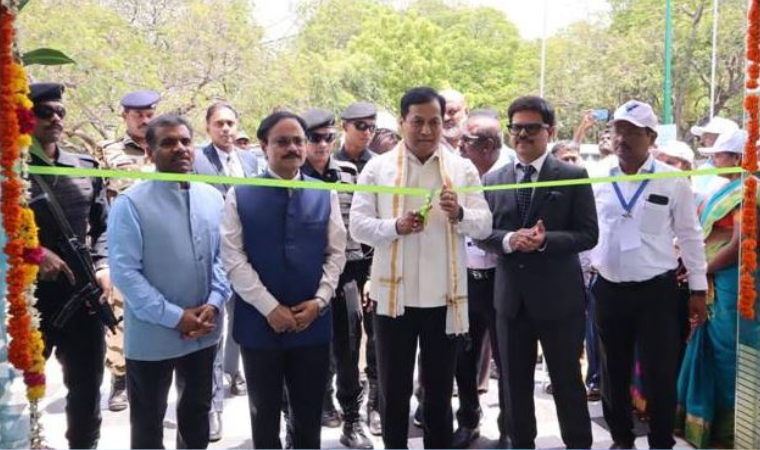
The first port-based Green Hydrogen Pilot Project in India was inaugurated by Union Minister of Ports, Shipping and Waterways, Shri Sarbananda Sonowal, today at V.O. The project marks a milestone in India’s quest to make a green energy transition in the maritime industry.
Inauguration on the 154th birth anniversary of freedom fighter V.O. Chidambaranar marked the convergence of the rich maritime heritage of India with its current dream of being a global centre of sustainable and self-reliant shipping.

Green Hydrogen Pilot Project: Indian Ports First
The pilot project of 10 Nm3/hour capacity, 3.87 crore with Green Hydrogen will be utilized in the lighting and electric vehicle charging station within the port colony.
Green Hydrogen is a fuel of the future, a clean, renewable energy-derived water electrolysate, widely applied in food production. It does not emit any carbon when used, as opposed to fossil fuels. VOC Port is now the first port in India to showcase the use of Green Hydrogen in its day-to-day port activities with this pilot.

The authorities assured that it would also become a testbed to scale up green hydrogen production at additional larger capacities in other key ports in the years ahead.
Green Methanol Bunkering Facility
With the hydrogen project, Shri Sonowal also unveiled a Green Methanol Bunkering and Refuelling Facility at the port.
- Project Cost: [?]35.34 crore
- Capacity: 750 cubic metres
- Purpose: To offer the services of bunkering and refuelling of vessels with methanol.
Methanol is also becoming a viable sustainable marine fuel because it emits substantially less sulphur oxides, nitrogen oxides, and particulate matter than traditional fuels.
The suggested Kandla-Tuticorin Coastal Green Shipping Corridor, which is one of the first green maritime corridors in India, is also associated with this project. VOC Port will become a green bunkering station in the South India region upon commencement and will cater to the eco-friendly vessels as they pass the area.

Renewable Energy Push
Shri Sonowal also commissioned a 400 kW rooftop solar power station to complement the hydrogen and methanol projects, making VOC Port the largest Indian port with a total of 1.04 MW of rooftop solar capacity.
Besides this, another foundation stone was laid, to:

- A 6 MW Wind Farm Project that is likely to supply clean energy to the port.
- A Maritime heritage museum of Tamil Nadu, honoring seafaring in the state.
These renewable energy initiatives will aid the VOC Port to move towards being carbon neutral as per the overall commitment of India to sustainable development and climate action.
Other Major Infrastructure Projects
In addition to the other projects that improved the efficiency and capacity of VOC Port, the Minister also initiated and laid the foundation of several infrastructure projects:
- Multi-Cargo 75,000 MTR Multi-Cargo Berth, 90 crore capacity.
- 3.37 km Four-lane Road, enhancing accessibility of port facilities and decongestion.
- Link Conveyor Coal Jetty-I to Stack Yard 24.5 crore, capacity increased by 0.72 MMTPA.
These projects will hopefully render cargo handling faster, safer, and cost-effective, and enhance the competitiveness of VOC Port.
Address by the Minister: Viksit Bharat 2047/ India
Speaking at the event, Shri Sonowal remarked that the projects have incorporated the four pillars of development that the Government envisions, which are speed, scale, sustainability, and self-reliance.
“These green energy projects are not only about clean fuels but also about creating a resilient economy. They will generate thousands of jobs, attract global investors, and place Tamil Nadu at the forefront of India’s maritime transformation. By 2030, India will be among the Top 10 shipbuilding nations, and by 2047, we will stand proudly in the Top 5,” he said.
The Minister underlined that the vision of Viksit Bharat @2047, which the Prime Minister Narendra Modi envisions, is being gradually fulfilled with the help of such projects that are both eco-friendly and economically productive.

Tribute to V.O. Chidambaranar
Shri Sonowal also paid a floral tribute to the memorial of V.O. Chidambaranar, more commonly known as Kappalottiya Tamizhan, before the inauguration.
The Swadeshi Steam Navigation Company was formed by Chidambaranar as part of the freedom movement to rebuke British supremacy in maritime commerce. Shri Sonowal observed that efforts made today respect his spirit of self-reliance, which has now been spread to include energy independence as well as clean shipping.
“Just as VOC sowed the seeds of indigenous shipping in the early 20th century, today’s green initiatives mark the dawn of a new self-reliant era in maritime energy,” the Minister said.
Sagarmala: 10 Years of Change
The activities currently initiated are extensions of those initiated through the Sagarmala Programme – the flagship programme of the Government to develop ports as the leading agent of development.
- Through Sagarmala 98 projects valued at 93,715 crore have been approved in Tamil Nadu.
- Among them, 50 of these 11-year-old projects are completed.
- The VOC Port alone has been invested in more than 16,000 crores with an emphasis on modernization, capacity expansion, and connectivity.
Such projects have already made Chennai, Kamarajar, and VOC Ports modern maritime gateways, which have stimulated trade and job creation in the area.
Global Context: India in the Green Map of Maritime
Ports are shifting to green fuels such as hydrogen, ammonia, and methanol across Europe, the Middle East, and Asia to cut down on emissions. Through such strategies, India can make its ports competitive in international trade.
VOC Port’s initiatives will:
- Lessen reliance on foreign fossil fuels.
- Make Position India a clean maritime logistics leader.
- Assist the nation in achieving its net-zero pledges.
Economic and Environmental Welfares
For the Environment:
- Massive decrease in greenhouse gas emissions.
- Use of clean fuels in port processes.
- Port infrastructural integration of solar and wind energy.
For the Economy:
- Creation of both direct and indirect jobs.
- Local industries and businesses in Tuticorin have boosted.
- Pull of green ports by global shipping lines.
For India’s Strategy:
- Strengthening Energy Security.
- Strengthening of Eco-sensitive maritime corridors.
- Added to the Indian dream of a green economy leader.
Strategic Partnerships
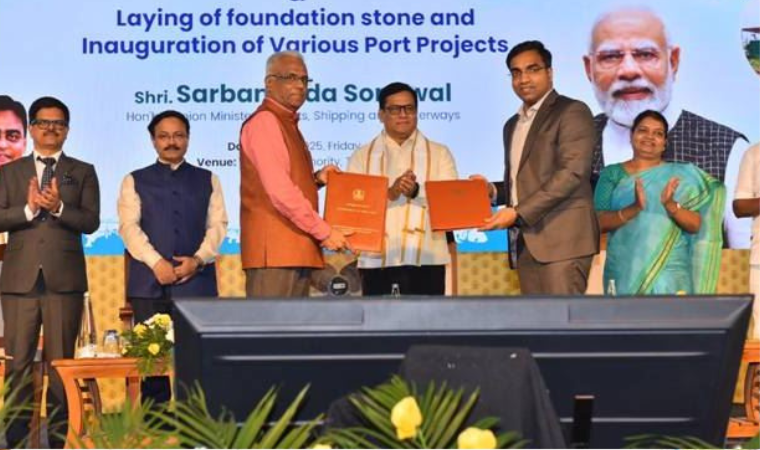
On the occasion, two MoUs were signed:
- With Indian Port Rail & Ropeway Corporation Ltd (IPRCL): rail connectivity to the project of VOC Port, Outer Harbour.
- With NTPC Ltd., to implement green mobility solutions at the port.
These partnerships will help to speed up the process of adopting green technologies adopting port operations.
Conclusion
Commissioning the Green Hydrogen Pilot Project and establishing the Green Methanol Bunkering Facility is a historic step in the Indian marine experience. These efforts make VOC Port a leader in green shipping and the use of clean fuels.
Along with renewable energy and modern infrastructural developments, Tuticorin would become a prototype of a green port in India, which the country shows its intentions to develop through economic growth and environmental responsibility.
The projects that are being rolled out at VOC Port today are not merely infrastructure, as Shri Sonowal pointed out; it is a step towards the long journey of the Indian towards Viksit Bharat @2047.