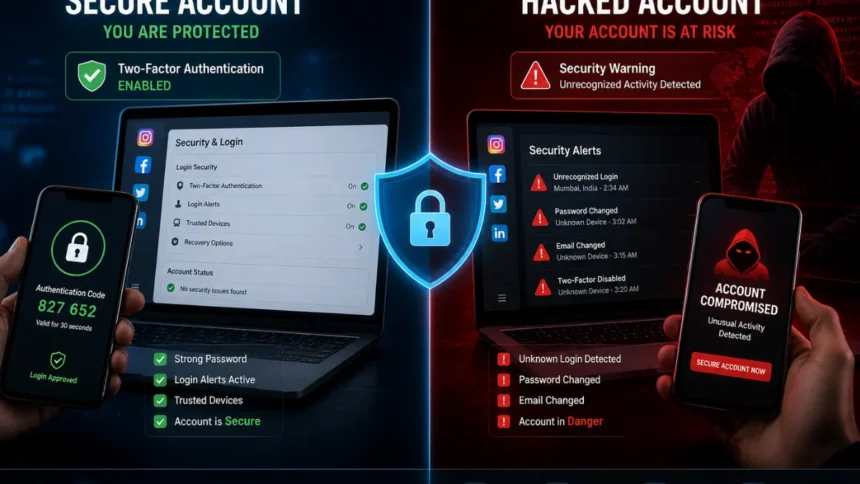
A WhatsApp account suddenly starts sending crypto links to relatives. An Instagram creator loses years of content overnight because someone bypassed a weak password. A small business owner wakes up to discover their Facebook page running scam ads they never approved.
These stories no longer feel unusual in India. They feel routine.
The country’s digital growth has been explosive. Cheap smartphones, low-cost internet, UPI adoption, and social media-driven business culture have brought hundreds of millions online. But the speed of digital participation has also created a strange imbalance: people have learned how to use social platforms faster than they’ve learned how to protect themselves on them.
That gap is exactly where cybercriminals operate.

Today, social media accounts are not just profiles. They are identity systems, financial gateways, professional portfolios, advertising platforms, communication tools, and sometimes even entire businesses. Losing access can mean reputational damage, financial fraud, emotional stress, or legal complications.
Which is why conversations around Cybersecurity & Safety are no longer limited to tech experts or IT departments. They’ve become personal.
The Real Problem Isn’t Technology — It’s Digital Habits
Most account breaches aren’t the result of dramatic, Hollywood-style cyberattacks. Instead, they often occur because everyday people tend to overlook small risks.
These risks include things like:
* Using the same password for multiple accounts.
* Responding to suspicious one-time password (OTP) requests.
* Falling for fake login pages.
* Using unsecured public Wi-Fi, like at an airport.
* Granting access to random third-party apps.
Cybersecurity experts frequently emphasize that attackers usually go after human behavior rather than directly targeting systems. This behavioral vulnerability becomes even more critical in places like India, where digital literacy levels can differ significantly depending on age and location.

A common misconception people still hold is, “Why would anyone hack my account? I’m not a famous person.”
However, cybercrime has become a large-scale industry. Attackers aren’t just targeting celebrities or large companies anymore. Automated scams are now designed for mass impact. Thousands of accounts can be compromised simultaneously through methods like using leaked passwords, phishing schemes, fraudulent verification messages, or malicious links.
Ultimately, your account doesn’t need to be individually valuable to be a target; it just needs to be accessible.

Why Cybersecurity & Safety Matters More Than Ever on Social Media
There was a time when social media was mostly about posting photos and chatting with friends. That era is over.
Instagram is now a storefront.
LinkedIn is a career profile.
WhatsApp is a business communication system.
Facebook manages communities and ad campaigns.
Telegram channels influence markets and politics.
As platforms evolved, so did the stakes.
A compromised social media account can now lead to:
- Financial fraud
- Identity theft
- Reputation damage
- Blackmail or impersonation
- Loss of business access
- Ad account misuse
- Exposure of private conversations
In India especially, the rise of influencer culture, creator economies, online businesses, and digital payments has turned social profiles into monetizable assets. Criminals understand this very well.
That’s why Cybersecurity & Safety discussions are increasingly shifting toward prevention rather than recovery.
Because once an account is compromised, recovering it can become surprisingly difficult.
Passwords Are Still the Weakest Link
Despite years of warnings, password behavior remains alarmingly poor.
People still use:
- birthdays
- pet names
- “123456”
- mobile numbers
- reused passwords across platforms
The problem isn’t just simplicity. It’s repetition.
If one website experiences a data breach and your password gets leaked, attackers immediately test the same credentials across Instagram, Facebook, Gmail, and banking-linked services.
This technique is called credential stuffing, and it works far more often than people realize.
Strong passwords today should be:
- unique for every platform
- long and unpredictable
- stored using password managers
- changed immediately after suspicious activity
Oddly enough, people often spend more time protecting physical wallets than protecting digital identities connected to their bank accounts, photos, contacts, and personal history.
That mindset has to change.
Two-Factor Authentication Is No Longer Optional
If there’s one security step that dramatically improves protection, it’s two-factor authentication (2FA).
Yet many users in India still ignore it because it feels inconvenient.
That small inconvenience is precisely what blocks many attacks.
With 2FA enabled, even if someone steals your password, they still need secondary verification — usually through an authenticator app, SMS code, or device confirmation.
Authenticator apps are generally safer than SMS-based verification because SIM-swap fraud has increased globally, including in India.
Most major platforms already support advanced login protection:
- X
- Gmail
And yet millions still operate accounts with only a password standing between them and a breach.
In the current digital climate, that’s similar to locking your house but leaving the windows open.
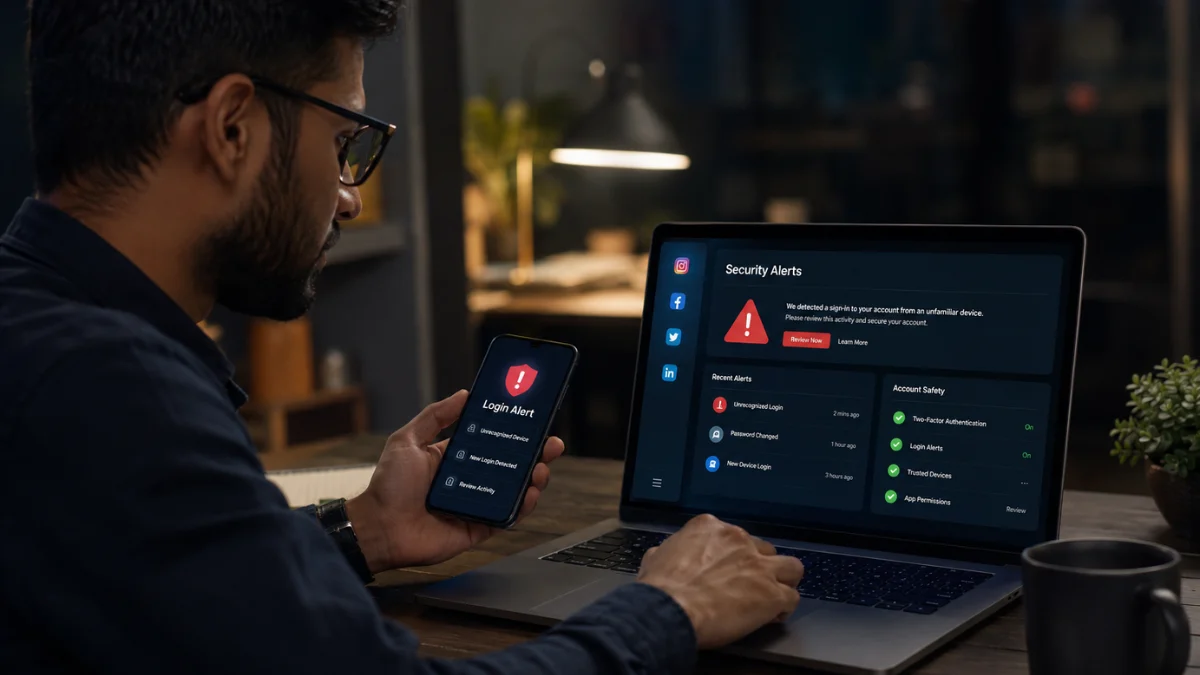
Phishing Is Becoming More Psychological
Modern scams don’t always look suspicious anymore.
That’s what makes them dangerous.
Attackers now imitate:
- Meta verification emails
- Instagram copyright notices
- Facebook business warnings
- fake sponsorship requests
- fake brand collaborations
- customer support messages
Some messages are professionally written. Some even use cloned websites that look nearly identical to official platforms.
The real weapon is urgency.
“Your account will be suspended.”
“Verify immediately.”
“Click within 30 minutes.”
“Your page violated community standards.”
Panic changes human behavior. Attackers know this.
One of the smartest digital habits people can build is simple: never click login links directly from emails or DMs. Open the app or website manually instead.
That single habit prevents an enormous number of phishing attacks.
Public Wi-Fi and Third-Party Apps Are Quiet Risks
People often associate cybersecurity threats with dramatic hacks, but many compromises happen quietly through convenience.
Logging into accounts using unsecured public Wi-Fi at cafes, airports, hotels, or railway stations can expose browsing sessions to interception risks. While HTTPS encryption helps, unsecured networks still create vulnerabilities.
Third-party apps are another overlooked issue.
Many quiz apps, editing tools, analytics dashboards, or automation services request excessive permissions:
- account access
- message permissions
- profile control
- advertising permissions
Users grant access casually without reviewing what’s actually being shared.
Months later, they forget those apps even exist.
A useful habit is auditing connected apps every few months and removing anything unnecessary.
Digital clutter creates digital risk.
The Psychological Cost of Losing an Account
The emotional side of social media security rarely gets discussed enough.
For creators, entrepreneurs, freelancers, journalists, or public-facing professionals, accounts often represent years of work and audience-building. Losing access can feel deeply personal.
There’s also a strange modern reality where social profiles hold memories people never backed up elsewhere:
- conversations
- photos
- business contacts
- community networks
- customer databases
An account breach today isn’t just technical disruption. It can feel like identity disruption.
That’s one reason why Cybersecurity & Safety is gradually moving from an IT concern into a mental-security concern as well.
People are beginning to realize that digital stability affects emotional stability too.
India’s Digital Future Will Depend on Security Awareness
India’s internet economy is expected to grow aggressively over the next decade. More people will become creators, remote workers, online sellers, digital educators, and independent brands.
At the same time, cybercrime ecosystems are becoming more organized, automated, and AI-assisted.
Deepfake scams, AI-generated phishing emails, cloned voices, fake verification pages, and impersonation attacks are likely to become more sophisticated.
The future challenge won’t simply be access to technology. It will be the ability to navigate technology safely.
This is why digital literacy campaigns can no longer focus only on “how to use apps.” They must also teach:
- verification habits
- privacy awareness
- scam recognition
- password management
- account recovery preparedness
Because cybersecurity is no longer a niche technical skill. It’s becoming a basic life skill.
Small Habits Create Stronger Security
The good news is that most major social media attacks are preventable.
Not through expensive software.
Not through advanced technical knowledge.
But through consistent habits.
Simple actions matter:
- enabling 2FA
- avoiding suspicious links
- using password managers
- reviewing app permissions
- keeping recovery emails updated
- logging out from unused devices
- backing up important data
Security rarely fails because of one catastrophic mistake. It usually weakens slowly through dozens of small compromises people stop paying attention to.
And in a world where digital identity increasingly overlaps with real identity, protecting social media accounts is no longer optional self-care. It’s infrastructure.
More Read

Conclusion
The internet in India has become deeply personal. Social media accounts now hold relationships, businesses, reputations, opportunities, and memories. That’s exactly why they’ve become valuable targets.
The conversation around Cybersecurity & Safety is no longer about paranoia. It’s about preparedness.
Because modern cyber threats don’t only attack systems. They exploit distraction, urgency, trust, and routine behavior.
The people who stay safest online are rarely the most technical. They’re usually the most cautious, consistent, and aware.
And in the coming years, that awareness may become one of the most important digital advantages anyone can have.
Final Insight
At a time when digital life is becoming inseparable from real life, online security can no longer be treated as a background setting people configure once and forget. The future of social media will not only depend on innovation and engagement — it will depend on trust. And trust survives only when users feel safe inside the systems they rely on every day. The Vue Times
Frequently Asked Questions
1. How can I secure my social media accounts in India?
Use strong unique passwords, enable two-factor authentication, avoid suspicious links, and regularly review connected apps and login activity.
2. What is the safest way to protect Instagram and Facebook accounts?
The safest approach includes enabling 2FA through authenticator apps, using password managers, and avoiding login attempts through unknown links or messages.
3. Why are social media accounts getting hacked more frequently?
Cybercriminals now use automated phishing attacks, leaked passwords, fake verification messages, and social engineering tactics to target large numbers of users.
4. Is public Wi-Fi dangerous for social media logins?
Public Wi-Fi can expose browsing sessions to security risks, especially on unsecured networks. Avoid logging into important accounts on unknown networks whenever possible.
5. What should I do if my social media account gets hacked?
Immediately reset passwords, revoke suspicious app access, enable 2FA, report the breach to the platform, and check linked email or banking accounts for unusual activity.