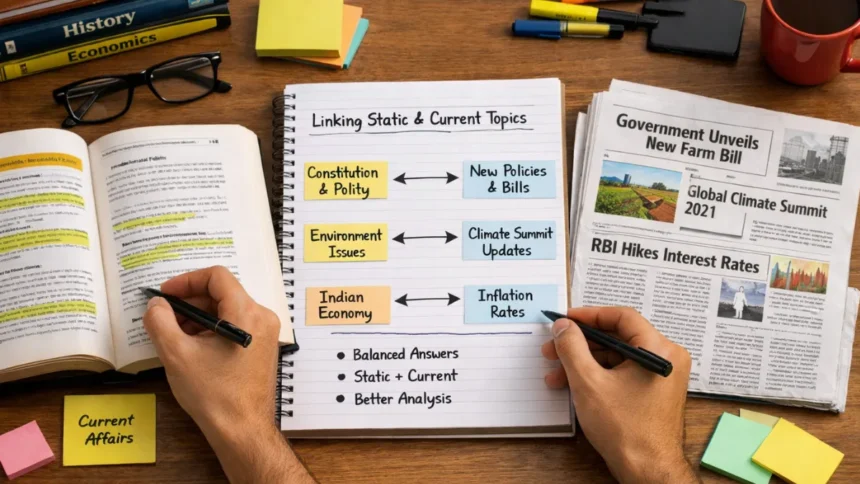
Government exam papers increasingly test a candidate’s ability to connect foundational concepts with contemporary developments. This is where Static and Current Linkage becomes a critical preparation strategy. Many aspirants study static syllabus topics and current affairs separately, but exam questions often require an integrated approach. Without this connection, answers become incomplete, lack analytical depth, and fail to score well.
For example, a question on environmental conservation may require knowledge of constitutional provisions, international agreements, and recent policy updates. Candidates who rely only on news summaries or only on textbooks struggle to produce structured answers.
This article explains how to systematically build Static and Current Linkage using a practical framework that improves answer quality, analytical clarity, and scoring potential in government exams.
Problem Statement
One of the most common preparation mistakes among government exam aspirants is studying static subjects and current affairs independently.

Typical Preparation Pattern
Most candidates follow this routine:
- Read static subjects from textbooks (Polity, Geography, Economy).
- Read current affairs from monthly magazines or newspapers.
- Attempt mock tests.
However, exam questions rarely follow this separation.
Example Question Pattern
Question:
Discuss the role of cooperative federalism in implementing recent agricultural reforms.
To answer this effectively, a candidate must combine:
- Static knowledge: Federalism, constitutional provisions, centre-state relations.
- Current context: Agricultural policy debates, reforms, and state responses.
Without Static and Current Linkage, answers become descriptive rather than analytical.

Resulting Problems
Aspirants often face:
- Incomplete answers
- Weak introductions
- Lack of examples
- Generic conclusions
- Difficulty applying concepts
This preparation gap reduces scoring potential even when the candidate has studied both static subjects and current affairs.
Concept Clarity
What is Static and Current Linkage?
Static and Current Linkage refers to the systematic integration of foundational syllabus topics with relevant current developments.

Static topics include:
- Constitutional provisions
- Geographical features
- Economic theories
- Historical events
- Governance frameworks
Current topics include:
- Government policies
- International developments
- Economic indicators
- Social issues
- Environmental updates
When these are studied together, preparation becomes integrated preparation, where concepts support current analysis.
Why Examiners Prefer Integrated Answers
Government exam questions aim to test:
- Conceptual clarity
- Application of knowledge
- Analytical thinking
- Awareness of current developments
An answer that combines theory with recent developments demonstrates deeper understanding.
Example
Topic: Fundamental Rights
Static aspect:
- Articles 12–35 of the Constitution
- Judicial interpretation
Current aspect:
- Recent court rulings
- Policy debates about freedom of expression
- Digital privacy discussions
A well-prepared candidate automatically links these elements.
Practical Framework
Step-by-Step Method to Build Static and Current Linkage
Identify Core Static Topics
Start by listing key topics from the syllabus.
Example categories:
Polity
- Parliament
- Federalism
- Fundamental Rights
Economy
- Inflation
- Fiscal policy
- Banking regulation
Environment
- Biodiversity
- Climate change
- Conservation laws
These form the static base.
Track Related Current Developments
While reading newspapers or current affairs sources, categorize information under static headings.
Example:
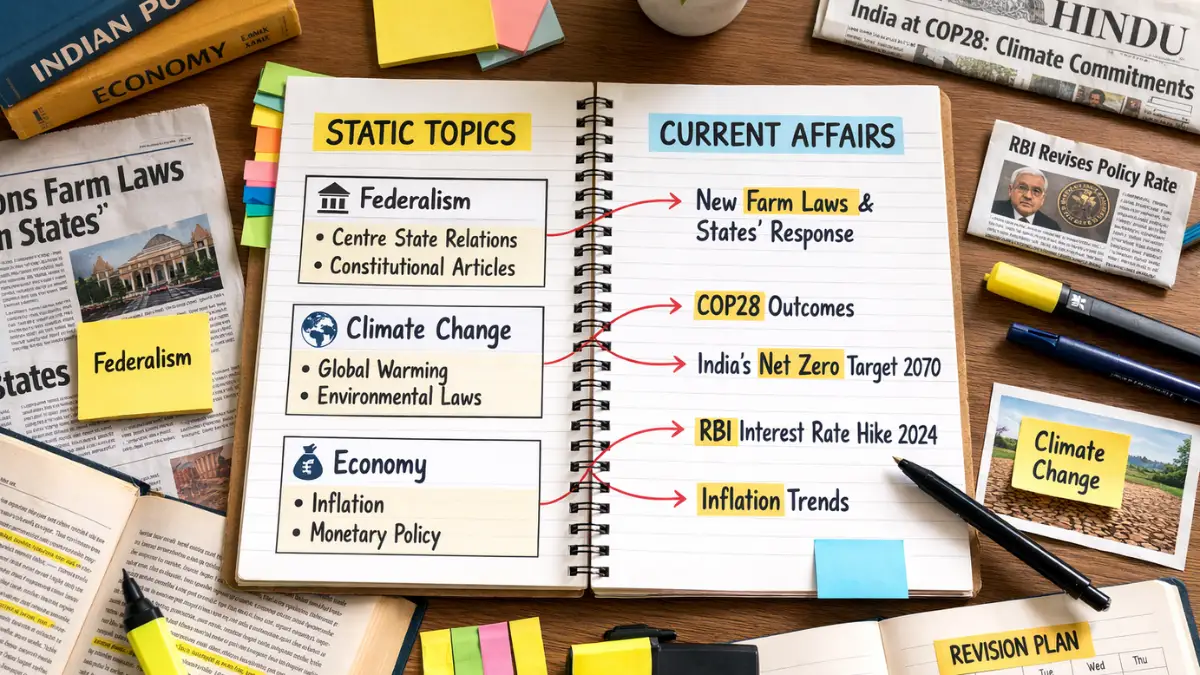
| Static Topic | Current Link |
| Federalism | State demands for financial autonomy |
| Climate Change | International climate summit outcomes |
| Inflation | Central bank policy decisions |
This habit gradually builds Static and Current Linkage automatically.
Create Micro Notes
For each topic, add a Current Affairs section in your static notes.
Example:
Topic: Federalism
Static points:
- Division of powers
- Constitutional provisions
- Role of Finance Commission
Current additions:
- Fiscal debates between centre and states
- Policy coordination challenges
- Examples from recent reforms
These notes become powerful revision tools.
Use Structured Answer Framework
When writing answers, combine both elements.
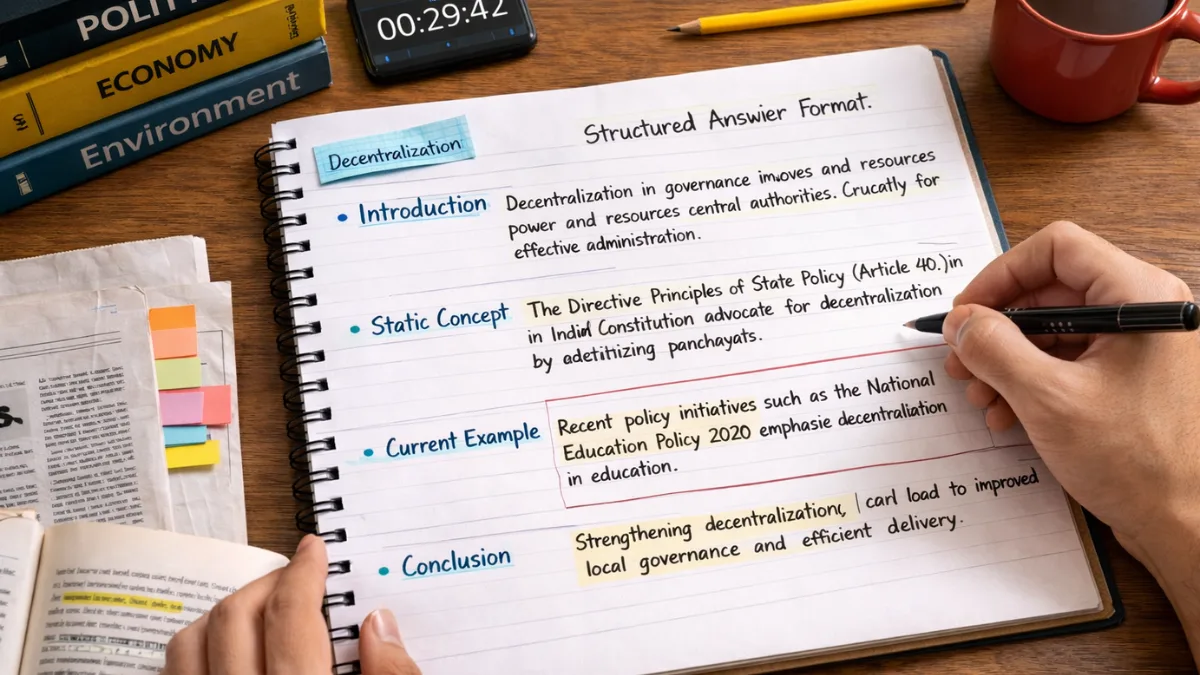
Standard answer structure:
- Introduction
- Static explanation
- Current example
- Analytical observation
- Conclusion
Model Answer Snippet
Question:
Explain the significance of cooperative federalism in policy implementation.
Answer Structure:
Introduction:
Cooperative federalism refers to collaboration between central and state governments in policy design and implementation.
Static Component:
The Constitution distributes powers between the union and states through three lists, enabling coordinated governance.
Current Link:
Recent policy initiatives in agriculture and public health have highlighted the importance of centre–state coordination for effective implementation.
Analysis:
When states participate actively in decision-making, policy acceptance and regional adaptation improve.
Conclusion:
Strengthening cooperative federalism ensures better governance outcomes and balanced development.
Mistake vs Correct Approach
| Mistake | Correct Approach |
| Writing only theoretical explanation | Adding recent policy examples |
| Memorizing current affairs separately | Linking news to syllabus topics |
| Long introductions | Context-based introductions |
| Generic conclusions | Analytical conclusions referencing current context |
This comparison highlights how integrated preparation improves answer quality.
Common Errors
Many aspirants attempt to implement Static and Current Linkage, but several mistakes reduce effectiveness.
Error 1: Overloading Answers with Current Affairs
Some candidates include multiple news references without explaining the static concept.
Problem:
- Answer appears like a news summary.
- Core conceptual clarity is missing.
Correct approach:
Start with the static framework, then add relevant examples.
Error 2: Memorizing Current Affairs Without Context
Reading monthly compilations without linking them to syllabus topics creates information overload.
Result:
- Difficult to recall during exams
- Limited analytical use
Correct approach:
Always ask:
“Which syllabus topic does this news relate to?”
Error 3: Ignoring Older Static Concepts
Some aspirants focus excessively on current affairs and neglect foundational topics.
This leads to:
- Weak conceptual explanations
- Inaccurate definitions
Balanced preparation is necessary.
Error 4: Lack of Answer Structure
Even when candidates know both static and current content, poor structure reduces clarity.
Example of weak structure:
- Long paragraphs
- No headings
- No clear argument flow
Correct approach:
Use short sections:
- Concept
- Example
- Analysis
Tactical Application
Building Static and Current Linkage directly improves answer scoring in several ways.
Stronger Introductions
Current developments allow candidates to begin answers with relevant context.
Example:
Instead of writing:
“Climate change is an important environmental issue.”
Write:
“Recent international climate negotiations have highlighted the urgency of addressing global warming.”
Evidence-Based Arguments
Static theory becomes stronger when supported by examples.
Example:
Topic: Inflation
Static explanation:
- Causes of inflation
Current example:
- Policy responses by monetary authorities
This combination strengthens argument credibility.
Higher Analytical Depth
Questions often include directives like:
- Analyze
- Evaluate
- Discuss
Static knowledge explains the concept.
Current examples enable evaluation.
Better Examiner Perception
Well-integrated answers show:
- Awareness
- Conceptual clarity
- Analytical ability
These factors influence higher marks.
Improvement Plan
A systematic routine is required to develop Static and Current Linkage.
Daily Execution Method
Newspaper Reading (30–40 minutes)
While reading:
- Identify key issues.
- Tag them to syllabus topics.
Example:
News about renewable energy → Environment → Climate policy.
Update Static Notes (15 minutes)
Add current developments under the relevant static topic.
Example:
Topic: Energy security
Add:
- Policy initiatives
- International developments
Answer Writing Practice
Practice questions requiring integration.
Example:
- Environment policy questions
- Economic policy discussions
- Governance issues
Weekly Strategy
Once a week:
- Review static subjects.
- Match major news developments.
- Update summary notes.
Create Topic Sheets.
Example structure:
Topic Sheet: Agriculture
Static:
- Cropping patterns
- Agricultural institutions
Current:
- Policy reforms
- Technology adoption
- Climate challenges
These sheets become valuable revision tools before exams.
Monthly Consolidation
At the end of each month:
- Identify 10 major issues.
- Write practice answers linking static and current elements.
This reinforces integrated preparation.

Conclusion
Modern government exam questions require analytical answers supported by both conceptual clarity and contemporary awareness. Candidates who prepare static subjects and current affairs independently struggle to meet this expectation.
Developing Static and Current Linkage transforms preparation from information accumulation into structured understanding. By systematically connecting syllabus topics with real-world developments, aspirants produce answers that demonstrate clarity, relevance, and analytical depth.
Consistent practice of this method—through categorized notes, structured answer writing, and regular revision—creates a strong foundation for integrated preparation. Over time, this approach improves answer quality, enhances argument strength, and increases scoring potential in competitive government examinations.
Internal Link Placeholders