


Time Management Government Exams is not about studying for longer hours. It is about allocating cognitive energy, structuring answer time, and distributing effort according to scoring patterns. Many aspirants prepare sincerely, complete the syllabus, and revise multiple times—yet their marks do not reflect the quality of their preparation. The issue is rarely a knowledge deficiency. It is an inefficient time deployment.
This article provides a structured, practical framework for Time Management Government Exams that serious aspirants can implement immediately.
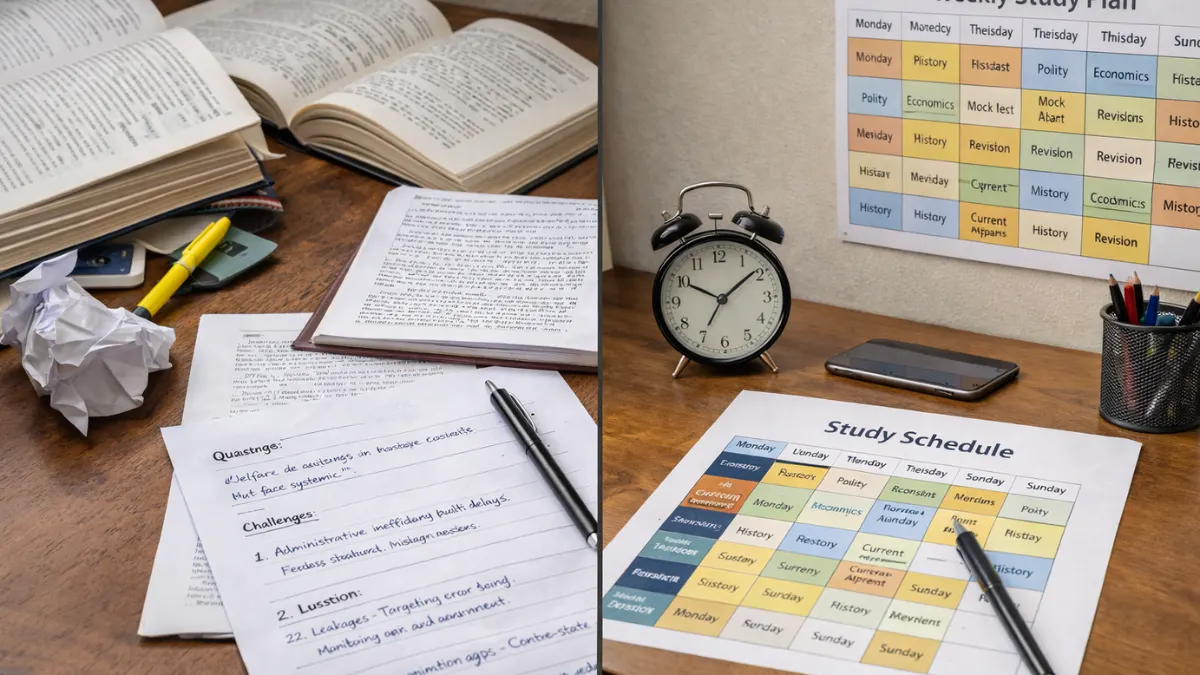
Problem Statement
Here are some common time-related mistakes that test-takers often make during government exams:
- Spending too much time on subjects they enjoy or feel comfortable with.
- Writing lengthy introductions in descriptive sections.
- Getting stuck on challenging multiple-choice questions (MCQs).
- Not managing time well between different sections.
- Overlooking the importance of revision time, even during mock tests.
- Spending too much time on topics that carry less weight in the exam.
These mistakes can lead to three main negative results:
- Not being able to finish the exam paper.
- Rushing through the final answers.
- Making mistakes that lower the overall score.
For instance, in descriptive exams, many candidates might spend 12 to 15 minutes on a 10-mark question that should ideally take only 7 to 8 minutes. In objective exams, students might lose 8 to 10 minutes re-reading questions that are confusing. Over the course of a 3-hour exam, these small time losses add up to a significant deficit of around 20 to 25 minutes. Mismanaging time directly limits the chances of scoring well.
Concept Clarity
Time management in competitive exams operates at three levels:
- Macro-Level Allocation – How you divide months, weeks, and subjects.
- Paper-Level Allocation – How you divide 3 hours in the exam hall.
- Answer-Level Allocation – How you structure minutes per question.
Effective Time Management Government Exams requires structured time budgeting based on marks distribution.
The Core Principle:
Time must follow marks.
Marks must follow structure.
If a 20-mark question carries 4x the value of a 5-mark question, time allocation must reflect that ratio.
Example:
| Marks | Ideal Time |
| 5 Marks | 3–4 minutes |
| 10 Marks | 7–8 minutes |
| 15 Marks | 10–11 minutes |
| 20 Marks | 12–14 minutes |
This prevents over-writing and protects overall coverage.
Practical Framework
Calculate Paper Time Budget
Assume 180 minutes total.
- 10 minutes – Reading & selection
- 160 minutes – Writing
- 10 minutes – Review buffer
Now divide writing time proportionally according to marks.
Pre-Define Question Slots
Before writing:
- Mark the sequence.
- Decide attempt order.
- Allocate rough end time per section.
Example:
If Section A ends at 11:45 AM, move forward regardless of one incomplete question.
Use Structured Writing Templates
Instead of thinking during writing, use fixed answer formats.
Example 10-Mark Structure:
- 2–3 line introduction
- 3–4 structured points
- 1 brief conclusion
This prevents time drift.
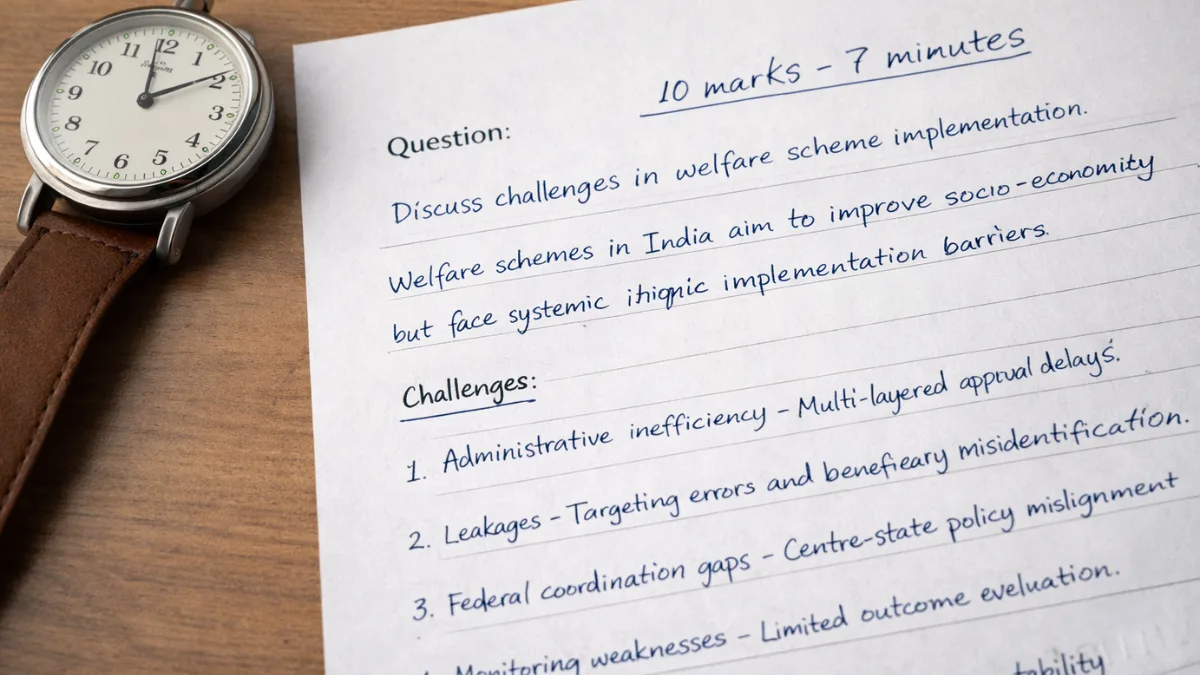
Model Answer Snippet (Short Format – 10 Marks)
Question: Discuss challenges in welfare scheme implementation.
Introduction:
Welfare schemes in India aim to improve socio-economic equity but face systemic implementation barriers.
Body:
- Administrative inefficiency – Multi-layered approval delays.
- Leakages – Targeting errors and beneficiary misidentification.
- Federal coordination gaps – Centre-state policy misalignment.
- Monitoring weaknesses – Limited outcome evaluation.
Conclusion:
Strengthening digital tracking and accountability mechanisms can enhance scheme efficiency.
This format fits within 7–8 minutes without over-expansion.
Mock Test Time Simulation
During practice:
- Set visible timer.
- Stop writing when slot ends.
- Leave space and move forward.
Discipline improves time accuracy.
Mistake vs Correct Approach
| Mistake | Correct Approach |
| Writing detailed essays in 10-mark answers | Limiting structure to marks value |
| Re-reading same MCQ multiple times | Mark for review and move |
| Ignoring review time | Keeping fixed 10-minute buffer |
| Studying randomly daily | Structured weekly hour blocks |
Common Errors
Emotional Time Allocation
Students give more time to topics they enjoy. This skews preparation balance.
Over-Planning, Under-Execution
Timetables created but not tracked. Without weekly review, plans fail.
Ignoring Energy Cycles
Studying analytical subjects at low-energy hours reduces efficiency.
Writing Speed Neglect
Slow handwriting or excessive structuring wastes 10–15 minutes in descriptive exams.
No Mock Time Calibration
Many students practice without time pressure. Exam hall shock reduces performance.
Tactical Application
How does structured Time Management Government Exams improve marks?
1. Full Paper Coverage
Completing all questions adds 20–30% scoring opportunity.
2. Structured Answers
When time is controlled, answers remain proportional and examiner-friendly.
3. Reduced Cognitive Fatigue
Pre-defined templates reduce mental strain.
4. Strategic Attempting
Difficult questions are attempted last, preserving scoring rhythm.
5. Balanced Subject Preparation
Time tracking prevents subject neglect.
Refer to:
[ Answer Writing Structure Guide]
[ Why Students Lose Marks in Government Exams]
[ 20 Mark Answer Strategy Framework]
Improvement Plan
Daily Execution Model
Morning (High Focus – 2 Hours)
Core subject conceptual study.
Afternoon (1.5 Hours)
MCQs or applied practice.
Evening (1.5 Hours)
Answer writing or revision.
Weekly Allocation Plan
| Day | Focus |
| Monday | Core Subject 1 |
| Tuesday | Core Subject 2 |
| Wednesday | Current Affairs Integration |
| Thursday | Revision Block |
| Friday | Mock Section Practice |
| Saturday | Full-Length Timed Practice |
| Sunday | Error Analysis & Planning |
Weekly Review Checklist
- Did I overspend time on one subject?
- Did I complete 1 timed mock?
- Did I track writing speed?
- Did I maintain review buffer?
Without review, time strategy collapses.
More Read

Conclusion
Managing your time for government exams isn’t just about feeling motivated; it’s about having a solid, organized plan. It really involves setting specific times for each task, sticking to the right way to write your answers, practicing with timed tests to get calibrated, and regularly checking how you’re doing.
Think about it: students who really get a handle on their time are the ones who can cover all the material. And if you can cover all the material, you stand a much better chance of scoring well.
When you manage your time effectively, your whole preparation shifts from just putting in the hours to actually getting results. If you divide your time according to how many marks each section is worth and use the right structure for your answers, you’ll suddenly see how to get more points. In these tough exams, what you know gives you the potential to do well, but it’s your time management that turns that potential into actual marks.