

The startup ecosystem in India has grown at an accelerated rate in the last ten years to yield both big entrepreneurship-supported firms and an increasingly large number of small-scale firms. In the context of this landscape, the Lifestyle Startups India is a category that is usually shadowed by venture-backed unicorn ventures worth more than 1 billion dollars. Although unicorn startups dominate the majority of media coverage, capital inflows and policy discourse, lifestyle startups are structurally distinct economic models of the entrepreneurship ecosystem.
This comparison of unicorns does not concern the type of startup that is better. Rather, it looks at the operation of the various startup models in the Indian economic framework. Also, lifestyle startups may care more about consistent revenue and the ability to operate independently, whereas unicorn startups rely on the large-scale venture capital funding and market expansion plans, which are aimed at conquering industries within a short period.
It is significant that the entrepreneurs, policymakers, and investors understand the difference between these two startup models since they are the two ways of developing businesses in India. Lifestyle startups tend to bring in job creation within a region and a stable economy, whereas unicorn startups aim to expand nationally or internationally by rapid expansion initiatives.
The current article examines Lifestyle Startups India vs Unicorn Startups in terms of their structure; specifically, how they are funded, what their business model is, what issues concerning regulatory implications, or operational challenges and what economic rationality is behind their models.
Startup Context
Since the beginning of the 2010s, the Indian startup ecosystem has been changing greatly. Technology startups and online platforms have developed faster with the government efforts like Startup India and venture capital involvement. A large portion of the social discourse about entrepreneurship in India is centered on unicorn startups- companies such as Flipkart, Paytm, and others that were made billion-dollar startups through venture capital funding.
Nevertheless, when attention is paid to unicorns only, it generates a biased view of entrepreneurship. Most of the businesses started in India are of categories that do not entail the hypergrowth strategies. Most founders purposely construct companies that are created to generate stable revenues and not hyper-scaling.
The ones that are mostly classified under this are Lifestyle Startups India.
Lifestyle startups are startups designed to maintain the lifestyle or income level that the founder desires and not to grow their valuation or attract returns of large investors on a short basis. Such businesses can serve in any area like consulting, design services, digital marketing, niche e-commerce, education platform, or services of a special nature.
Unicorn startups, in contrast, are based on a completely different economic logic. Their business models are based on the strategies of external capital, aggressive market expansion and high-risk scaling. Fintech, e-commerce, mobility, SaaS platforms, as well as digital marketplaces are some of the areas in which they usually operate.
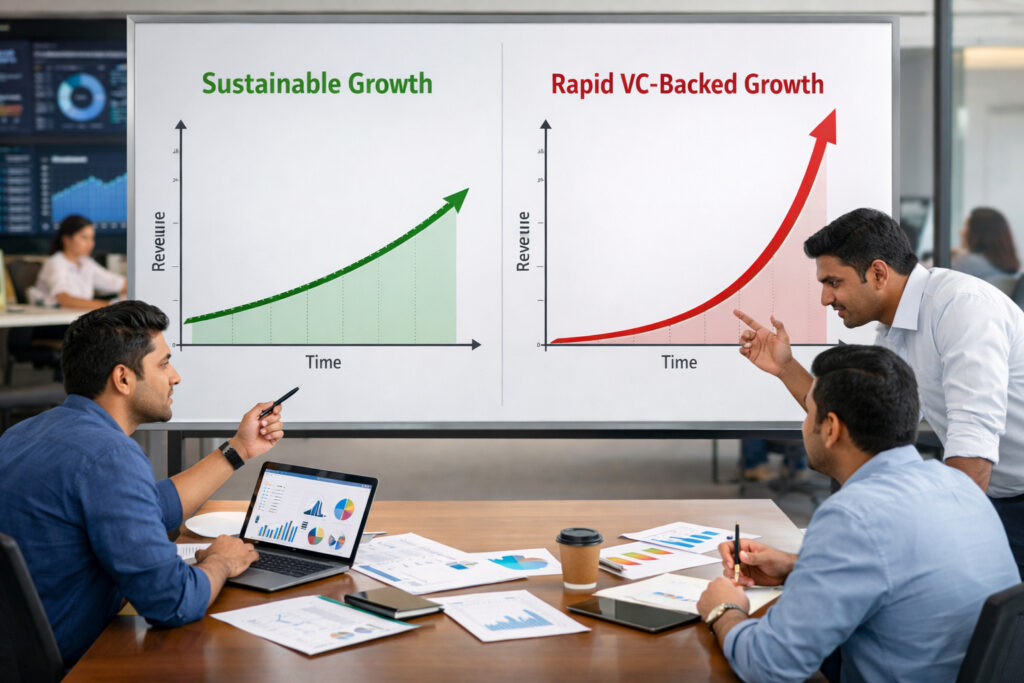
The difference between these two models lies in the structure. Lifestyle startups are run under the conventional profitability models whereas the unicorn startups depend on the valuation growth and market share acquisition.
This distinction is important in the analysis of the larger startup ecosystem in India.
Structural Breakdown
To get to know the differences between these two types of startups it is imperative to look at their structural underpinnings.
Funding Structure
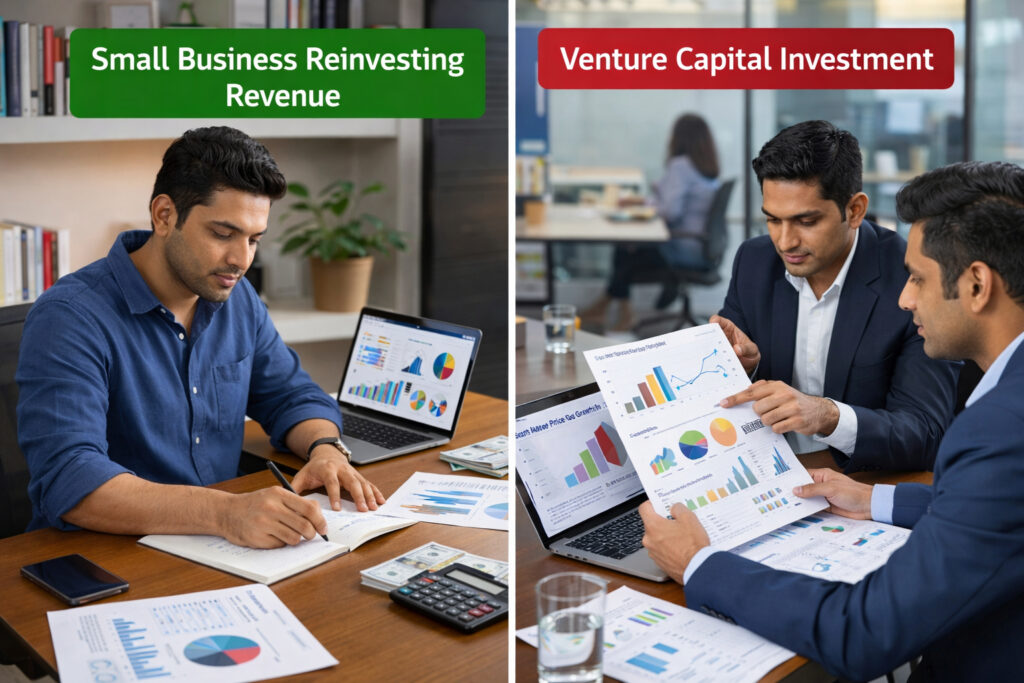
The funding architecture is one of the most distinguishing aspects in lifestyle startups versus unicorn startups.
The lifestyle startups usually depend on:
- Founder savings
- Small business loans
- Revenue reinvestment
- Limited angel investment
In their financial approach, they are focused on sustainability and not on growth acceleration.
Unicorn startups, conversely, are run using a venture capital model that is meant to fund the fast growth.
Common unicorn fund sources are:
- Venture capital firms
- Institutional investors
- Private equity funds
- Long term corporate investments.
This is not about the profitability in the short-term but instead market expansion and valuation growth by being aggressive.
This organizational disparity has a far-reaching operational decision-making repercussion. Lifestyle startups are bound to revenue-based forms of growth and unicorn startups are bound to capital-based growth cycles.
Business Model Logic
Lifestyle startups can be easily defined in terms of niches. They normally rely on their revenue models which are:
- Direct service delivery
- Subscription-based services
Much like in the case of consulting services, advisory services involve consulting with a client to assist them in a particular matter. Consulting or advisory services are similar to consulting services, where the consultant meets with a client to help them in a specific issue.
- Niche product offerings
- Since they run at a small scale, they have relatively low cost structures.
Unicorn startups follow completely different ways. Their models of business are usually based on:
- Platform-based marketplaces
- Network effects
- Digital ecosystems
- Big data infrastructure.
These models have a large initial investment then they become profitable.
Regulatory Environment
The two models also have great differences in regards to regulatory interaction.
The most typical startups in the lifestyle sector are registered as:
- Sole proprietorships
- Partnerships
- Small privately-owned limited enterprises.
Their regulatory load is still not very high.
Unicorn companies, in turn, have to deal with complicated regulatory structures that include:
- International investment policies.
- Foreign Direct Investment regulations.
- Data governance laws
- Competition regulations
This presents a high cost of operation and compliance.
Economic Logic
Lifestyle startups and unicorn startups are based on very different economic logic.
Lifestyle startups are profit-driven in nature. They are mainly interested in creating stable sources of income that will fund the sustainability of the business in the long run.
Revenue and profitability are usually noted at the beginning stages of the business lifecycle as the founders have to use operations cash flows and not investment capital.
Unicorn startups subscribe to scale-first.
The logic behind unicorn startups is economic in nature, and presupposes that once the market is dominated, there will be a lot of profit to be made once the competition is eradicated or minimized.
This is a very capital-intensive strategy that is dependent on investor confidence.
Nevertheless, there are risks associated with this model. Many unicorn startups are unable to sustain themselves in case the investor mood shifts or the financing becomes unavailable.
Smaller but usually more resilient, lifestyle startups have self-sustaining financial structures.
Operational Challenges
The two start up models have operational problems but they vary in nature.
Challenges in Lifestyle Startups.
The major operational challenges are:
- Limited capital access
- Slower growth potential
- Founder dependency
- Limited brand visibility
Due to the high level of involvement of a founder in lifestyle startups, it may become challenging to scale without the creation of bigger teams.

Unicorn Startup Challenges
Unicorn startups have varied complexities of operations.
These include:
- Rapid scaling pressures
- Complex team structures
- Risks of international expansion.
- High operational burn rates
Startups that are backed by venture capital start to be concerned with burn rate management.
Operational sustainability may prove to be challenging without the availability of funds at all times.
Comparison Table: Lifestyle vs Unicorn Startups
| Factor | Lifestyle Startups | Unicorn Startups |
| Funding | Founder-funded or small loans | Venture capital |
| Growth Model | Gradual growth | Rapid scaling |
| Risk Level | Moderate | High |
| Profitability | Early-stage profitability | Delayed profitability |
| Operational Complexity | Low to moderate | High |
| Founder Control | High | Often diluted due to investors |
| Market Scope | Local or niche | National or global |
This unicorn comparison highlights the structural differences in business strategy.
Policy Interaction
Startup models differ in ways the government policy affects them.
The policy framework of the start-up in India is the venture backed start-ups mostly with the initiatives like:
- Startup India recognition
- Fund of Funds for Startups
- Venture capital investment tax break.
Whereas these programs assist high-growth startups, lifestyle startups tend to be less favored with regard to help.
A lot of lifestyle founders make use of policies intended to serve small business, including:
- MSME registration
- Mudra loans
- Internet business programs.
Consequently, the policy atmosphere is more inclined to support startups with venture capital funding as compared to autonomous entrepreneurship.
This imbalance creates an approach taken by new founders towards business formation.
Founder Implications
The decisions to make a lifestyle start up or a unicorn pathway have a huge impact on the decision making of the founders.
Generally, the lifestyle founders emphasize:
- Personal autonomy
- Sustainable growth
- Work-life balance
- Operational independence
The founders of Unicorns are obliged to work in investor-oriented structures with accents to:
- Growth metrics
- Market share expansion
- Exit strategies
- Investor returns
Such pressures may change the role of the founder in the company considerably in the long run.
The founders in most unicorn startups eventually end up in big corporate management systems and not as decision-makers.
Future Outlook
It is possible that both models will feature in the future of the startup ecosystem in India.
This development is affected by several macroeconomic trends:
- Developing more digital infrastructure.
- Growth of online services
- Growth in the involvement of venture capital around the world.
Nevertheless, increased interest in sustainable business models may also be a result of economic volatility.
Within these settings, Lifestyle Startups India would be able to enjoy more respect as stable economic players.
Lifestyle startups provide local jobs and make a region economically stable, whereas unicorn startups seek to localize technological innovation to larger markets.
Conclusion
The two approaches to entrepreneurship that are completely different in the changing business ecosystem in India in the comparison of lifestyle startups and unicorn startups is seen.
Lifestyle Startups India has a sustainability based business model that emphasizes on stable income flow, independence of the founders and control of complexity of operation. Such businesses usually cater to niche markets and have definite growth trends.
More Read

Unicorn startups, in their turn, are involved in venture capital-driven models which focus on high growth rates, market share, and valuation increase. In as much as these startups have received extensive investment and media coverage, their risks are also higher in terms of finances and operations.
The structural trade-offs between stability and scale are brought out in this unicorn analogy. These two models of start-ups have various functions in the larger economic environment in India.
These differences are critical to understand by founders who might wish to examine their entrepreneurial approach, investors who might wish to examine risk profiles, as well as policymakers who might wish to develop frameworks that enable a diverse and sustainable startup ecosystem.