
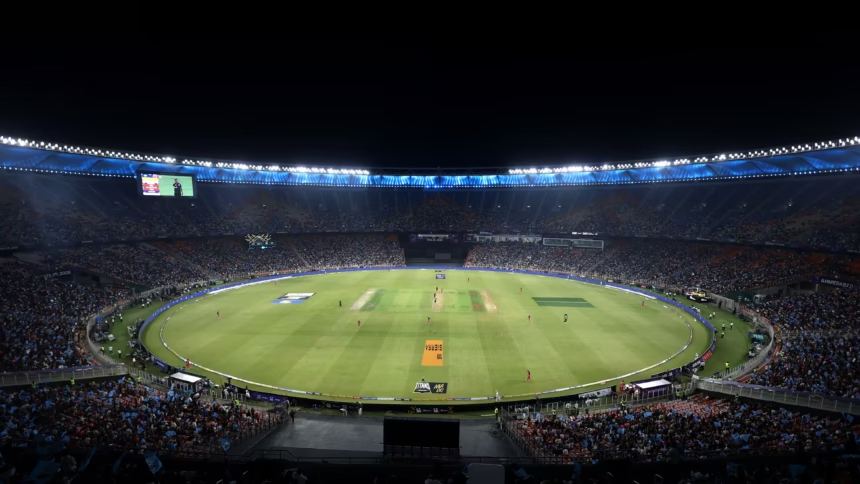
The IPL business model has transformed the Indian Premier League from a domestic Twenty20 competition into one of the world’s most valuable sporting properties. What began in 2008 as an ambitious experiment has evolved into a commercial ecosystem where broadcasters, sponsors, franchise owners, technology companies, advertisers, and content creators all compete for one of the most valuable commodities in modern business, consumer attention.
For cricket fans, the IPL is a tournament.
For marketers, investors, and entrepreneurs, it is one of the finest examples of how branding, storytelling, and strategic partnerships can create extraordinary commercial value.
Cricket Was Popular. The IPL Made It Scalable.
Long before the Indian Premier League existed, cricket was already India’s most followed sport. International matches regularly attracted massive television audiences, and players enjoyed celebrity status unmatched by athletes in most other sports.
However, the traditional format had limitations.
International tours depended on bilateral schedules. Domestic competitions struggled to attract widespread audiences. Commercial opportunities were largely concentrated around international fixtures.
The IPL changed that equation.
Instead of treating cricket solely as a sport, its architects designed it as an entertainment product capable of generating recurring commercial value. Franchise-based teams representing major cities created local rivalries, while player auctions introduced an entirely new narrative that extended beyond performances on the field.
Prime-time scheduling made matches accessible to working professionals and families. Celebrity ownership generated mainstream media attention. Cheerleaders, music performances, strategic time-outs, and digital fan engagement transformed every match into an entertainment package rather than a standalone sporting contest.
The result was a tournament that appealed not only to cricket enthusiasts but also to casual viewers, advertisers, and global investors.
That broader appeal became the foundation of the modern IPL business model.
The IPL Business Model Is Built on Multiple Revenue Streams
Many sporting events rely heavily on ticket sales or sponsorship income.
The IPL operates differently.
Its financial strength comes from diversification. Rather than depending on a single source of revenue, the league combines broadcasting rights, title sponsorships, franchise fees, merchandising, ticket sales, licensing, digital partnerships, and hospitality into an integrated commercial ecosystem.
This diversified structure makes the IPL business model remarkably resilient.
When one revenue stream experiences slower growth, others often compensate.
For example, while stadium attendance contributes to franchise earnings, broadcasting rights generate significantly larger revenues because they reach hundreds of millions of viewers worldwide. Similarly, sponsorship agreements extend beyond jersey branding to include digital integrations, strategic time-outs, analytics segments, presentation ceremonies, and social media campaigns.
Each commercial partnership reinforces the others, creating a self-sustaining cycle of audience growth and advertiser interest.
For businesses studying scalable growth models, this is perhaps one of the IPL’s most important lessons.
Multiple revenue streams reduce dependence on any single customer or market.
Broadcasting Rights Changed Everything
No component of the IPL business model demonstrates its commercial success more clearly than media rights.
When the league launched in 2008, television rights were already considered valuable. Over successive auction cycles, however, competition among broadcasters pushed valuations to unprecedented levels.
The turning point came with the sale of media rights for the 2023–2027 cycle, which were acquired for approximately ₹48,390 crore, making the IPL one of the world’s most valuable sports properties on a per-match basis. That valuation placed the tournament alongside leading global leagues in terms of media value and highlighted the increasing demand for premium live sports content.
Why are broadcasters willing to invest so heavily?
The answer lies in audience behaviour.
Unlike on-demand entertainment, live sport is consumed in real time. Fans rarely postpone watching an IPL match, and they are less likely to skip advertisements during live broadcasts because doing so risks missing key moments of the game.
For broadcasters, this creates premium advertising inventory.
For advertisers, it delivers something increasingly difficult to achieve in today’s fragmented media landscape—millions of highly engaged viewers watching simultaneously.
Live attention has become one of the most valuable assets in modern media, and the IPL consistently delivers it.
Why Brands Compete for IPL Sponsorships
Every IPL season brings fierce competition between teams.
Away from the stadium, an equally intense contest unfolds among brands.
Companies invest heavily to secure sponsorship rights because visibility during the tournament extends far beyond traditional advertising. Logos appear on jerseys, helmets, boundary ropes, giant screens, score graphics, dugouts, interview backdrops, and digital broadcasts.
More importantly, these placements are integrated into moments that audiences actively choose to watch.
A match-winning six, a dramatic catch, or a last-over finish often becomes one of the most shared moments on social media. Every replay, highlight clip, and discussion carries brand exposure that extends well beyond the original broadcast.
This is what distinguishes sports marketing from conventional advertising.
Rather than interrupting entertainment, brands become part of it.
That emotional association significantly improves recall and helps explain why long-term sponsorships remain highly valuable despite rising costs.
For many advertisers, IPL campaigns are no longer viewed as seasonal promotions.
They are considered long-term brand-building investments.
Readers interested in broader economic developments can also explore our article on Common Money Mistakes Middle-Class Indians Should Avoid. To learn more about the league’s official commercial partnerships, fixtures, and governance, visit the official IPL website.
The Digital Revolution Expanded the IPL Beyond Television
The IPL’s commercial success no longer depends solely on television audiences.
Digital streaming has fundamentally reshaped how fans consume cricket.
The transition to streaming platforms has enabled viewers to watch matches across smartphones, tablets, laptops, and connected televisions while interacting through live chats, fantasy leagues, multilingual commentary, and real-time statistics.
This digital transformation has also generated valuable consumer data.
Streaming platforms analyse viewing behaviour, session duration, engagement patterns, language preferences, and advertising performance to deliver increasingly personalised experiences.
For advertisers, this represents a major advantage over traditional television.
Instead of broadcasting the same advertisement to every viewer, digital platforms enable campaigns to reach specific audience segments based on demographics, interests, and behaviour.
The result is a more measurable and efficient advertising ecosystem.
For the IPL, it creates additional commercial value beyond media rights alone.
For brands, it delivers stronger returns on marketing investment.
More Than Cricket
The IPL’s greatest achievement is not that it created one of the world’s richest cricket tournaments.
It is that it redefined how sport can function as a business.
The IPL business model demonstrates that sustainable commercial success comes from creating an ecosystem where every stakeholder benefits. Fans enjoy world-class entertainment. Broadcasters attract premium audiences. Sponsors gain meaningful brand exposure. Franchises build valuable intellectual property. Digital platforms increase engagement, while local businesses benefit from the economic activity surrounding the tournament.
Few organisations have integrated sport, entertainment, technology, media, and commerce as effectively.
For entrepreneurs, marketers, and business leaders, the lesson is clear.
Products can be copied.
Pricing can be matched.
Technology eventually becomes accessible to competitors.
What is far more difficult to replicate is an ecosystem built on community, storytelling, strategic partnerships, and consistent customer engagement.
That is why the IPL is no longer simply a cricket tournament.
It has become one of the world’s most successful business case studies.