

What if the most influential startup in history wasn’t built in Silicon Valley but in London over 400 years ago?
Long before venture capital, unicorn valuations, or billion-dollar IPOs, a small trading enterprise called the East India Company set out with a simple goal: make money through commerce.
It succeeded beyond imagination.
By the 18th century, the company controlled vast territories, commanded its own army, collected taxes, influenced governments, and played a central role in shaping colonial history, global trade, and British rule in India.
Its story is one of extraordinary innovation, ambition, and scale.
It is also a cautionary tale about unchecked power, ethics, and the consequences of putting profit above people.
A Startup With a Royal License
The East India Company was founded in 1600 after receiving a royal charter from Queen Elizabeth I.
Its initial mission was straightforward: trade spices, textiles, and other valuable goods with Asia.
At first, it looked much like a modern startup.
It attracted investors, pursued international expansion, managed financial risk, and sought new markets before its competitors.
But unlike most businesses today, it also received extraordinary political privileges that allowed it to operate with minimal accountability.
Those privileges would eventually transform a trading company into one of history’s most powerful corporate entities.
When Business Became Government
Most companies sell products.
The East India Company went much further.
As its influence expanded, it negotiated treaties, minted currency, maintained diplomatic relationships, and even raised private armies.
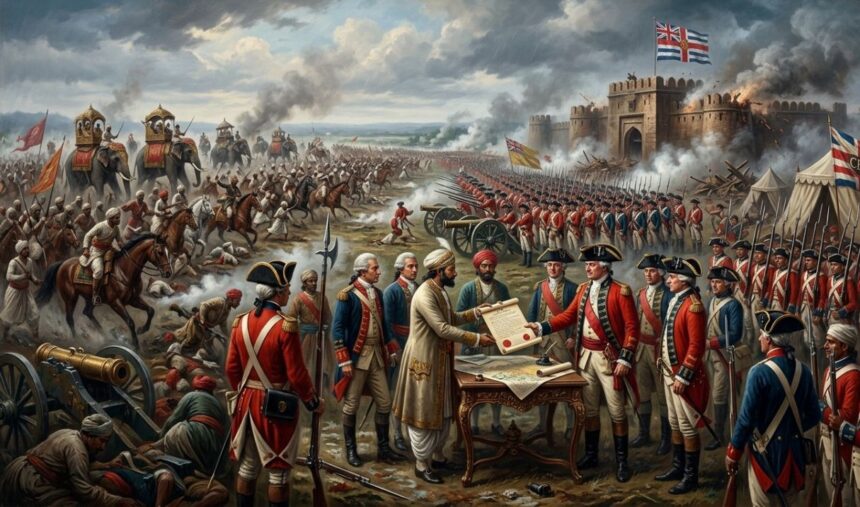
Following major military victories, particularly after the Battle of Plassey in 1757, the company gained control over significant parts of the Indian subcontinent.
In effect, a corporation began performing many of the functions normally associated with a sovereign state.
Few examples in business history illustrate the dangers of concentrated corporate power more clearly.
How Trade Turned Into Empire
The company’s growth was driven by commerce, but it did not stop there.
Control over trade routes created political influence.
Political influence enabled territorial expansion.
Territorial expansion generated greater economic control.
This cycle reinforced itself for decades, allowing the East India Company to dominate markets while reshaping local economies and governance structures.
Its rise demonstrates how commercial success can evolve into geopolitical influence when checks and balances are absent.
Innovation Was Only Part of the Story
The East India Company introduced sophisticated systems for logistics, finance, and international trade.
It coordinated shipments across continents, managed investor capital, and operated one of the earliest large-scale multinational business networks.
From an operational perspective, it was remarkably advanced for its time.
Yet innovation alone does not define a legacy.
The company’s pursuit of wealth often came at enormous human cost, contributing to exploitation, economic disruption, and policies that left lasting scars across regions under its control.
Its history reminds us that efficiency without ethics can become profoundly destructive.
The Biggest Startup Mistake: Growing Without Accountability
Modern founders often hear advice to “move fast” and “scale aggressively.”
The East India Company shows what can happen when growth outpaces responsibility.
As the organization accumulated more authority, meaningful oversight weakened.
Decisions that benefited shareholders frequently imposed severe consequences on local populations.
The absence of accountability created incentives that prioritized expansion over fairness and profit over public welfare.
For today’s entrepreneurs, this remains a critical lesson: sustainable success requires transparency, governance, and ethical leadership.
Founder Lessons Modern Entrepreneurs Should Remember
The East India Company’s story offers several lessons that remain relevant centuries later.
First, ambition should always be balanced by responsibility. Building a successful company is admirable, but growth should never come at the expense of ethics or human dignity.
Second, trust is more valuable than unchecked power. Businesses that earn public confidence through fairness and accountability tend to create more durable success than those relying solely on dominance.
Third, incentives matter. Leaders should design organizations where long-term value creation outweighs short-term gains.
Finally, every founder should remember that reputation becomes part of a company’s legacy. Financial success may create headlines, but ethical conduct determines how history remembers an organization.
Why the East India Company Still Matters Today
Although the East India Company ceased to exist long ago, its influence remains visible in discussions about globalization, regulation, multinational corporations, and corporate governance.
Its rise raises questions that are still relevant:
How much power should private companies hold?
Who should hold them accountable?
What responsibilities accompany extraordinary commercial success?
These questions are increasingly important in an era where technology companies influence economies, information, and public policy across the world.
More Than a History Lesson
The East India Company is often studied through the lens of colonial history or British rule, but it is equally a story about business.
It demonstrates the extraordinary potential of entrepreneurship to reshape societies and the equally extraordinary risks when power is exercised without ethical restraint.
For founders, investors, and business leaders, the takeaway is simple:
Building a successful company is only half the challenge.
Building one that creates lasting value without causing lasting harm is the true measure of success.