Why India’s Foreign Policy Matters Right Now
India’s foreign policy is no longer a quiet, background function of the state. It has become a central pillar of national strategy, shaping how the country engages with major powers, manages its neighborhood, and positions itself in a rapidly fragmenting global order. As geopolitical tensions rise, supply chains realign, and multilateral institutions struggle to keep pace, India’s diplomatic choices are being watched closely, by allies, competitors, and its own citizens.
Understanding India’s foreign policy principles is essential to understanding how the country thinks about power, autonomy, cooperation, and responsibility. These principles are not static doctrines written in stone. They have evolved with history, leadership, and global realities, yet they retain a distinct philosophical core rooted in India’s civilizational outlook and post-independence experience.
This article offers a deep-dive explainer into the guiding ideas of India’s foreign policy, tracing their origins, explaining how they operate today, and examining what they mean for the future. Rather than focusing on daily headlines, it explores the strategic logic beneath India’s external engagements and why that logic continues to adapt without abandoning its fundamentals.
The Conceptual Foundations of India’s Foreign Policy
India’s foreign policy did not emerge in a vacuum. It was shaped by colonial experience, the freedom struggle, and the early challenges of nation-building. From the outset, Indian policymakers sought a framework that balanced moral principles with hard realities.

At its core, India’s foreign policy rests on three broad foundations:
- Strategic autonomy, or the ability to make independent decisions
- Peaceful coexistence, rooted in diplomacy over coercion
- Pragmatic engagement, guided by national interest rather than ideology
These ideas have persisted across governments, even as their expression has changed with time.
Strategic Autonomy: The Cornerstone Principle
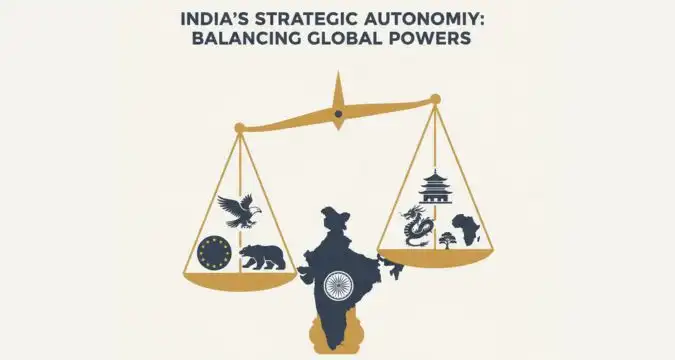
Strategic autonomy is the most enduring concept in India’s foreign policy thinking. It refers to India’s insistence on retaining freedom of choice in its external relations, avoiding binding alliances that limit independent decision-making.
Origins of Strategic Autonomy
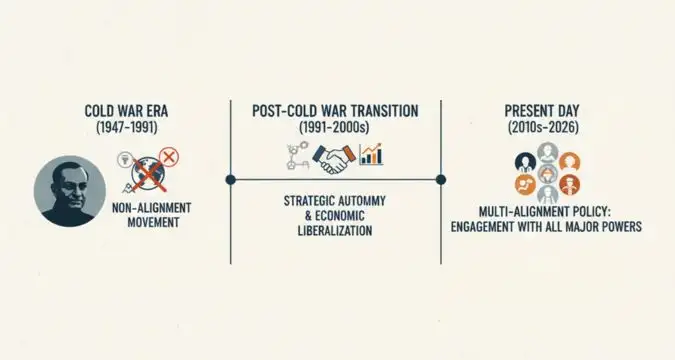
In the early years after independence, India faced a bipolar world dominated by the United States and the Soviet Union. Rather than aligning formally with either bloc, India pursued non-alignment, not as neutrality, but as independence of judgment. This approach allowed India to engage both sides while safeguarding its sovereignty.
Over time, non-alignment evolved, but the underlying impulse remained. Strategic autonomy today is less about distance from power blocs and more about flexibility within a multipolar system.

How Strategic Autonomy Works Today
Modern strategic autonomy looks different from Cold War-era non-alignment:
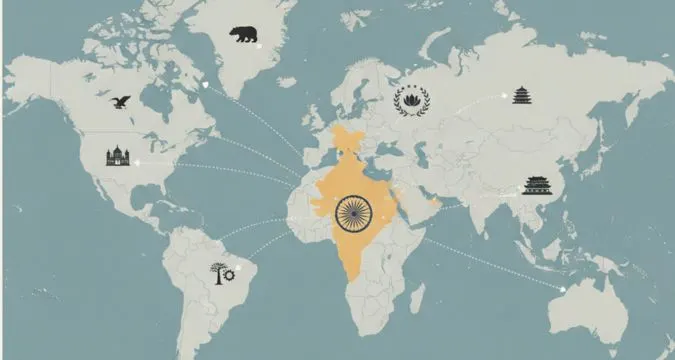
- India maintains strong partnerships with the United States, Russia, the European Union, and Japan simultaneously
- It participates in groupings like QUAD without entering military alliances
- It balances economic engagement with security caution, especially with neighboring powers
This approach allows India to cooperate where interests converge while preserving room to dissent when they diverge.
Panchsheel and Peaceful Coexistence
Another foundational element of India’s foreign policy is the principle of peaceful coexistence, famously articulated through the Panchsheel agreement in the 1950s.

The Five Principles of Panchsheel
Panchsheel outlines five norms for state-to-state relations:
- Mutual respect for sovereignty and territorial integrity
- Mutual non-aggression
- Mutual non-interference in internal affairs
- Equality and mutual benefit
- Peaceful coexistence
While originally framed in a specific historical context, these ideas continue to influence India’s diplomatic language and behavior, especially in multilateral forums.
Relevance in a Changing World
Peaceful coexistence does not imply passivity. India has consistently argued that stability is best achieved through dialogue, respect for international law, and restraint. Even when tensions rise, India tends to emphasize diplomatic channels before escalation.
This preference for diplomacy reflects both normative belief and practical calculation in a region where instability carries high costs.
Multilateralism as a Strategic Tool
India has long viewed multilateralism as a way to amplify its voice and shape global norms. Participation in international institutions allows India to engage beyond bilateral power asymmetries.
India’s Multilateral Engagement
India is active in a wide range of forums:
- United Nations and its specialized agencies
- G20, where India positions itself as a bridge between developed and developing economies
- Regional groupings such as ASEAN-led platforms
Through these platforms, India promotes reform of global governance structures, arguing that existing institutions no longer reflect contemporary power realities.
From Idealism to Interest-Based Multilateralism
Earlier phases of Indian diplomacy emphasized moral leadership and solidarity with the Global South. While those elements remain, today’s multilateral engagement is more interest-driven, focusing on:
- Climate finance and energy transitions
- Technology governance
- Supply chain resilience
This shift reflects a broader trend toward pragmatic multilateralism.
Neighborhood First: Regional Stability as Priority
India’s immediate neighborhood has always been central to its foreign policy calculations. Geography, shared history, and economic interdependence make regional stability a strategic necessity.
The Logic Behind Neighborhood First
India’s regional approach rests on several assumptions:
- Instability in neighboring countries directly affects India’s security
- Economic integration can reduce political friction
- Development cooperation builds long-term goodwill
Accordingly, India emphasizes connectivity, trade facilitation, and development assistance in South Asia.
Challenges in the Neighborhood
Despite intent, neighborhood diplomacy remains complex. Political instability, external influence, and unresolved disputes create friction. India’s approach increasingly combines outreach with realism, recognizing that goodwill alone is insufficient without strategic preparedness.
Global South Leadership and Development Diplomacy
India continues to position itself as a representative voice of the Global South, drawing on its own development experience.
South-South Cooperation
Rather than traditional aid, India emphasizes capacity-building:
- Technical training programs
- Digital public infrastructure sharing
- Affordable healthcare and pharmaceuticals
This model seeks partnership rather than dependency, reinforcing India’s image as a development collaborator.
Why This Matters Strategically
Leadership in the Global South enhances India’s diplomatic leverage in global forums. It also aligns with India’s aspiration to shape international norms on development, sustainability, and equity.
Economic Diplomacy and Trade Pragmatism
Foreign policy today is inseparable from economic strategy. India’s external engagements increasingly focus on securing markets, investments, and supply chains.
Shifts in Trade Thinking
India’s approach to trade has become more selective:
- Greater emphasis on bilateral and minilateral agreements
- Caution toward large multilateral trade pacts without safeguards
- Focus on resilience in critical sectors
This reflects lessons from past liberalization as well as current global disruptions.
Economic Security as Foreign Policy
Energy security, technology access, and critical minerals have become diplomatic priorities. India uses foreign policy tools to diversify dependencies and reduce vulnerability.
Common Misconceptions About India’s Foreign Policy
Despite its complexity, India’s foreign policy is often oversimplified. Several misconceptions persist.
“India Is Non-Committal”
India’s refusal to enter formal alliances is sometimes mistaken for indecision. In reality, it reflects a deliberate strategy to retain autonomy while engaging deeply across partnerships.
“India Has Abandoned Non-Alignment”
Non-alignment as a movement may have faded, but its core principle, independent judgment, remains intact, adapted to a multipolar world.
“India Avoids Taking Sides”
India does take positions, but it prefers issue-based alignment rather than bloc-based loyalty. This nuance is often lost in binary narratives.
Current Trends Shaping India’s Foreign Policy
Several forces are reshaping how India applies its long-standing principles.
Multipolar Competition
As power diffuses globally, India finds greater space to maneuver, but also faces pressure to navigate competing expectations.
Technology and Geopolitics
Digital infrastructure, data governance, and emerging technologies are now diplomatic issues, expanding the scope of foreign policy beyond traditional domains.
Diaspora Engagement
India increasingly views its global diaspora as a strategic asset, contributing to soft power, economic ties, and political influence abroad.
What to Watch Next: The Future Direction
India’s foreign policy principles are likely to remain stable, but their application will continue to evolve.
Key signals to monitor include:
- How India balances relations among major powers amid intensifying rivalry
- Its role in reforming global institutions
- The integration of climate and sustainability into strategic planning
The challenge will be to maintain consistency of purpose while adapting to rapid global change.
More Read

Key Takeaways
- India’s foreign policy is guided by strategic autonomy, peaceful coexistence, and pragmatic engagement
- These principles have evolved without losing their core logic
- India balances moral positioning with national interest
- Misconceptions often arise from viewing India through binary lenses
- The future will test India’s ability to adapt principles to complex global realities
Understanding these foundations offers insight into not just India’s diplomacy, but its broader worldview.
Frequently Asked Questions
Why is strategic autonomy so important to India’s foreign policy?
Strategic autonomy allows India to protect its decision-making freedom in a complex global environment. By avoiding rigid alliances, India can cooperate with different partners on specific issues while retaining the ability to act independently when interests diverge. This flexibility is especially valuable in a multipolar world marked by shifting power balances.
How is India’s current foreign policy different from the Cold War era?
While the Cold War emphasized non-alignment between two blocs, today’s approach focuses on multi-alignment within a multipolar system. India engages simultaneously with multiple major powers, prioritizing issue-based cooperation over ideological positioning, while maintaining continuity in its emphasis on independence and diplomacy.
Does India still follow the principles of Panchsheel?
The principles of Panchsheel continue to influence India’s diplomatic language and conduct, particularly regarding sovereignty and non-interference. Although the geopolitical context has changed, these ideas remain relevant as normative guidelines that support stability, dialogue, and peaceful engagement between states.
How does India balance moral values with national interest?
India’s foreign policy blends normative commitments with pragmatic considerations. While it advocates dialogue, international law, and development equity, it also makes decisions based on security, economic needs, and strategic realities. This balance allows India to pursue ideals without ignoring constraints.
What role will India play in global governance in the coming years?
India is likely to push more assertively for reform of global institutions to reflect contemporary realities. By leveraging its economic growth, demographic weight, and Global South partnerships, India aims to shape rules on development, technology, and sustainability while positioning itself as a constructive global actor.