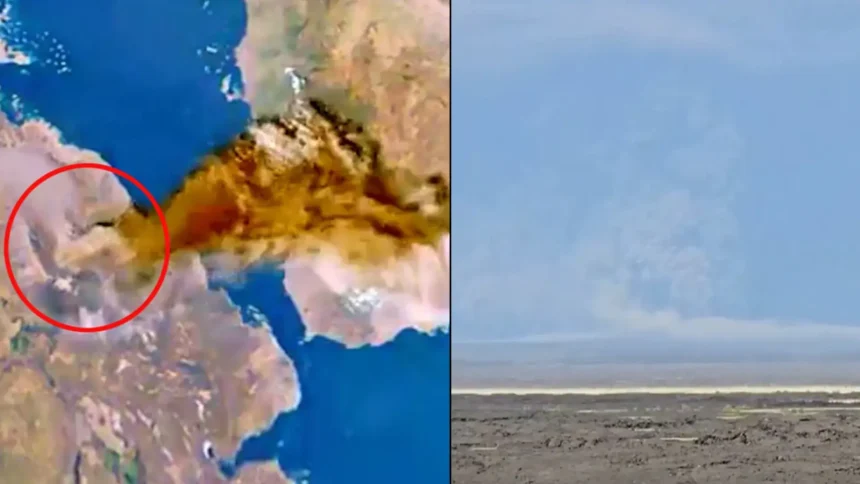
In November 2025, the Hayli Gubbi volcano in Ethiopia’s Afar region erupted for the first time in thousands of years. Long believed to be dormant for nearly 12,000 years, this eruption has sent shockwaves across the globe, not just for its geological importance, but for the way its ash plume has impacted airspace over India. As The Vue Times, it is crucial to examine what happened, how it matters, and what future implications this event holds.
The Geological Awakening of Hayli Gubbi
Hayli Gubbi is a shield volcano, situated in a remote and tectonically active region in Ethiopia. Shield volcanoes are typically broad and built by low-viscosity lava, but this particular volcano has no confirmed eruptions in the Holocene epoch, making this event especially significant.
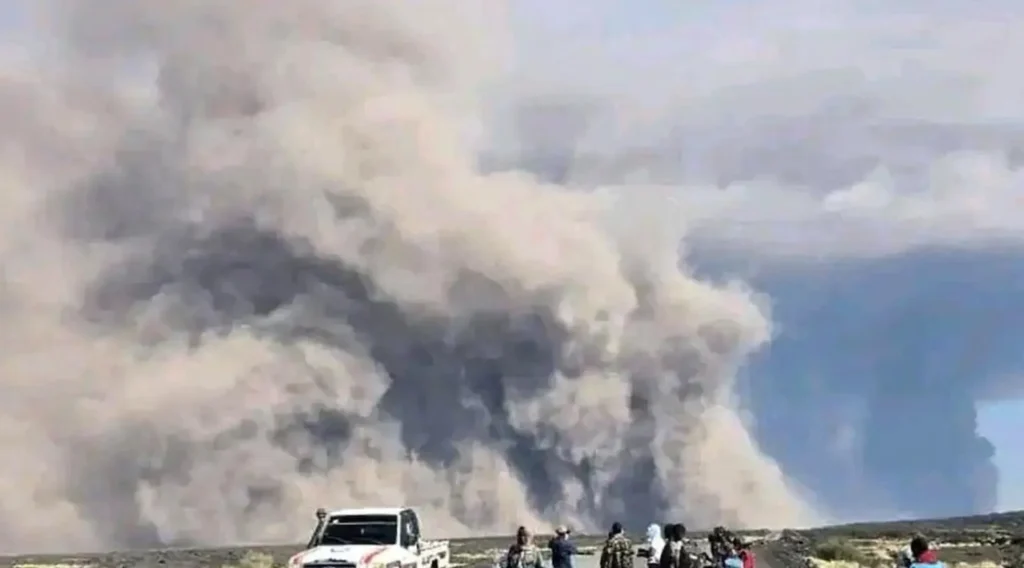
Its location in the East African Rift system makes it geologically important. The rift is a zone where tectonic plates are diverging, creating conditions that may foster magma buildup and eventual eruptions. Scientists have long monitored the Afar region for seismic and volcanic activity, but the sudden explosive eruption of this volcano underscores how even poorly documented volcanoes can surprise us.
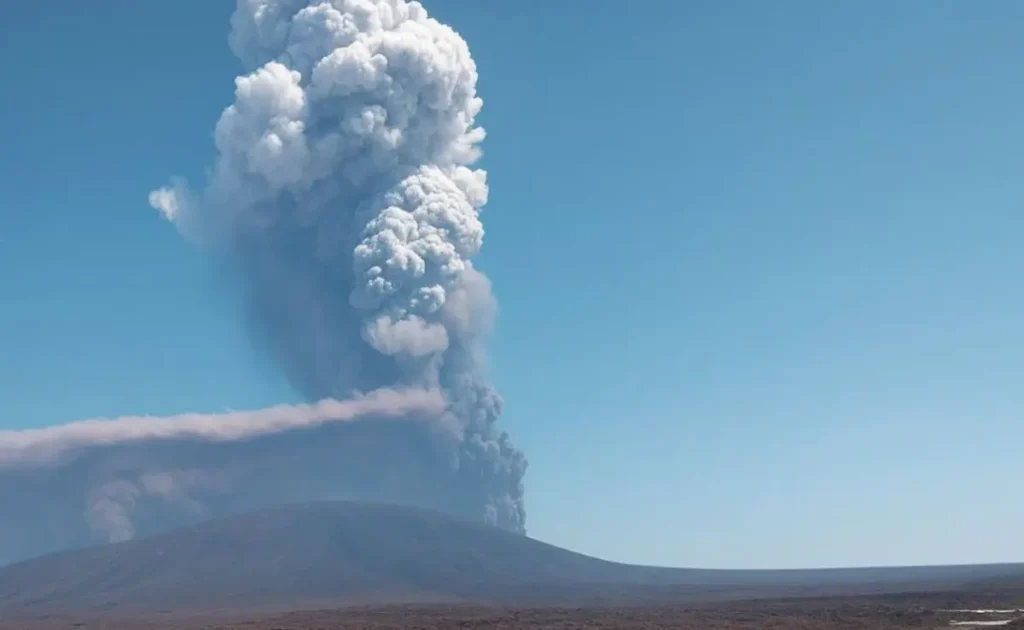
The 2025 eruption was detected via satellite imagery and advisory centers. The plume reportedly rose to heights of 14–15 kilometres, indicating a strong explosive phase rather than a gentle lava flow. This level of explosiveness, combined with the volcano’s dormancy, underscores its scientific importance.

How the Plume Journeyed Toward India
Once ejected into the upper atmosphere, the ash and gas plume of Hayli Gubbi began a long and far-reaching journey. High-altitude winds carried the cloud across the Red Sea, moved it over Yemen and Oman, and then eastward toward the Indian subcontinent.
Meteorological data show that the ash cloud’s forward motion was roughly 100–120 km per hour, and its vertical structure was complex. Some layers of the plume were estimated to lie between 15,000 and 45,000 feet, indicating a stratified cloud with different risk profiles.
In India, regions like Gujarat, Rajasthan, Delhi-NCR, Haryana, and Punjab came under potential influence of this plume. While the thickest parts of the cloud remained high in the sky, the drift was enough to trigger serious concern, especially for aviation.
Aviation Disruption and Safety Measures
The aviation sector responded swiftly. India’s aviation regulator issued urgent operational guidance, telling airlines to strictly avoid the ash-affected altitudes and regions. Aircraft operators were asked to adjust their routing and fuel planning in real time, based on the latest advisories and satellite data.
Airlines also faced immediate disruption. Several carriers cancelled or diverted flights, especially those operating through or near the affected airspace. Airlines were instructed to report any suspected ash encounters, including engine anomalies, cabin odour, or smoke, to ensure rapid response and maintenance.

Airports were not spared either. Station operators were advised to inspect runways, taxiways, and aprons for ash contamination. If ash was detected, operations were to be restricted or temporarily suspended, followed by cleaning protocols.
From a technical standpoint, volcanic ash is especially dangerous for aircraft. The microscopic, abrasive particles can damage engine components, clog sensors, and degrade performance. Given that parts of the plume reached very high cruising altitudes, aircraft flying through or near those layers risked serious mechanical risk.
Impact on Air Quality and Atmospheric Conditions
From a public health and environmental perspective, the plume’s effect on surface-level air quality in India appears limited but cannot be ignored.

Much of the ash remains high above the ground, reducing the risk of heavy deposition or dangerous levels of particulate matter at surface level. Experts note that because the cloud is largely in the upper troposphere, direct inhalation risk for people on the ground is lower than one might assume.
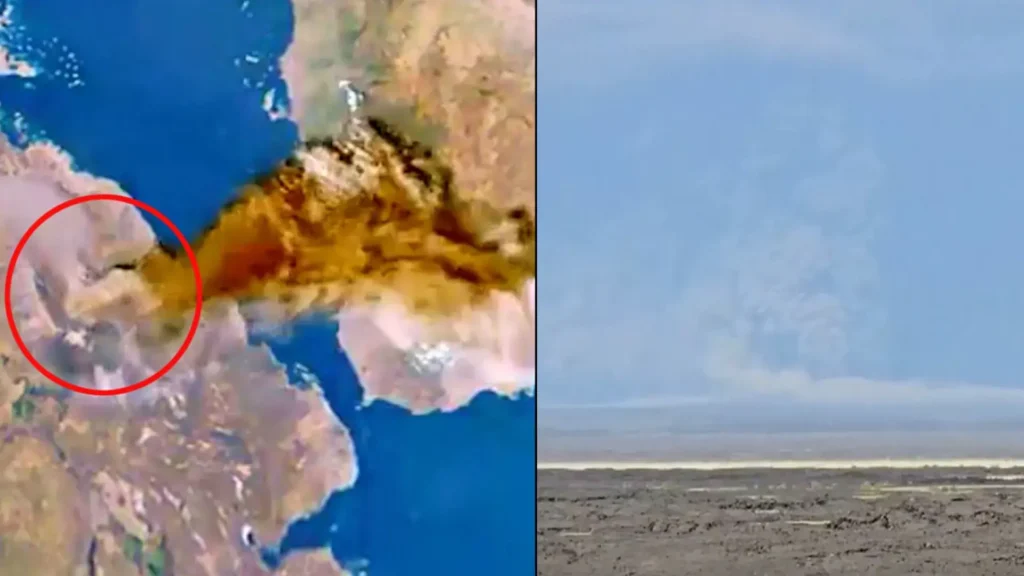
Still, the plume carries sulfur dioxide (SO₂), which could form acidic aerosols if it descends and mixes with moisture. While significant ground-level concentration increases are not expected, a marginal uptick in SO₂ may be possible, especially in hilly or elevated regions.
Additionally, observers anticipate visual atmospheric effects. The suspended fine particles may cause hazy or darker skies, particularly during sunrise or sunset, when light scattering is more pronounced. There is also a potential for a temporary rise in nighttime minimum temperatures, as the plume can act as a high-altitude “blanket,” reducing the radiation of heat away from Earth.
Broader Implications: Science, Policy, and Global Cooperation
Scientific Insights
This eruption is a goldmine for scientists. It challenges the understanding of “inactive” volcanoes, showing that even those with no known recent history can become active. It also provides critical data on magma dynamics in the East African Rift system. Remote sensing and satellite monitoring have once again proven their value, helping detect and track eruptions in regions where ground-based monitoring is difficult.
Policy and Regulatory Lessons
The cross-border nature of this event (from Ethiopia to India) underscores the need for international coordination. Volcanic ash does not respect national boundaries, and regulatory frameworks must reflect that reality. Real-time data sharing among nations, advisory centres, and aviation authorities is vital.
Air navigation agencies and airlines must integrate volcanic risk into their standard operating procedures. This includes contingency planning, fuel and route flexibility, and rigorous training for crew and ground staff on ash-related risks.
Airport operators should also build ash-inspection and cleaning protocols into their disaster preparedness plans. Investing in ground-level resilience will pay off during emergencies.
Environmental Resilience and Monitoring
Volcanic events like this one highlight the need for robust air-quality monitoring systems, especially for trace gases like SO₂ and fine particles that conventional networks may not regularly sample. Governments and research institutions should consider expanding their monitoring infrastructure, particularly in regions vulnerable to transported volcanic emissions.
Also Read: Why India Faces Coldest In Winter
There is also a case for strengthening early-warning systems. By investing in both remote sensing and ground-based geological monitoring, nations can better prepare for future volcanic activity, even from remote and historically quiet volcanoes.
What to Watch Going Forward
- Plume Monitoring
- Continue watching satellite updates and advisory centre bulletins to track the ash cloud’s density, altitude, and drift.
- Look for signs that parts of the plume may descend or disperse, which could change local impact.
- Aviation Advisories
- Regulators may issue follow-up guidance, route changes, or stricter safety checks depending on how the situation evolves.
- Airlines should maintain readiness for ongoing inspections and possible reroutes.
- Air Quality Changes
- Monitoring stations in affected areas should record SO₂, fine particulate counts, and visibility.
- Public-health agencies may track any unusual respiratory complaints or environmental anomalies.
- Scientific Research
- Geoscience teams will likely launch new studies on Hayli Gubbi’s magma composition, eruption dynamics, and historical activity.
- Findings could shape future volcanic hazard assessments for the East African Rift.
- Policy Developments
- Governments may reevaluate volcanic risk strategies, particularly for remote volcanoes.
- There may be renewed discussion on formal cross-border frameworks for atmospheric hazard sharing and aviation safety coordination.
More Read

Conclusion
The Hayli Gubbi eruption is a wake-up call, a reminder that Earth’s geological processes remain active, even in places long thought quiescent. For India, the event is not just a distant spectacle but a real-world challenge: high-altitude ash disrupting aviation, possible atmospheric effects, and a lesson in the power of international cooperation.
For The Vue Times, this is more than breaking news. It is a story about science, risk, preparedness, and global connectivity. It encourages reflection on how we monitor, regulate, and adapt to natural phenomena that transcend borders.
Sources
- Al Jazeera report on Hayli Gubbi’s eruption and historic dormancy Al Jazeera
- The Guardian coverage of the eruption’s scale and impact The Guardian
- Wikipedia entry on Hayli Gubbi volcano Wikipedia
- Times of India reporting on DGCA advisory to airlines The Times of India
- Economic Times article on flight cancellations and DGCA guidance The Economic Times
- NDTV coverage on airline monitoring and response www.ndtv.com
- Outlook India report on cancellations by Akasa, IndiGo, and others Outlook India
- Indian Express explainer on what airlines and regulators are doing The Indian Express
- Telegraph India account of monitoring, SIGMET advisories, and flight disruptions Telegraph India
- Indian Express report on DGCA safety instructions and engine-inspection protocols The Indian Express
- Gulf News coverage of international airline and country-level responses Gulf News
- India Today reporting on air-quality, ash height, and aviation warnings indiatoday.in