

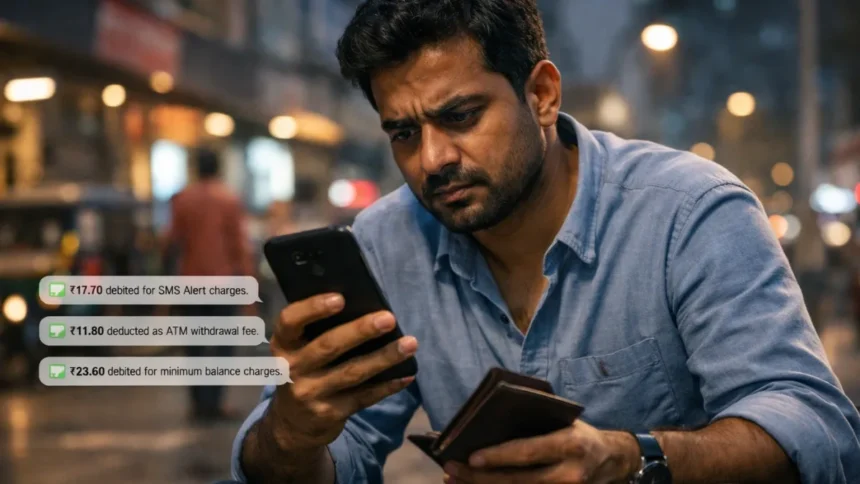
A Small SMS, A Big Realization
It usually begins with a message—short, transactional, easy to ignore.
“₹17.70 debited for SMS alert charges.”
“₹23.60 deducted for non-maintenance of minimum balance.”
Individually, these amounts don’t sting. But over months, and across millions of customers, they quietly accumulate into something much larger. For many Indians—especially those managing tight monthly budgets—these deductions aren’t just minor inconveniences. They are unexpected costs in a system that was supposed to be increasingly transparent.
Now, this quiet irritation has made its way into the louder corridors of Parliament. The issue of Hidden Bank Charges in India: Why This Issue Is Being Raised in Parliament is no longer just a consumer complaint—it has become a policy question.
What Are Hidden Bank Charges in India: Why This Issue Is Being Raised in Parliament?
The term “hidden charges” doesn’t necessarily mean illegal or undisclosed fees. In most cases, banks do mention them—somewhere in terms and conditions, often buried in fine print or lengthy documents.
These charges include:
- SMS alert fees
- ATM withdrawal limits beyond free transactions
- Penalties for low balance
- Charges for cheque book issuance
- Debit card annual fees
- IMPS/NEFT transaction fees in certain cases
What makes them “hidden” is not their existence—but their invisibility in everyday awareness. Customers often discover them only after deductions happen.
The parliamentary concern stems from a simple question:
If a charge is not clearly understood by the average customer, can it truly be called transparent?
Why Hidden Bank Charges in India: Why This Issue Is Being Raised in Parliament Matters Now
Timing is everything—and this issue has surfaced at a moment when India is rapidly transitioning into a digital-first economy.
Over the past decade:
- Banking has expanded massively through financial inclusion drives
- Digital payments have become routine
- Millions of first-time users have entered the formal banking system
With initiatives like Jan Dhan accounts and UPI adoption, banking is no longer limited to urban, financially literate populations. It now includes rural users, daily wage earners, and first-time account holders.
This is where the friction begins.
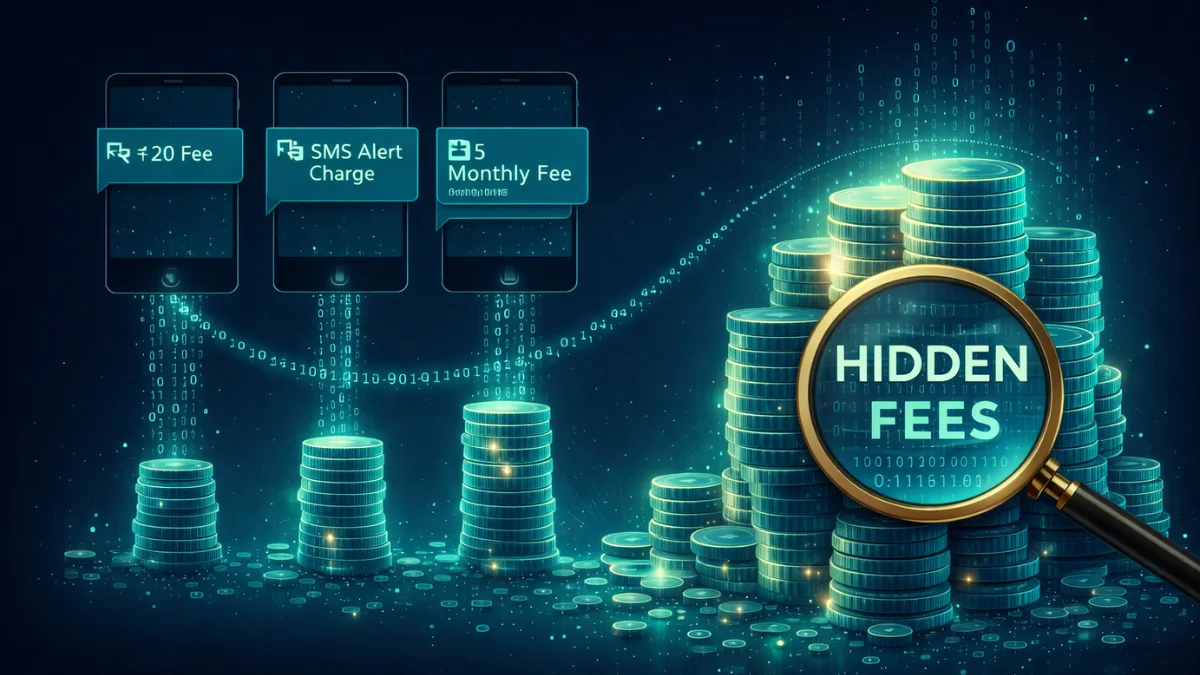
For a digitally aware user, a ₹20 charge may be predictable. For someone new to banking, it can feel arbitrary—even unfair. Members of Parliament have raised concerns that these charges disproportionately affect the financially vulnerable, contradicting the spirit of inclusion.
The Psychology Behind “Small Charges”
There’s a reason why these fees rarely trigger immediate outrage.
Behavioral economics calls it the “small loss effect.” People tend to ignore minor deductions, especially when:
- They are infrequent
- They are not immediately noticeable
- They don’t require active payment
Banks, intentionally or not, operate within this psychological comfort zone. A ₹15 charge doesn’t demand attention. But multiply that by:
- 10 charges per year
- 500 million account holders
The scale becomes enormous.
From a business perspective, these micro-fees create a steady revenue stream. From a customer perspective, they create a slow erosion of trust.
Banking Economics vs Consumer Expectations
Banks defend these charges with a familiar argument: operational costs.
Running a banking system isn’t free. Infrastructure, cybersecurity, ATM networks, customer service—all require continuous investment. Fees, therefore, are seen as a way to sustain services.
But here’s where expectations have shifted.
Customers today compare banking with digital platforms where:
- Transactions are instant
- Costs are often zero
- Interfaces are transparent
When a UPI transfer is free but an ATM withdrawal beyond limits costs money, it raises a fundamental question:
Are traditional banking charges aligned with the realities of modern finance?
This tension between legacy systems and digital expectations is now playing out at the policy level.
The Regulatory Angle: Where Does the RBI Stand?
The Reserve Bank of India (RBI) has not been silent on this issue. Over time, it has:
- Capped certain ATM charges
- Mandated free transactions within limits
- Issued guidelines on transparency
Yet, regulation has often been reactive rather than proactive.
Parliamentary discussions are pushing for:
- Standardized disclosure formats
- Real-time alerts before deductions
- Simplified fee structures
The idea is not to eliminate charges altogether—but to make them predictable, visible, and understandable.
Who Is Most Affected? The Unequal Impact
Not all customers experience these charges equally.
Urban vs Rural Divide
Urban users often have higher balances, avoiding penalties. Rural users, especially those with basic accounts, are more likely to face minimum balance charges.
Low-Income Households
For someone earning ₹10,000 a month, even ₹200 in annual bank charges is significant.
Elderly Customers
Less familiarity with digital banking means they rely more on physical transactions—often the ones that incur charges.
This unequal burden is a key reason why lawmakers are framing the issue as one of fairness, not just finance.
Why Parliament Is Paying Attention Now
Parliament rarely debates something unless it reflects widespread sentiment.
Several triggers have brought this issue forward:
- Rising complaints on banking ombudsman platforms
- Increased awareness through social media
- Questions about financial inclusion policies
- Pressure to align with global transparency standards
More importantly, this debate fits into a larger narrative:
How should public-facing financial systems behave in a digital democracy?
Banks are no longer just private institutions—they are critical infrastructure.
What Could Change Next?
The parliamentary debate could lead to several possible outcomes:
1. Clearer Fee Disclosure
Banks may be required to present charges in a simplified, one-page format.
2. Pre-Deduction Alerts
Customers could receive notifications before a charge is applied, not after.
3. Reduced Charges for Basic Accounts
Special protections for low-income or Jan Dhan account holders.
4. Greater Competition Pressure
Fintech companies offering zero-fee services may force traditional banks to rethink pricing.
5. Policy-Level Caps
Stricter limits on how much banks can charge for essential services.
None of these changes would eliminate fees entirely—but they would reshape how customers experience them.
The Trust Factor: What Banks Risk Losing
At its core, banking is built on trust.
Not just trust that money is safe—but trust that the system is fair.
Hidden or poorly understood charges chip away at that trust. Slowly, quietly—but consistently.
In an era where customers can switch banks with a few clicks, trust is no longer guaranteed. It must be earned—and maintained.
Conclusion: Transparency Is No Longer Optional
The debate around Hidden Bank Charges in India: Why This Issue Is Being Raised in Parliament is not really about ₹10 or ₹20 deductions.
It’s about clarity.
It’s about fairness.
It’s about whether financial systems evolve with the people they serve.
As India continues its digital transformation, the expectation is clear:
Banking should not just be accessible—it should be understandable.
Because in the end, it’s not the size of the charge that matters.
It’s whether the customer knew it was coming.
Final Insight
If banking is the backbone of a modern economy, transparency is its spine.
Without it, even the smallest imbalance can eventually bend the entire structure.
The question Parliament is asking today is simple—but powerful:
Should financial literacy be a prerequisite for fairness? Or should fairness be built into the system itself?-The VUE TIMES
Frequently Asked Questions
What are hidden bank charges in India?
Hidden bank charges are fees that customers are often unaware of, such as SMS alerts, ATM usage beyond limits, or minimum balance penalties, usually disclosed in fine print.
Why are hidden bank charges being discussed in Parliament?
Lawmakers are concerned that these charges lack transparency and disproportionately affect low-income and first-time banking users.
Are these bank charges legal in India?
Yes, most charges are legal and regulated by RBI, but the issue lies in how clearly they are communicated to customers.
How can customers avoid hidden bank charges?
Customers should review bank terms, maintain minimum balance, track transactions regularly, and opt for zero-balance or digital-first accounts where possible.
Will bank charges be removed in the future?
Complete removal is unlikely, but stricter regulations and better transparency measures may reduce their impact.