
Government Schemes Supporting Indian Startups
The entrepreneurship ecosystem of India has grown in the last ten years tremendously. However, behind the measures of growth there is a structural question: how well Government Schemes of Startups…



Prelims vs Mains Strategy for Government Exams
Prelims vs Mains Strategy for Government Exams Government exam aspirants in India repeatedly struggle not because of lack of effort, but because they fail to separate their Prelims vs Mains…
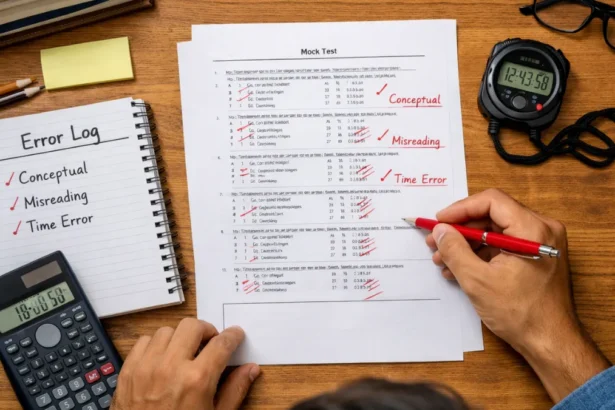
Self-Evaluation Method for Government Exams Preparation
Problem Statement One of the biggest reasons serious aspirants fail to improve despite months of preparation is the absence of a structured Self Evaluation Government Exams system. Students attempt mocks,…

Using Current Affairs in Government Exam Answers
Problem Statement One of the most common scoring gaps in descriptive government exams is the inability to properly use Current Affairs in Government Exams answers. Aspirants either: Write static, textbook-only…
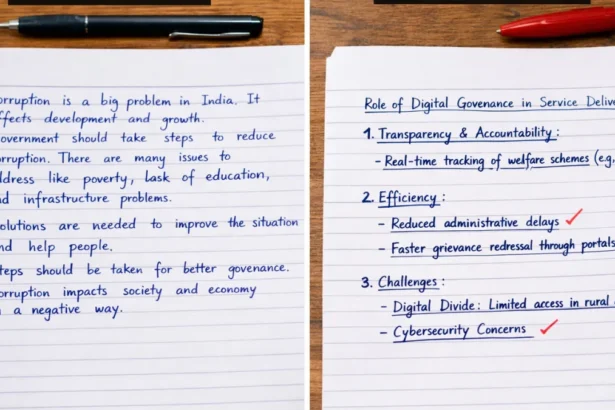
Avoiding Generic Answers in Government Exams
One of the most consistent reasons aspirants lose marks in descriptive papers is writing Generic Answers in Government Exams. These answers appear relevant but lack depth, specificity, and structured enrichment.…
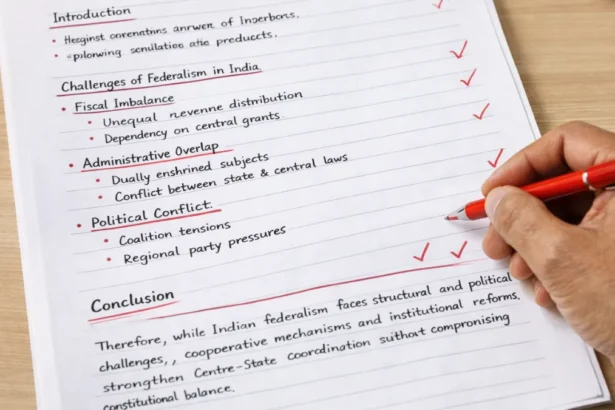
Writing Effective Conclusions in Government Exams (Conclusion Writing Government Exams)
In descriptive government examinations, students often focus heavily on introductions and body content while neglecting the final 3–5 lines of their answer. However, Conclusion writing in government exams plays a…
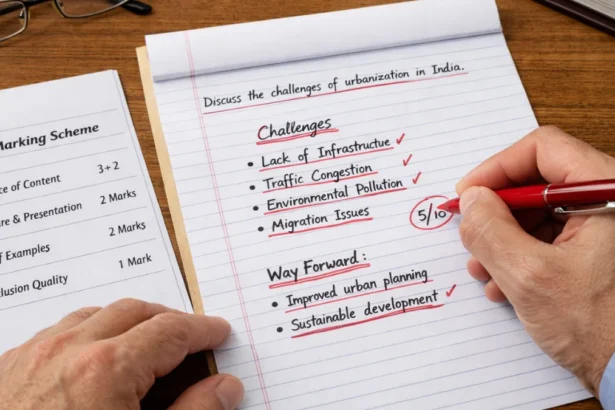
How Examiners Evaluate Government Exam Answer Sheets
Most aspirants prepare content. Very few prepare for the Government Exam Evaluation. This gap creates avoidable mark loss. Students assume that knowledge alone determines scores. In reality, marks depend on…

Understanding Directive Words in Government Exams
Understanding Directive Words in Government Exams A large percentage of marks lost in descriptive papers is not due to lack of knowledge but due to misinterpretation of directive words in…
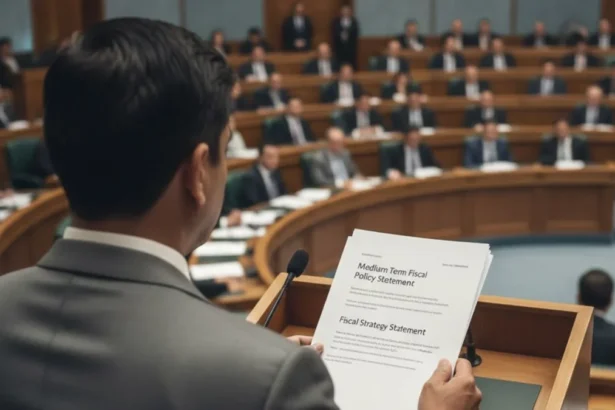
Fiscal Deficit India Responsibility and Budget Management Act Simplified
The pillar of India fiscal discipline architecture is the FRBM Act. The Act aims to institutionalize macroeconomic stability and contain fiscal deficit India experiences on recurrent basis, as well as…

Time Management Strategy for Government Exams
Time Management Government Exams is not about studying for longer hours. It is about allocating cognitive energy, structuring answer time, and distributing effort according to scoring patterns. Many aspirants prepare…
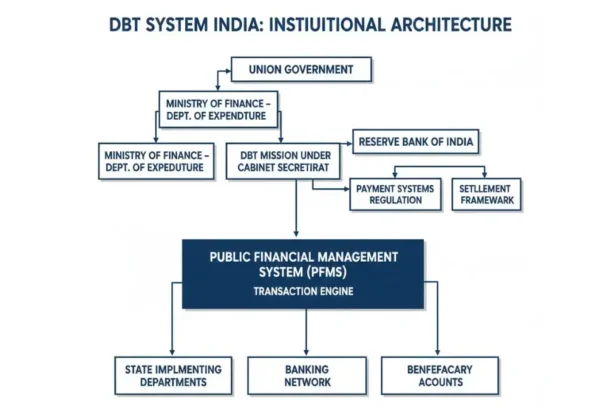
Direct Benefit Transfer System: Efficiency or Centralization?
India's welfare state has had a history of layers of administrative chains, subsidized mediation, and departmentally fragmented channels of delivery. The Direct Benefit Transfer System represents a structural departure from…
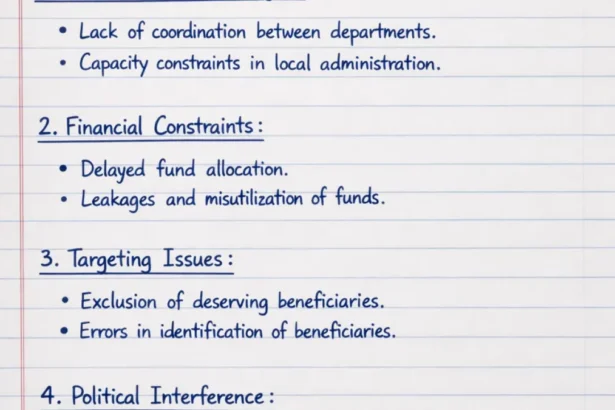
Structuring 10 and 20 Mark Answers in Government Exams (20 Mark Answer Structure)
In descriptive government examinations, marks are rarely lost because students lack information. They are struggling because the answers aren't structured according to the evaluation expectations. The difference between an average…

Why Most Indian Startups Fail Within Five Years
Indian Startup Failure is not a one-off event but an institutional consequence of convergence of capital, regulation, market demand and operating realities in the changing economy of India. The survival…

PM Gati Shakti Master Plan: Infrastructure Reform Blueprint
The story of India's infrastructure development strategy over the years is marked by a history of fragmented planning, siloed implementation and lack of inter-ministerial coordination. The PM Gati Shakti initiative…

Bootstrapped vs Funded Startups: Structural Differences
Bootstrapped vs Funded Startups This argument is usually described as a cultural or aspirational decision. As a matter of fact, it is a structural choice based on capital structure, business…
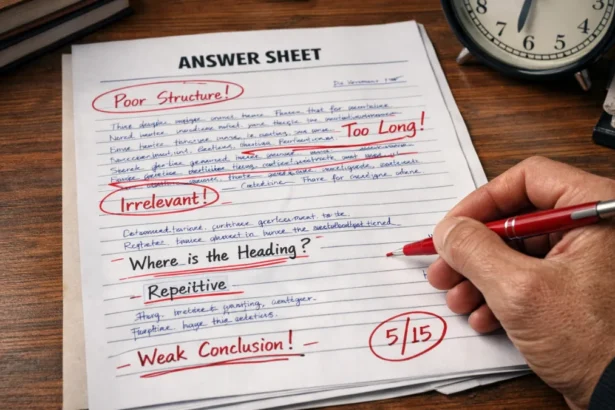
Why Students Lose Marks in Government Exams: A Deep Analysis of Government Exam Mistakes
Problem Statement: Why Students Lose Marks In Government Exams One of the most misunderstood realities of competitive preparation is this: students do not primarily lose marks due to lack of…