Artificial Intelligence is no longer a future concept. It already influences how governments deliver services, how businesses operate, how courts analyze data, and how citizens interact online. As AI systems grow in power and scale, governments across the world are trying to regulate them without slowing innovation. Two major approaches stand out globally: AI regulation in India and the European Union’s AI Act.
This article explains how AI regulation in India compares with the EU in a clear, student-friendly and citizen-focused manner. It answers common questions, removes confusion around legal terms, and explains what these regulations mean in real life for startups, students, developers, businesses, and everyday users.
The goal is simple: help readers understand where India stands today, how the EU approach works, and what the future may look like.

Why AI Regulation Matters Today
AI systems now influence:

- Loan approvals and credit scores
- Hiring and workplace monitoring
- Facial recognition and surveillance
- Healthcare diagnosis and insurance
- Content moderation and news visibility
- Government welfare delivery
Without rules, AI can reinforce bias, invade privacy, spread misinformation, or make unaccountable decisions that affect millions of lives. Regulation does not mean banning AI. It means setting boundaries so innovation benefits society rather than harming it.
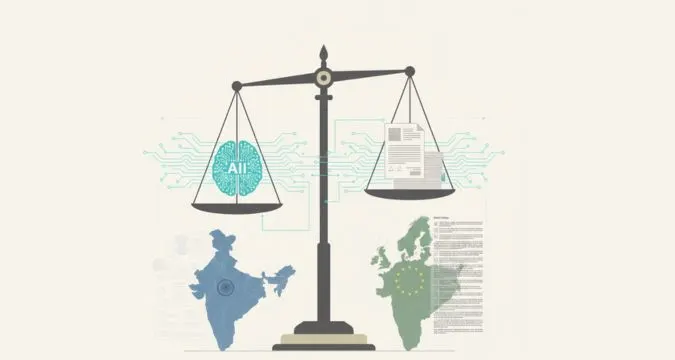
This is where AI regulation in India and the EU’s regulatory framework begin to diverge in philosophy and execution.
Understanding the EU’s AI Regulation Framework
What Is the EU AI Act?
The European Union introduced the EU Artificial Intelligence Act, the world’s first comprehensive and legally binding AI law. Its core idea is simple: not all AI systems carry the same risk, so regulation should be proportionate.
The EU AI Act follows a risk-based classification model.
Risk Categories Under the EU AI Act
- Unacceptable Risk AI
- Social scoring by governments
- Manipulative AI affecting free will
- Certain real-time biometric surveillance
- These systems are largely banned.
- High-Risk AI Systems
- AI used in recruitment
- Creditworthiness assessments
- Medical devices
- Law enforcement tools
- Education and exams
- These systems are allowed but strictly regulated.
- Limited Risk AI
- Chatbots
- Emotion recognition systems
- Transparency obligations apply.
- Minimal Risk AI
- AI in games
- Photo filters
- Recommendation systems
- Largely unregulated.
Key Obligations Under EU AI Regulation
- Mandatory risk assessments
- Human oversight requirements
- High-quality training data
- Record-keeping and audit trails
- Transparency to users
- Heavy penalties for non-compliance
The EU model prioritizes fundamental rights, consumer protection, and legal accountability.

AI Regulation in India: The Current Approach
Does India Have a Dedicated AI Law?
As of now, AI regulation in India does not exist as a single, consolidated law. Instead, India follows a sector-based and principle-driven approach.

Rather than regulating AI upfront with strict legal controls, India emphasizes:
- Innovation first
- Soft governance
- Ethical guidelines
- Sector-specific regulation
This reflects India’s broader economic and developmental priorities.

Key Government Initiatives Shaping AI Regulation in India
1. NITI Aayog’s AI Strategy
NITI Aayog released the National Strategy for Artificial Intelligence, focusing on “AI for All.” The goal is to use AI for:
- Healthcare
- Agriculture
- Education
- Smart cities
- Governance
The emphasis is on responsible AI, not restrictive regulation.
2. IndiaAI Mission
The IndiaAI Mission aims to:
- Build domestic AI capacity
- Encourage startups
- Promote research and skill development
- Create public digital infrastructure
This mission signals that AI regulation in India is currently aligned with growth and self-reliance.
3. Digital Personal Data Protection Act (DPDP Act)
Although not an AI-specific law, the DPDP Act indirectly regulates AI by controlling:
- Data collection
- Consent requirements
- Data processing obligations
Since AI systems rely heavily on data, this law acts as a partial regulatory check.
Fundamental Difference: India vs EU on AI Regulation
| Aspect | AI Regulation in India | EU AI Regulation |
| Legal framework | Fragmented | Comprehensive AI Act |
| Approach | Innovation-first | Risk-first |
| Enforcement | Soft governance | Strict penalties |
| Flexibility | High | Limited |
| Focus | Growth and inclusion | Rights and safety |
This contrast explains why India has not rushed into heavy AI regulation.
Why India Has Chosen a Softer AI Regulation Model
1. Economic Development Priorities
India is still building its digital economy. Over-regulation could:
- Discourage startups
- Increase compliance costs
- Slow adoption in public services
Hence, AI regulation in India prioritizes economic inclusion.
2. Innovation Ecosystem
Indian AI startups often operate with limited funding. EU-style compliance frameworks may be manageable for global tech giants but not early-stage Indian firms.
3. Institutional Capacity
Effective enforcement requires technical expertise, regulators, and audit mechanisms. India is still building this ecosystem.
Risks of India’s Light-Touch AI Regulation
While flexibility has benefits, it also creates challenges:
- Lack of accountability in AI decisions
- Potential misuse of surveillance tools
- Algorithmic bias in welfare delivery
- Limited legal remedies for citizens
These gaps have led to growing calls for structured AI regulation in India.
Will India Copy the EU AI Act?
India is unlikely to copy the EU model word-for-word. However, convergence is expected in certain areas:
- High-risk AI classification
- Transparency standards
- Human oversight
- Sector-specific compliance
India may adopt a hybrid model, blending flexibility with enforceable safeguards.
What This Means for Students and Researchers
Understanding AI regulation in India is essential for:
- Law students studying technology law
- Engineering students building AI tools
- Policy students analyzing governance models
India’s evolving framework offers opportunities for research, policy innovation, and legal reform.
Impact on Businesses and Startups
For Indian Startups
- Fewer compliance barriers
- Faster experimentation
- Easier market entry
For Global Companies
- Different compliance standards across regions
- Need for dual regulatory strategies
Businesses operating in both India and the EU must align with the stricter EU AI Act, even if Indian rules are relaxed.
Citizen Rights Under AI Regulation: India vs EU
EU Citizens
- Right to explanation
- Right to human oversight
- Legal remedies against AI harm
Indian Citizens
- Limited AI-specific rights
- Data protection rights under DPDP Act
- Judicial remedies through constitutional law
This highlights a critical gap in AI regulation in India when it comes to individual rights
The Future of AI Regulation in India
India is gradually moving toward:
- Risk-based frameworks
- Ethical AI standards
- Sectoral AI laws
Instead of a single AI Act, India may regulate AI through:
- Telecom law
- Healthcare regulations
- Financial sector guidelines
This decentralized model reflects India’s governance style.
FAQs: AI Regulation in India vs EU
1. Does India have an AI law like the EU AI Act?
No. AI regulation in India is currently governed through policies, guidelines, and sector-specific laws rather than a single AI statute.
2. Is AI banned in India?
No. India actively promotes AI development, especially in public services and startups.
3. Why is the EU stricter than India?
The EU prioritizes data protection and fundamental rights, while India focuses on economic growth and digital inclusion.
4. Can EU AI rules affect Indian companies?
Yes. Indian companies offering AI services in Europe must comply with the EU AI Act.
5. Will India introduce stricter AI regulation in the future?
Yes, but gradually. India is expected to adopt targeted and sector-based AI regulation rather than a blanket law.
6. Is AI regulation in India bad for innovation?
No. The current approach supports innovation, but safeguards will become necessary as AI adoption increases.
7. What should students learn about AI regulation?
Students should understand risk-based models, ethical AI principles, and comparative regulatory approaches like India and the EU.
More Read

Conclusion: Two Paths, One Goal
Both AI regulation in India and the EU AI framework aim to shape a future where technology serves society. The difference lies in timing and method.
The EU regulates first and innovates within strict boundaries. India innovates first and regulates gradually. Neither approach is inherently right or wrong. Each reflects economic priorities, institutional capacity, and social context.
As AI becomes deeply embedded in daily life, India will inevitably strengthen its regulatory framework. The challenge will be doing so without losing the innovation momentum that defines its digital growth story.
Understanding these differences is essential not only for policymakers and businesses, but for every citizen navigating an AI-driven world.